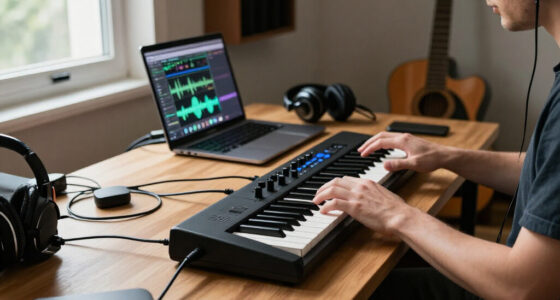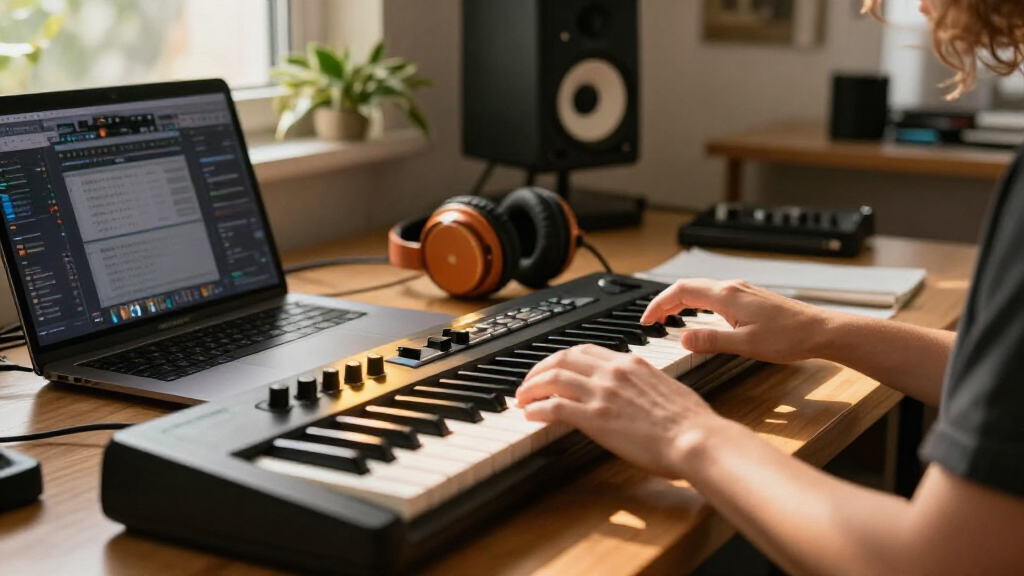

Choosing the right MIDI keyboard controllers depends entirely on your workflow, whether you prioritize portability, tactile feedback, or deep DAW integration. The M-Audio Keystation 88 MK3 stands out as the best overall choice for producers who need full-size, weighted action keys for realistic piano performance. For those tight on desk space or traveling frequently, the Akai Professional MPK Mini MK3 remains the gold standard for compact production with its responsive pads and knobs. The main tradeoff in this category is between key count and portability; larger controllers offer better playability but demand significant real estate. Continue reading to see which model fits your specific production needs and budget.

Get audio and creator gear delivered free with Prime
- Fast, free delivery on millions of items
- Prime Video, Amazon Music and more included
- Member-only deals all year
Complete the kit


Key Takeaways
- Full-size weighted keys significantly improve piano realism but drastically reduce portability compared to mini-key alternatives.
- DAW-specific integration, such as that found in Novation Launchkey models, saves more time in the long run than generic mapping.
- Mini-key controllers are viable for chord progressions and drum pads but become frustrating for complex melodic lines.
- USB-C connectivity is becoming standard on newer models like the MPK Mini IV, offering cleaner power delivery than older USB-A units.
- Build quality varies widely in the budget segment, with plastic chassis on entry-level units often feeling unstable during aggressive playing.
| M-Audio Keystation 88 MK3 USB MIDI Controller |  | Best for Full-Range Piano Playing | Keys: 88 | Key type: Full-size, velocity-sensitive, semi-weighted | Connectivity: USB | VIEW LATEST PRICE | See Our Full Breakdown |
| Donner N-25 25-Key Mini MIDI Keyboard Controller |  | Best for Portable Practice | Keys: 25 | Key type: Velocity-sensitive mini keys | Connectivity: USB-MIDI | VIEW LATEST PRICE | See Our Full Breakdown |
| M-Audio Keystation 49 MK3 USB MIDI Controller |  | Best for Full-Size Keys in a Desk-Friendly Layout | Keys: 49 | Key type: Full-size, velocity-sensitive | Connectivity: USB-MIDI | VIEW LATEST PRICE | See Our Full Breakdown |
| midiplus AKM320 32-Key MIDI Keyboard Controller |  | Best Simple Compact Controller | Keys: 32 velocity-sensitive keys | Connectivity: USB Type B | Power: USB | VIEW LATEST PRICE | See Our Full Breakdown |
| Akai Professional MPK Mini MK3 25-Key USB MIDI Keyboard Controller |  | Best for Beat Making | Keys: 25 velocity-sensitive mini keys | Drum pads: 8 backlit velocity-sensitive MPC-style pads with Note Repeat and Full Level | Knobs: 8 assignable 360-degree knobs | VIEW LATEST PRICE | See Our Full Breakdown |
| Novation Launchkey 49 MK4 USB MIDI Keyboard Controller |  | Best Overall | Key Count: 49 | Key Type: Semi-weighted | Pads: 16 with polyphonic aftertouch | VIEW LATEST PRICE | See Our Full Breakdown |
| Akai Professional MPK Mini IV 25-Key USB-C MIDI Keyboard Controller, White |  | Best for Portability | Key Count: 25 | Key Type: Velocity-sensitive mini keys | Pads: 8 velocity- and pressure-sensitive RGB MPC pads | VIEW LATEST PRICE | See Our Full Breakdown |
| Arturia MiniLab 37 MIDI Keyboard Controller |  | Best Compact Full-Size Feel | Key Count: 37 | Key Type: Slim velocity-sensitive keys | Pads: 8 DAW-integrated pads (2×4 stack) | VIEW LATEST PRICE | See Our Full Breakdown |
| M-AUDIO Keystation Mini 32 MK3 USB MIDI Controller |  | Best for Beginners | Key Count: 32 | Key Type: Mini velocity-sensitive keys | Controls: Pitch bend and modulation buttons, Volume knob | VIEW LATEST PRICE | See Our Full Breakdown |
| Akai Professional MPK Mini IV 25-Key USB-C MIDI Keyboard Controller, Black |  | Best Value Performance | Key Count: 25 | Key Type: Velocity-sensitive mini keys | Pads: 8 velocity- and pressure-sensitive RGB MPC pads | VIEW LATEST PRICE | See Our Full Breakdown |
| Akai Professional MPK Mini Play MK3 25-Key USB MIDI Keyboard Controller |  | Best for Standalone Practice | Key Count: 25 | Onboard Sounds: 128+ instruments and drum kits | Power Source: Batteries or USB | VIEW LATEST PRICE | See Our Full Breakdown |
| Akai Professional MPK Mini Plus 37-Key USB MIDI Keyboard Controller |  | Best Hybrid Controller for Hardware | Key Count: 37 | Connectivity: USB, MIDI I/O, CV/Gate | Sequencer: 64-step with two tracks | VIEW LATEST PRICE | See Our Full Breakdown |
| Novation Launchkey 61 MK4 USB MIDI Keyboard Controller |  | Best for DAW Integration | Key Count: 61 | Keybed Type: Semi-weighted | Pads: 16 with polyphonic aftertouch | VIEW LATEST PRICE | See Our Full Breakdown |
| Akai Professional LPK25 25-Key USB MIDI Keyboard Controller |  | Best Ultra-Portable Entry Level | Key Count: 25 | Weight: 0.48 kg | Connectivity: USB | VIEW LATEST PRICE | See Our Full Breakdown |
| M-Audio Keystation 61 MK3 USB MIDI Controller |  | Best for Pianists | Key Count: 61 | Key Type: Full-size semi-weighted | Controls: Pitch/Mod wheels, Fader, Transport | VIEW LATEST PRICE | See Our Full Breakdown |
| MIDI keyboard controller | Connectivity | Key type | Key Count |
|---|---|---|---|
| M-Audio Keystation 88 MK3 USB | USB | Full-size, velocity-sensitive, semi-weighted | — |
| Donner N-25 25-Key Mini MIDI K | USB-MIDI | Velocity-sensitive mini keys | — |
| M-Audio Keystation 49 MK3 USB | USB-MIDI | Full-size, velocity-sensitive | — |
| midiplus AKM320 32-Key MIDI Ke | USB Type B | — | — |
| Akai Professional MPK Mini MK3 | USB 2.0 Type B | — | — |
| Novation Launchkey 49 MK4 USB | USB-C, MIDI | Semi-weighted | 49 |
| Akai Professional MPK Mini IV | USB-C, Full-size MIDI Out | Velocity-sensitive mini keys | 25 |
| Arturia MiniLab 37 MIDI Keyboa | USB-C | Slim velocity-sensitive keys | 37 |
| M-AUDIO Keystation Mini 32 MK3 | USB | Mini velocity-sensitive keys | 32 |
| Akai Professional MPK Mini IV | USB-C, Full-size MIDI Out | Velocity-sensitive mini keys | 25 |
| Akai Professional MPK Mini Pla | USB | — | 25 |
| Akai Professional MPK Mini Plu | USB, MIDI I/O, CV/Gate | — | 37 |
| Novation Launchkey 61 MK4 USB | USB-C, MIDI | — | 61 |
| Akai Professional LPK25 25-Key | USB | Velocity-sensitive mini keys | 25 |
| M-Audio Keystation 61 MK3 USB | USB-MIDI | Full-size semi-weighted | 61 |
More Details on Our Top Picks
M-Audio Keystation 88 MK3 USB MIDI Controller
For players who want to perform broad piano parts at a desk, the Keystation 88 MK3 offers the widest key range in this group. Its 88 full-size, semi-weighted keys make two-handed arrangements and wide-spanning parts easier than on the Keystation 49 MK3 or the compact Donner N-25. Pitch and modulation wheels, a volume fader, and transport controls add practical software control without crowding the playing surface.
The tradeoff is its large footprint: it is less suited to travel or a small workstation than the 49-key model. It also makes no sound on its own, and iOS use requires a separately sold Apple to USB Camera Adapter. I’d choose it for range and familiar key size, not portability or standalone play.
Pros:- 88 full-size keys provide a broad range for two-handed playing.
- Semi-weighted, velocity-sensitive keys support expressive dynamics.
- Pitch and modulation wheels, a volume fader, and transport controls support software performance.
- USB-powered operation and included music software provide a straightforward computer-based setup.
Cons:- The 88-key body takes up considerably more space than the 49- and 25-key options.
- It is a controller only, so sound requires compatible software or instruments.
- Connecting to iOS requires an Apple to USB Camera Adapter sold separately.
Best for: Piano players and composers who need full-size keys and room for two-handed parts while controlling software instruments.
Not ideal for: Traveling musicians or people with limited desk space; its 88-key layout is substantially less compact than the Donner N-25 or Keystation 49 MK3.
- Keys:88
- Key type:Full-size, velocity-sensitive, semi-weighted
- Connectivity:USB
- Power:USB-powered
- Controls:Volume fader, transport and directional buttons, pitch and modulation wheels, octave buttons
- Pedal input:Sustain pedal input
- Compatible platforms:Mac, Windows, iOS
- Included software:Ableton Live Lite, MPC Beats, Mini Grand, Xpand!2, TouchLoops, Velvet
Our verdict“Choose the Keystation 88 MK3 if full-size, wide-range playing matters more than a compact setup.”
Donner N-25 25-Key Mini MIDI Keyboard Controller
The Donner N-25 is a compact choice for learning or sketching parts away from a full studio setup. Its 25 velocity-sensitive mini keys, four programmable banks, and controls for arpeggiation, pitch bend, octave, and tempo give it more playing functions than a bare travel keyboard. The included teaching courses also make it a more practice-oriented pick than the Akai Professional MPK Mini MK3, which puts greater emphasis on beat pads and assignable knobs.
That compactness comes with a real compromise: mini keys limit playing comfort, especially for anyone accustomed to a full-size keyboard like the M-Audio Keystation 49 MK3. It can connect to compatible mobile devices, but an OTG adapter is needed. I’d pick it for portability and guided practice rather than as a main keyboard for intricate parts.
Pros:- Compact 25-key design is easy to fit into a portable setup.
- Velocity-sensitive keys respond to differences in playing force.
- Four programmable banks and performance controls offer useful flexibility.
- Includes music production software and 40 keyboard teaching courses.
Cons:- Mini keys can feel cramped for players used to full-size keyboards.
- Mobile-device connections require a separately obtained OTG adapter.
- The two-octave range limits parts that need more notes at once.
Best for: Beginners who want a small controller for basic practice, music sketches, and compatible mobile-device setups.
Not ideal for: Players who need full-size keys or a wider playing range; its 25 mini keys are less suitable for extended piano parts than the Keystation 49 MK3.
- Keys:25
- Key type:Velocity-sensitive mini keys
- Connectivity:USB-MIDI
- Programmable banks:4
- Controls:Arpeggiator, sustain, octave, tap tempo, pitch bend
- Compatibility:Mac, Windows, iOS, Android
- Included components:USB cable, music production software, 40 teaching courses
- Warranty:90 days
Our verdict“Pick the Donner N-25 for portable practice and learning, but choose a full-size controller for more demanding keyboard parts.”
M-Audio Keystation 49 MK3 USB MIDI Controller
The Keystation 49 MK3 is a sensible middle ground for players who want full-size keys without giving an 88-key controller an entire desk. Its 49 velocity-sensitive keys, pitch and modulation wheels, octave buttons, and sustain input cover core playing needs; USB power keeps setup simple with a Mac or PC. Compared with the Keystation 88 MK3, it gives up range but is easier to place in a smaller workstation. Against the mini-key Donner N-25, it offers a more familiar playing surface.
It is intentionally less feature-dense than the Akai Professional MPK Mini MK3: there are no drum pads or bank of assignable knobs listed. The sustain pedal is sold separately, and iOS connection needs a separate adapter. I’d choose this for straightforward software-instrument playing, not pad-based beat production.
Pros:- 49 full-size, velocity-sensitive keys balance familiar playing feel with a manageable footprint.
- Pitch and modulation wheels and octave controls support expressive performance.
- USB-powered operation works with Mac and PC without a separate power supply.
- Includes music software and access to online lessons.
Cons:- The sustain pedal is sold separately.
- iOS connectivity requires an Apple to USB Camera Adapter sold separately.
- It has fewer beat-production controls than the Akai Professional MPK Mini MK3.
Best for: Home-studio players who want full-size keys for software instruments but have limited room for an 88-key controller.
Not ideal for: Beat makers who want built-in pads and assignable knobs, or mobile users who need a direct iOS connection without a separate adapter.
- Keys:49
- Key type:Full-size, velocity-sensitive
- Connectivity:USB-MIDI
- Power:USB-powered
- Controls:Volume fader, transport and directional buttons, pitch and modulation wheels, octave buttons
- Pedal input:1/4 in (6.3 mm) sustain pedal input
- Compatibility:Mac and PC; iOS with separately sold Apple to USB Camera Adapter
- Included software and lessons:MPC Beats, Ableton Live Lite, Velvet, XPand2, Mini Grand, Touch Loops, Skoove online lessons, over 60 Melodics app-based lessons
Our verdict“Choose the Keystation 49 MK3 for full-size keys in a more desk-friendly format than an 88-key controller.”
midiplus AKM320 32-Key MIDI Keyboard Controller
The midiplus AKM320 suits a buyer who wants more than a two-octave mini controller but still needs a small keyboard. Its 32 velocity-sensitive keys are paired with pitch and modulation wheels, a volume slider, and octave and transpose buttons. That gives it a straightforward set of hands-on controls compared with the Donner N-25, whose listed functions lean more toward arpeggiation and tap tempo. USB also supplies its power, keeping the setup simple.
The limits are just as plain: 32 keys still constrain range, and the sustain pedal is not included. Unlike the M-Audio Keystation 49 MK3, it does not offer a full 49-key span or the same listed transport controls and software bundle. I’d choose it as a compact, uncomplicated computer controller, not as a primary keyboard for wide parts.
Pros:- 32 velocity-sensitive keys offer a little more range than a 25-key controller.
- Pitch and modulation wheels add hands-on expressive control.
- Octave and transpose buttons help reach notes beyond the physical key range.
- USB provides both computer connectivity and power.
Cons:- The 32-key range can restrict parts that require more notes at once.
- Sustain pedal is not included.
- Its listed control set is simpler than the Akai Professional MPK Mini MK3’s pads and assignable knobs.
Best for: Beginners and compact-workstation owners who want velocity-sensitive keys, pitch and modulation wheels, and simple USB operation.
Not ideal for: Players who need a wide range for two-handed parts or want a sustain pedal included; the 32-key layout is limited and the pedal is sold separately.
- Keys:32 velocity-sensitive keys
- Connectivity:USB Type B
- Power:USB
- Controls:Pitch wheel, modulation wheel, volume slider, octave buttons, transpose buttons
- Sustain input:Sustain pedal interface; pedal not included
- Compatible operating systems:Windows XP and above, Mac OS X, Linux
- Dimensions:18.11 x 4.92 x 1.18 inches
- Weight:0.72 kg
Our verdict“Choose the AKM320 for a simple compact controller with a few extra keys, not for full-range playing.”
Akai Professional MPK Mini MK3 25-Key USB MIDI Keyboard Controller
The Akai Professional MPK Mini MK3 is the most beat-focused controller in this set. Its 25 velocity-sensitive mini keys are only part of the package: eight backlit MPC-style pads with Note Repeat and Full Level, eight assignable knobs, an arpeggiator, and a four-way joystick put drum programming and software control within reach. Compared with the Donner N-25, it gives up the included teaching courses in favor of a broader set of production controls; unlike the Keystation 49 MK3, it is built around compact keys and pads rather than full-size keyboard playing.
The mini-key range is restrictive for extended melodic parts, and its USB-powered controller design depends on compatible software or instruments for sound. The extensive controls make it a strong fit for beat makers, but less compelling for someone seeking a simple piano-style keyboard.
Pros:- Eight velocity-sensitive MPC-style pads include Note Repeat and Full Level for drum and sample work.
- Eight assignable knobs provide hands-on control of software instruments and effects.
- Four-way joystick combines pitch and modulation control in a compact layout.
- Arpeggiator and included production software support music-making from a small setup.
Cons:- 25 mini keys provide a limited range and may feel cramped for piano-style playing.
- It relies on compatible software or instruments for sound.
- Its production-oriented controls may be unnecessary for buyers seeking a straightforward keyboard controller.
Best for: Beat makers and home-studio producers who want a compact controller with drum pads, assignable knobs, and hands-on DAW or instrument control.
Not ideal for: Piano-focused players who need full-size keys or a wider range; the Keystation 49 MK3 is better suited to that style of playing.
- Keys:25 velocity-sensitive mini keys
- Drum pads:8 backlit velocity-sensitive MPC-style pads with Note Repeat and Full Level
- Knobs:8 assignable 360-degree knobs
- Performance controls:Four-way pitch and modulation joystick; built-in arpeggiator
- Connectivity:USB 2.0 Type B
- Power:USB-powered
- Compatibility:Mac and Windows; compatible DAW software
- Included software:MPC Beats, three virtual instruments, 2 GB of sound content, and a selectable Komplete 15 Select bundle
Our verdict“Pick the MPK Mini MK3 if pads and hands-on beat-production controls matter more than full-size keys.”
Novation Launchkey 49 MK4 USB MIDI Keyboard Controller
The Novation Launchkey 49 MK4 stands out as a balanced powerhouse for producers who need both expressive playability and deep DAW integration. Unlike the Arturia MiniLab 37, which uses slim keys, this model offers semi-weighted full-size keys, providing a tactile response that feels closer to a traditional piano. The inclusion of 16 pads with polyphonic aftertouch is a significant advantage for drum programming and dynamic expression, surpassing the standard velocity-only pads found on many competitors. While it excels in hands-on control with nine faders and an OLED display, it requires a computer connection to function fully, making it less ideal for standalone hardware setups compared to the Akai MPK Mini IV.Pros:- Semi-weighted keys offer superior playing comfort compared to mini-key controllers
- Polyphonic aftertouch on pads allows for nuanced dynamic control
- Extensive DAW integration with hands-on faders and dedicated transport controls
Cons:- Requires a computer or compatible MIDI host for full functionality
- 49 keys may feel limited for complex piano arrangements compared to 61-key models
Best for: Producers who want a balance of full-size key feel and deep Ableton Live integration
Not ideal for: Musicians needing a standalone controller without a computer or those requiring 61+ keys
- Key Count:49
- Key Type:Semi-weighted
- Pads:16 with polyphonic aftertouch
- Faders:9
- Display:OLED
- Connectivity:USB-C, MIDI
- Software Integration:Ableton Live, Logic, Cubase, Reason, Reaper, FL Studio
Our verdict“This is the go-to choice for producers who prioritize expressive key feel and seamless software integration over portability.”
Akai Professional MPK Mini IV 25-Key USB-C MIDI Keyboard Controller, White
The Akai Professional MPK Mini IV in White is engineered for creators who value mobility without sacrificing core expressive tools. Its 25 velocity-sensitive mini keys and 8 pressure-sensitive RGB pads make it incredibly compact, fitting easily into backpacks where the Novation Launchkey 49 MK4 would be too bulky. The addition of full-size MIDI Out distinguishes it from older mini controllers, allowing direct connection to hardware synths—a feature the M-Audio Keystation Mini 32 MK3 lacks. However, the mini keys can feel cramped for those accustomed to full-size layouts, and the lack of faders means mixing adjustments must be done via software or knobs.Pros:- Ultra-compact and lightweight design ideal for travel
- Full-size MIDI Out enables direct connection to hardware synths
- Pressure-sensitive RGB pads provide visual feedback and dynamic control
Cons:- Mini keys feel restrictive for players used to full-size keyboards
- Lacks dedicated faders for hands-on mixing control
Best for: Traveling producers and mobile DJs who need a compact, expressive controller with hardware connectivity
Not ideal for: Pianists or composers who require full-size keys for accurate playing technique
- Key Count:25
- Key Type:Velocity-sensitive mini keys
- Pads:8 velocity- and pressure-sensitive RGB MPC pads
- Knobs:8 assignable 360° encoders
- Display:Full-color screen
- Connectivity:USB-C, Full-size MIDI Out
- Power:USB-powered
- Color:White
Our verdict“A highly portable option that bridges the gap between simple input devices and expressive hardware controllers.”
Arturia MiniLab 37 MIDI Keyboard Controller
The Arturia MiniLab 37 occupies a unique niche by offering 37 slim keys that allow for two-handed play in a footprint smaller than many 25-key units. Compared to the Akai MPK Mini IV, the keybed provides more range, reducing the need for constant octave shifting during chord progressions. The stacked 2×4 pad layout is designed for efficient drumming, though it lacks the polyphonic aftertouch found on the Novation Launchkey 49 MK4. While the DAW integration is smart and intuitive, users seeking a traditional piano-weight feel will find the slim keys lighter and less substantial than full-size alternatives.Pros:- 37 slim keys enable two-handed playing in a compact form factor
- Stacked pad layout optimizes workflow for drum programming
- Smart DAW integration simplifies mapping and control setup
Cons:- Slim key profile may feel unnatural for classically trained pianists
- Pads lack polyphonic aftertouch for advanced expression
Best for: Desktop producers who need more key range than a 25-key unit but have limited desk space
Not ideal for: Musicians who dislike slim key profiles or need heavy-weighted action for piano realism
- Key Count:37
- Key Type:Slim velocity-sensitive keys
- Pads:8 DAW-integrated pads (2×4 stack)
- Faders:4
- Knobs:8
- Display:Real-time mini display
- Dimensions:20.98″ D x 7″ W x 3.11″ H
- Weight:1.17 kg
- Connectivity:USB-C
Our verdict“An excellent middle ground for desktop studios where space is tight but 25 keys feel too limiting.”
M-AUDIO Keystation Mini 32 MK3 USB MIDI Controller
The M-Audio Keystation Mini 32 MK3 serves as an entry-level gateway into MIDI production, prioritizing simplicity and bundled software over advanced hardware features. It includes MPC Beats software and Melodics lessons, which is a strong educational advantage over the Akai MPK Mini IV, which focuses more on production tools. The 32 mini keys offer more range than standard 25-key units, allowing for slightly more complex melodies without octave jumps. However, it lacks the pressure-sensitive pads and full-color display found on the Akai, and has no MIDI Out, meaning it is strictly for computer-based workflows unlike the hardware-capable Akai.Pros:- Includes MPC Beats software and educational lessons for immediate learning
- 32 keys provide slightly more range than typical 25-key controllers
- Plug-and-play operation requires no drivers or complex setup
Cons:- No MIDI Out port, limiting use to computer-based setups only
- Basic feature set lacks the expressive controls of premium mini controllers
Best for: Students and hobbyists starting out who need software bundles and basic input capabilities
Not ideal for: Producers who need to control external hardware synths or require expressive aftertouch pads
- Key Count:32
- Key Type:Mini velocity-sensitive keys
- Controls:Pitch bend and modulation buttons, Volume knob
- Connectivity:USB
- Dimensions:4.2″ D x 16.44″ W x 0.72″ H
- Weight:454 g
- Software Bundle:MPC Beats, 60 Melodics lessons
- Compatibility:Mac, Windows, iOS
Our verdict“A solid, low-friction starting point for beginners who want to learn the basics without overwhelming features.”
Akai Professional MPK Mini IV 25-Key USB-C MIDI Keyboard Controller, Black
Functionally identical to its white counterpart, the Akai Professional MPK Mini IV in Black offers the same pressure-sensitive RGB pads and full-size MIDI Out at a potentially more accessible price point depending on current market availability. It outperforms the M-Audio Keystation Mini 32 MK3 by providing hardware connectivity and superior pad responsiveness, making it a more versatile tool for live performance or studio integration with external gear. While the 25 mini keys remain a constraint for complex piano parts, the inclusion of a full-color display and robust software bundle makes it a compelling value proposition for those needing a compact, expressive controller.Pros:- Pressure-sensitive pads and RGB lighting enhance visual workflow and expression
- Full-size MIDI Out allows direct control of external hardware synthesizers
- Compact USB-C design is highly portable and easy to integrate
Cons:- Mini keys limit playing range and comfort for advanced pianists
- USB-powered operation restricts use to locations with a connected host device
Best for: Budget-conscious producers who need hardware connectivity and expressive pads in a black aesthetic
Not ideal for: Users who prefer a larger keybed or do not need MIDI Out for hardware integration
- Key Count:25
- Key Type:Velocity-sensitive mini keys
- Pads:8 velocity- and pressure-sensitive RGB MPC pads
- Knobs:8 assignable 360° encoders
- Display:Full-color screen
- Connectivity:USB-C, Full-size MIDI Out
- Color:Black
- Software:Studio Instrument Collection, Ableton Live Lite 12
Our verdict“The black variant delivers the same high-value hardware connectivity and expressiveness as the white model for a different aesthetic preference.”
Akai Professional MPK Mini Play MK3 25-Key USB MIDI Keyboard Controller
This controller stands out because it does not require a computer to make sound. With 128+ onboard instruments and a built-in speaker, it functions as a self-contained synth. This is a major advantage over the LPK25, which is silent without a host device. The battery-powered design allows for true portability, making it ideal for songwriting in parks or trains. However, the 25 mini keys limit complex chord voicings, and the battery requirement adds ongoing cost and hassle compared to USB-only units like the MPK Mini Plus.
Pros:- Functions independently of a computer or tablet
- Includes a built-in speaker for immediate audio feedback
- Long battery life supports extended mobile sessions
Cons:- Batteries are not included in the box
- Limited to 25 keys, restricting chord complexity
Best for: Songwriters who need a silent practice tool or a standalone sketchpad that works without a laptop.
Not ideal for: Producers who rely on high-fidelity virtual instruments, as the onboard sounds are basic compared to software synths.
- Key Count:25
- Onboard Sounds:128+ instruments and drum kits
- Power Source:Batteries or USB
- Battery Life:14+ hours
- Display:OLED
- Connectivity:USB
Our verdict“Choose this if you need a music-making device that works anywhere, anytime, without needing a computer.”
Akai Professional MPK Mini Plus 37-Key USB MIDI Keyboard Controller
The MPK Mini Plus bridges the gap between software production and hardware synthesis. Its inclusion of CV/Gate outputs allows it to control modular synthesizers and analog gear, a feature entirely absent in the LPK25 or MPK Mini Play. The 37-key layout offers more range than the 25-key competitors, making it easier to play basslines and chords simultaneously. While it lacks the standalone sounds of the Play MK3, its ability to sequence external hardware makes it a central hub for hybrid studios. The mini keys remain a compromise for those used to full-size actions.
Pros:- CV/Gate outputs enable control of analog and modular synthesizers
- 37 keys provide a three-octave range for fuller compositions
- Built-in sequencer allows pattern creation without a DAW
Cons:- Mini keys can feel restrictive for players with larger hands
- Single USB port may require a hub for charging other devices
Best for: Musicians who integrate hardware synths or modular gear into their workflow and need CV/Gate compatibility.
Not ideal for: Piano players who demand full-size weighted keys, as the mini action feels cramped for classical techniques.
- Key Count:37
- Connectivity:USB, MIDI I/O, CV/Gate
- Sequencer:64-step with two tracks
- Pads:8 RGB MPC pads
- Knobs:8 assignable rotary encoders
- Keybed Type:Gen 2 dynamic mini keys
Our verdict“This is the top choice for producers who want to blend digital sequencing with analog sound sources.”
Novation Launchkey 61 MK4 USB MIDI Keyboard Controller
Designed primarily for Ableton Live users, this controller excels in workflow speed. The 16 pads with polyphonic aftertouch offer expressive control that surpasses the simple velocity-sensitive pads on the MPK Mini series. With semi-weighted keys, it feels more like a traditional piano than the mini-key alternatives, providing a better feel for playing chords and melodies. The extensive mapping to DAW functions means fewer mouse clicks during production. However, it is strictly a controller; unlike the MPK Mini Play, it produces no sound on its own and demands a computer connection.
Pros:- Polyphonic aftertouch pads allow for nuanced expression
- Deep integration with major DAWs for streamlined workflow
- Semi-weighted keys provide a familiar piano-like feel
Cons:- Requires a computer to function; no standalone audio
- Large footprint requires significant desk real estate
Best for: Electronic producers and Ableton Live users who prioritize hands-on control over software parameters.
Not ideal for: Travelers or students with limited desk space, as the 61-key form factor is bulky and stationary.
- Key Count:61
- Keybed Type:Semi-weighted
- Pads:16 with polyphonic aftertouch
- Faders:9
- Connectivity:USB-C, MIDI
- Display:OLED
Our verdict“Pick this if you need professional-grade DAW control and expressive keybeds in a fixed studio setup.”
Akai Professional LPK25 25-Key USB MIDI Keyboard Controller
This is the most minimalist option in the lineup, weighing less than half a kilogram. It strips away pads, knobs, and screens to focus purely on velocity-sensitive keys and basic performance tools like the arpeggiator. Compared to the MPK Mini Play, it lacks standalone sounds and speakers, meaning it is useless without a host device. However, its simplicity and low profile make it fit easily into a backpack. It is a dedicated input device, not an instrument. If you need more control surface than just keys, the MPK Mini Plus is a better investment.
Pros:- Extremely lightweight and compact for travel
- Plug-and-play functionality with major DAWs
- Low price point for basic MIDI input needs
Cons:- No drum pads or assignable knobs included
- Produces no audio without a connected computer
Best for: Students and travelers who need a lightweight, no-frills input device for occasional MIDI tasks.
Not ideal for: Performers who need drum pads or knobs for live manipulation, as this unit lacks those controls entirely.
- Key Count:25
- Weight:0.48 kg
- Connectivity:USB
- Key Type:Velocity-sensitive mini keys
- Controls:Octave, Sustain, Arpeggiator, Clock
- Presets:8 programmable slots
Our verdict“This is the right pick if you want the smallest possible footprint for basic keyboard input.”
M-Audio Keystation 61 MK3 USB MIDI Controller
Unlike the mini-key controllers from Akai, the Keystation 61 MK3 features full-size semi-weighted keys, offering a playing experience closer to an acoustic piano. This makes it far superior for practicing chord voicings and piano techniques compared to the Launchkey 61 or MPK Mini Plus. It includes dedicated transport controls and a volume fader, streamlining DAW navigation. However, it lacks the drum pads and knobs found on the Launchkey, making it less versatile for beat-making or sound design. It is a pure keyboard controller, best suited for playing virtual pianos and strings.
Pros:- Full-size semi-weighted keys provide a realistic piano feel
- Dedicated transport buttons simplify recording workflows
- Plug-and-play USB power eliminates the need for an adapter
Cons:- No drum pads or rotary encoders for mixing or beats
- Sustain pedal is not included in the package
Best for: Classically trained pianists and composers who prioritize key feel and playing range over production controls.
Not ideal for: Hip-hop producers or beatmakers who rely on drum pads for programming rhythms.
- Key Count:61
- Key Type:Full-size semi-weighted
- Controls:Pitch/Mod wheels, Fader, Transport
- Connectivity:USB-MIDI
- Pedal Input:1/4-inch sustain
- Power:USB-powered
Our verdict“Choose this if you want a comfortable, full-size keybed for playing virtual instruments without extra clutter.”
How We Picked
I evaluated these controllers based on three primary criteria: playability, connectivity, and workflow integration. Playability was assessed by key action type (synth-action, semi-weighted, or weighted), key size, and the responsiveness of pads and knobs. Connectivity focused on modern standards like USB-C versus older USB-B, as well as the presence of DIN MIDI outputs for hardware setups. Workflow integration looked at how well each unit communicates with popular DAWs, specifically checking for pre-mapped controls that reduce setup time.
Ranking was determined by balancing these factors against price points and intended use cases. A controller isn’t objectively ‘better’ if it solves a problem you don’t have; therefore, the Akai MPK Mini Play ranks lower for studio producers but higher for on-the-go creators. I also considered long-term durability, noting that models with metal chassis or reinforced keybeds received higher scores for longevity despite similar feature sets to their plastic counterparts.
Factors to Consider When Choosing MIDI Keyboard Controllers
Selecting a MIDI controller is less about brand loyalty and more about matching physical form factors to your musical habits. Here are the critical factors to weigh before making a purchase.Key Count and Size Tradeoffs
The number of keys dictates what you can play comfortably. 25-key controllers are excellent for one-handed basslines and chord stabs but force you to octave-shift constantly for melodies. 49-key models hit the sweet spot for many producers, offering enough range for two-handed playing without dominating the desk. If you are a pianist at heart, anything under 61 keys will feel restrictive. However, remember that full-size 88-key controllers require a dedicated studio desk; they are rarely portable enough for mobile setups unless you have a specialized gig bag.
Key Action and Feel
Synth-action keys are light and fast, ideal for electronic music and rapid arpeggios. Semi-weighted keys add some resistance, helping with dynamics and expression on softer instruments. Fully weighted (hammer action) keys mimic acoustic pianos, providing the resistance needed for classical or jazz performance. Beginners often mistake heavy keys for ‘better quality,’ but if you are producing hip-hop or EDM, the light touch of synth-action keys reduces fatigue during long sessions. Match the action to your genre, not just your budget.
Pads, Knobs, and Faders
Controllers with extensive control surfaces allow you to tweak synthesizers and mixers without touching the mouse. Velocity-sensitive pads are essential for drum programming, while assignable knobs enable real-time filter sweeps. Some units, like the Novation Launchkey series, include dedicated DAW transport controls and mixer faders that map instantly to Ableton Live or Logic Pro. If you prefer a minimalist setup, a controller with just keys and pitch/mod wheels might suffice, but adding even four knobs can significantly speed up sound design workflows.
Connectivity and Power
Most modern controllers use USB for both data and power, simplifying cable management. USB-C ports are increasingly common and offer a more robust connection than the older micro-USB or USB-B standards. Check if the unit requires an external power supply if you plan to connect it to a mobile device or a laptop with limited USB power output. For hardware synth users, look for 5-pin DIN MIDI outputs, as USB-only controllers cannot directly drive external analog gear without an interface.
DAW Integration and Software Bundles
Many manufacturers include software bundles, such as Ableton Live Lite or Pro Tools First, with their hardware. More importantly, some controllers offer plug-and-play integration with specific DAWs, meaning knobs and pads are pre-mapped to common functions like volume, pan, and send effects. Generic MIDI controllers require you to manually map every control, which can be time-consuming. If you work primarily in one DAW, choosing a controller designed for that ecosystem can save hours of setup and frustration.
Frequently Asked Questions
Is a 25-key MIDI controller too small for serious music production?
A 25-key controller is perfectly viable for serious production, particularly for genres like hip-hop, EDM, and pop where chord progressions and drum patterns dominate. The limitation lies in playing complex piano runs or two-handed arrangements, which require octave-shifting buttons to access higher and lower registers. Many professional producers use a small 25-key unit for sketching ideas quickly due to its portability and desk-friendly size. If your music relies heavily on intricate piano solos or orchestral arrangements, you might find the limited range frustrating, but for beat-making and sound design, it is often sufficient.
Do I need weighted keys if I am not a classical pianist?
You generally do not need weighted keys unless you are performing piano-heavy acoustic material or require realistic dynamic response for expressive playing. Synth-action keys are lighter and faster, which is preferred for electronic music, rapid arpeggios, and basslines. Weighted keys are heavier and can cause fatigue during long sessions if you are not used to the resistance. For most producers working in a DAW, semi-weighted or synth-action keys provide a better balance of comfort and control, allowing you to focus on composition rather than physical exertion.
What is the difference between USB MIDI and DIN MIDI connections?
USB MIDI transmits data over a standard USB cable, which is convenient because it usually provides power to the device as well. It is ideal for connecting directly to a computer for use with software instruments. DIN MIDI (5-pin) is the traditional standard used to connect hardware synthesizers, drum machines, and effects units. If you plan to use hardware synths, you need a controller with DIN outputs or a separate USB-to-MIDI interface. Most modern controllers are USB-only, so check your hardware needs before buying.
Can I use a MIDI keyboard controller without a computer?
Most standard MIDI keyboard controllers require a computer or a MIDI interface to function because they rely on USB power and data processing. However, some hybrid models, like the Akai MPK Mini Play, include built-in sounds and speakers, allowing them to work standalone without a computer. Other controllers may support MIDI over Bluetooth, enabling wireless connection to tablets or phones, but this still requires a receiving device with a DAW or synth app. For true standalone use, look for devices with internal sound engines and battery power.
Are expensive MIDI controllers better than cheap ones?
Higher prices usually reflect better build quality, more durable keybeds, and additional controls like faders and CV/Gate outputs for modular gear. A budget controller may have plastic keys that feel loose or pads that lack velocity sensitivity, which can hinder your playing experience. However, an expensive controller does not automatically make you a better musician; many hit records are made on entry-level gear. The value lies in the features you actually use; if you only need keys, a premium unit with extensive mixing controls is overkill. Match the price to the specific functionality you require.
Conclusion
For most producers, the M-Audio Keystation 88 MK3 offers the best balance of playability and value for full-size key needs. If you are limited on space or need a travel companion, the Akai Professional MPK Mini MK3 remains the unmatched choice for its compact footprint and excellent pad response. Beginners on a tight budget should look at the Donner N-25 or midiplus AKM320, which provide essential functionality without the premium price tag. Those deeply integrated into Ableton Live will find the Novation Launchkey series indispensable for its seamless workflow. Ultimately, choose the key count that matches your musical complexity and the control surface that matches your editing habits.