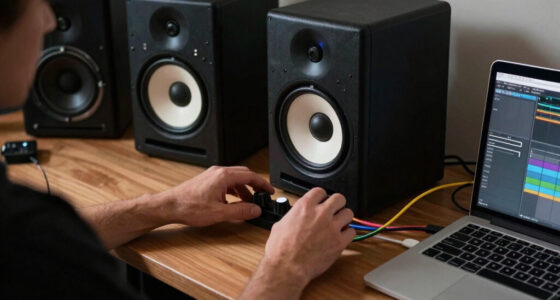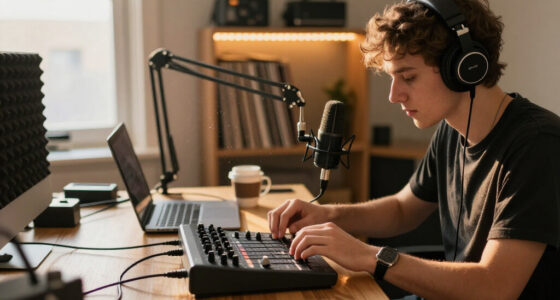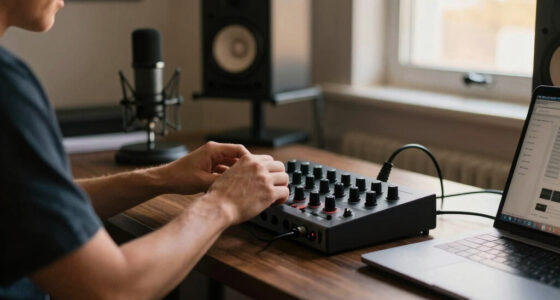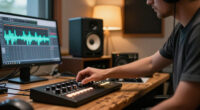
This checklist is for musicians, producers, and creators planning a studio upgrade—whether you’re setting up a first recording space or replacing a few key pieces of gear. It covers tools for recording, monitoring, performance, and room treatment.

Get audio and creator gear delivered free — and shop member deals
- Fast, free delivery on millions of items
- Access to Prime Big Deal Days deals on October 6–7
- Prime Video, Amazon Music and more included
The sections follow the path from connecting your equipment to shaping what you hear: interface, speakers, microphone, MIDI controller, headphones, and acoustic panels. Each pick is a specific product, with guidance on what to check before choosing it.
Use the checklist to compare each item with your current setup. Confirm connections, space, and compatibility with your computer and other equipment, then prioritize the items that address your biggest workflow or listening needs.
USB Audio Interface
An audio interface connects microphones and other audio sources to your computer, making it a core recording link in a studio setup. The Focusrite Scarlett 2i2 4th Gen USB-C Audio Interface is the pick for this slot. Before choosing any interface, list how many sources you need to record at once and which connections your microphones and instruments require.
A common mistake is choosing an interface based only on its name or appearance, then discovering it does not suit the session workflow. Check the computer’s available ports and operating system compatibility, and confirm that the included or planned cable matches the interface and computer. Think through where the interface will sit and whether its controls will be easy to reach while recording.
Also consider what needs to connect at the same time: microphones, instruments, headphones, and speakers may all shape your requirements. Match the interface to your actual input needs, rather than assuming a particular setup will cover every future project. Leave room in your plan for the cables and accessories needed to connect your gear.
What to look for:
- Confirm the computer has a compatible USB-C connection or planned adapter.
- Count the sources you may need to record simultaneously.
- Check microphone and instrument connection requirements.
- Plan connections for headphones and studio monitors.
- Confirm compatibility with your computer and recording software.
Focusrite Scarlett 2i2 4th Gen USB-C Audio Interface

The Scarlett 2i2 4th Gen is a USB-C audio interface for recording microphones and instruments, with two low-noise mic preamps and studio-grade converters offering a 120 dB dynamic range. Auto Gain and Clip Safe help set recording levels, while Air mode adds presence to vocals and guitars.
Pros:
- Two low-noise microphone preamps
- Auto Gain and Clip Safe simplify level setting and help prevent clipping
- Includes recording software and a collection of plugins
- Three-year warranty
Cons:
- The description does not specify detailed compatibility or system requirements
Best for: Creators building a straightforward computer-based recording setup.
Not ideal for: Anyone who needs more simultaneous inputs than their sessions require.
Bottom line: Choose the Scarlett 2i2 after checking that its connections fit your computer and recording workflow.
Studio Monitor Speakers
Studio monitors let you hear your production through speakers, so their placement and fit in the room matter as much as the model. The PreSonus Eris E7 XT 2-Way Active Studio Monitor is the pick here. Consider the listening space first: measure the desk or stands, identify where the speakers can sit, and account for the distance between them and your listening position.
A frequent buying mistake is selecting speakers without checking room layout or how they will connect to the rest of the studio. Verify the required audio connections against your interface, and consider whether you need one monitor or a matched pair for your setup. Plan for power outlets and cable routing so the speakers can be positioned without stretching or crossing walkways.
Speaker placement affects what you hear, so leave room to position them consistently around your listening spot. Check the product dimensions against the intended location and make sure the speaker orientation works for the desk or stands. If your room is shared or compact, consider how monitor placement fits alongside other equipment and any planned room treatment.
What to look for:
- Measure the intended desk or stand space against the speaker dimensions.
- Confirm audio connections work with your interface.
- Plan whether your setup calls for one monitor or a pair.
- Check access to power outlets and cable routes.
- Allow space for consistent placement around your listening position.
PreSonus Eris E7 XT 2-Way Active Studio Monitor

The PreSonus Eris E7 XT is a 2-way active studio monitor featuring a 6.5-inch woven composite low-frequency driver and a 1.25-inch silk-dome tweeter. It includes an EBM waveguide for a wide sweet spot and acoustic tuning controls to tailor the sound to your specific room environment.
Pros:
- Includes over $1000 worth of music production software
- EBM waveguide provides a wide sweet spot and solid imaging
- Acoustic tuning controls allow for accurate room correction
- Ported enclosure delivers deep, tight low-end response
Cons:
- No customer rating data available
- No price information provided in source text
Best for: Producers adding active monitors to a home or project studio.
Not ideal for: Setups without a suitable location or connection plan for speakers.
Bottom line: Check room dimensions and interface connections before planning monitor placement.
Condenser Microphone
A condenser microphone can be a key part of a recording chain, but the right choice depends on the voices or sources you record and the rest of your setup. The Neumann TLM 103 Large-Diaphragm Condenser Microphone with Shockmount is the pick for this checklist. Before buying, check that your interface supports the microphone’s connection and required operating setup, and confirm the shockmount fit suits your stand or boom.
One common mistake is focusing on the microphone alone and overlooking the supporting gear. Consider the stand, cable, pop filter if needed, and available space for positioning the mic. Check whether the room and recording environment suit the material you plan to capture; a microphone choice cannot replace planning for background sound or room reflections.
Think about who will use the microphone and whether its placement can be adjusted comfortably. Confirm that the shockmount and any other accessories are included as expected, especially given the product name’s trailing comma in the listing. Match the microphone to your recording needs and make sure the complete chain—from stand to interface—works together.
What to look for:
- Confirm interface compatibility and required operating setup.
- Check shockmount compatibility with your stand or boom.
- Plan space for microphone positioning and accessories.
- Verify which accessories are included in the listing.
- Consider whether the recording environment suits your intended sources.
Neumann TLM 103 Large-Diaphragm Condenser Microphone with Shockmount, Nickel

The Neumann TLM 103 is a cardioid large-diaphragm condenser microphone with low self-noise, high sound pressure handling, and a capsule derived from the U 87. This bundle includes a suspension shockmount, stand mount, wooden storage box, and mount adapters for studio, broadcast, or voiceover use.
Pros:
- Low self-noise
- Handles high sound pressure levels
- Cardioid pattern attenuates sound from the rear
- Includes suspension shockmount and mounting accessories
Cons:
- Availability can vary
Best for: Creators adding a large-diaphragm condenser to a recording chain.
Not ideal for: Buyers whose interface or room setup is not ready for a condenser microphone.
Bottom line: Confirm the full microphone chain, including interface, stand, and shockmount, before choosing this pick.
MIDI Keyboard Controller
A MIDI keyboard controller gives you a hands-on way to play and control music software. The Novation Launchkey 61 MK4 USB MIDI Keyboard Controller is the pick for this slot. Start by checking whether a 61-key layout fits both your playing style and available workspace. Measure the desk or stand, including space for a computer keyboard, mouse, and other controllers.
A common mistake is buying a controller without checking how it will connect to the computer and work with the software in use. Confirm operating system and software compatibility, and plan for the USB connection or any additional setup the workflow requires. If the controller will share space with other gear, map out cable access and a comfortable position before setting it up.
Consider the kinds of parts you want to play and how much range you need under your hands. Check the controller’s dimensions and compare them with your studio layout; the key count alone does not tell you whether it will fit. If portability matters, consider how you will store or move it. Pick a layout that supports your playing workflow without crowding other essential equipment.
What to look for:
- Measure the available desk or stand space for a 61-key controller.
- Confirm compatibility with your computer and music software.
- Check the USB connection plan and cable access.
- Consider how the key range fits your playing style.
- Plan storage or transport if the controller needs to move.
Novation Launchkey 61 MK4 USB MIDI Keyboard Controller

A 61-key USB MIDI controller with a semi-weighted keybed, 16 pads with polyphonic aftertouch, and hands-on controls for playing instruments, launching clips, and managing DAW mixers and effects. It integrates with major DAWs and includes Scale, Chord, and Arpeggiator tools, plus bundled music software and lessons.
Pros:
- Works with major DAWs
- Pads support polyphonic aftertouch and multiple creative functions
- Built-in tools help create chords, stay in key, and shape arpeggios
- Includes music software, sounds, and Melodics lessons
Cons:
- Requires a compatible computer or music device for USB-based workflows
Best for: Players who want a 61-key controller in their studio workflow.
Not ideal for: Small workspaces that cannot comfortably accommodate its layout.
Bottom line: Choose this controller if its key range, connections, and footprint suit your setup.
Closed-Back Headphones
Closed-back headphones offer a way to monitor audio while keeping listening close to you, which can be useful during recording and focused work. The Focal Lensys Professional Closed-Back Headphones is the pick in this category. Before choosing headphones, consider how long you typically wear them and whether the fit feels comfortable for your sessions.
A common buying mistake is judging headphones by the product description alone without checking how they connect to your interface or other equipment. Verify the connector and cable arrangement, and consider whether the cable length suits your recording position. If you plan to use them with multiple devices, confirm that the connections work for each one or identify any adapter needed.
Think about where the headphones will be used and how they will be stored between sessions. Try to assess fit and adjustability where possible, and check the product details for included accessories. Headphones can complement speakers, but consider how they fit into your monitoring routine rather than expecting one listening method to answer every production question. Match your choice to your session habits and connection needs.
What to look for:
- Check the connector against your interface and other devices.
- Confirm cable length suits your recording position.
- Assess comfort and adjustability for longer sessions.
- Review included accessories and storage needs.
- Consider how headphones will complement your speaker monitoring.
Focal Lensys Professional Closed-Back Headphones

The Focal Lensys Professional headphones feature dual Al/Mg drivers and a sound-isolating design, making them suitable for studio monitoring, mixing, and authentic playback. They offer a comfortable fit with memory foam earpads and a durable build, ideal for both professionals and enthusiasts.
Pros:
- Excellent sound quality with dual Al/Mg drivers
- Sound isolation for focused listening
- Comfortable fit for extended use
- Durable construction with carrying case
Cons:
- May be expensive for casual users
- Design may be bulky for portable use
Best for: Creators who want closed-back headphones in their monitoring setup.
Not ideal for: Buyers unable to confirm fit or connection compatibility before purchase.
Bottom line: Check comfort, cable details, and device connections to see whether the Lensys suits your sessions.
Acoustic Foam Panels
Acoustic panels are a room-treatment consideration for creators planning how their recording or listening space sounds. The ATS Acoustics Sound Absorbing Acoustic Panel 24" x 24" x 4" Beveled Ed is the pick for this slot. Begin by measuring the wall areas you are considering and checking the panel’s listed dimensions against the available space.
A common mistake is buying panels before deciding where they will go or how they will be mounted. Check the product details for mounting requirements and plan how the installation works with your wall surface and room layout. Consider furniture, doors, windows, and access to equipment so the chosen locations remain practical. Do not assume a panel will solve every acoustic issue in the room.
Confirm the full product name and listing details, since the supplied name ends with “Beveled Ed.” Check the panel quantity, finish, and mounting hardware listed by the seller before planning coverage. Sketch your intended arrangement and compare it with the areas you want to treat. A measured plan helps the panels fit the room rather than forcing a last-minute layout around them.
What to look for:
- Measure the intended wall area against the 24-inch by 24-inch panel dimensions.
- Confirm panel thickness and listing details before ordering.
- Check mounting requirements and wall compatibility.
- Verify quantity, finish, and included mounting hardware.
- Plan placement around doors, windows, furniture, and equipment.
ATS Acoustics Sound Absorbing Acoustic Panel 24" x 24" x 4" Beveled Edge (Ivory)

These acoustic panels are designed to improve sound clarity by effectively controlling reverb and echo. Made with a mineral wool core and wrapped in jute burlap fabric, they are suitable for various spaces like studios, offices, and home theaters, offering easy installation and durable construction.
Pros:
- Effective sound absorption with NRC rating of 1.15
- Easy to install with included hardware and template
- Durable, furniture-grade quality with attractive burlap fabric
- Suitable for various residential and commercial spaces
Cons:
- Limited color options (Ivory only)
- May require multiple panels for larger rooms
- Heavy weight (8 pounds) may need sturdy mounting
Best for: Studio owners planning measured acoustic panel placement.
Not ideal for: Anyone expecting panels to resolve every room sound issue on their own.
Bottom line: Verify the listing details and map panel placement to your room before choosing this pick.
Prioritize purchases by the biggest gap in your setup: first the connections needed to record, then the monitoring or microphone gear your work calls for, followed by performance controls and room treatment. Make a compatibility check before each purchase so cables, software, dimensions, and placement all line up.
Build the studio one practical step at a time, using your room and workflow to guide each choice. With a clear checklist and a few measurements, you can make upgrades that fit the way you actually create.
Halloween Picks
halloween
As an affiliate, we earn on qualifying purchases.