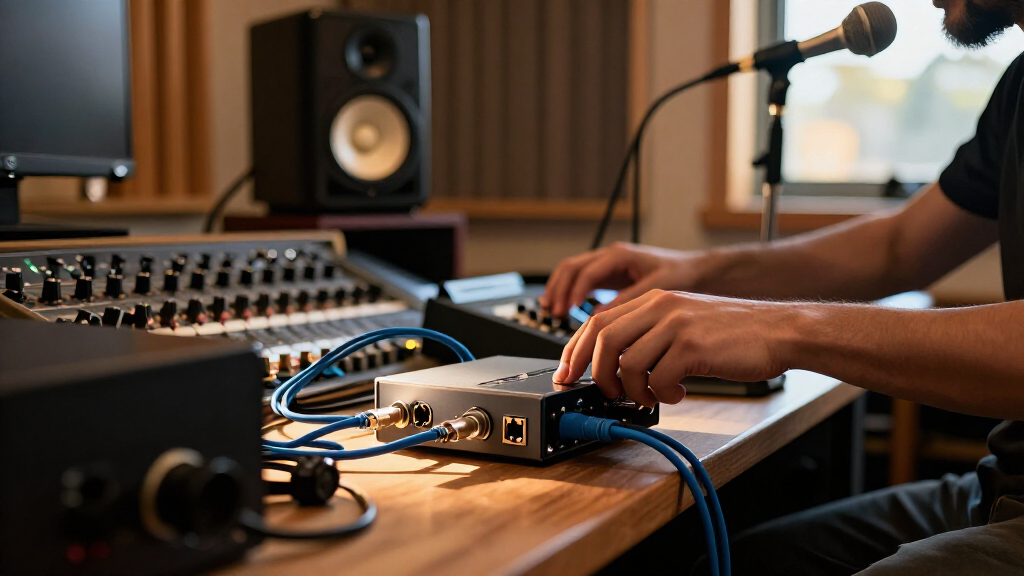
My picks for the best Ethernet audio interfaces serve different jobs on a Dante network. The Focusrite RedNet X2P is the most versatile choice here, combining two mic preamps with stereo monitoring connections. For a simpler way to feed a headphone or line-output destination, the RedNet AM2 is the more focused pick. And when the priority is bringing several analog sources into a network, the MSQ-3900D offers four XLR inputs with PoE.

Get audio and creator gear delivered free with Prime
- Fast, free delivery on millions of items
- Prime Video, Amazon Music and more included
- Member-only deals all year
These are not interchangeable desktop USB interfaces: each depends on compatible Dante network infrastructure, and their I/O serves distinct roles. I rank the X2P first for its mix of recording and monitoring connections, the MSQ-3900D second for its four-channel input capacity, and the AM2 third because it is a monitoring endpoint rather than a recording interface. The right choice comes down to whether your network needs mic inputs, multiple analog inputs, or headphone and line monitoring.
Complete the kit


Key Takeaways
- RedNet X2P: My most flexible pick for a small Dante-connected recording or production setup, with two mic preamps and stereo monitoring.
- MSQ-3900D: The only four-input option here, suited to sending multiple analog XLR sources into a Dante network.
- RedNet AM2: Choose it to monitor Dante audio through headphones or line outputs; it is not a mic-input interface.
- All three depend on Dante-compatible network equipment and setup; Ethernet connectivity alone does not make them plug-and-play USB interfaces.
- PoE can simplify installation for the MSQ-3900D and AM2, while the X2P’s listed details do not specify its power options.
| Focusrite RedNet X2P 2×2 Ethernet Audio Digital I/O with Mic Preamps | 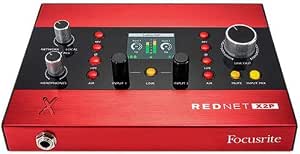 | Best Overall | Input channels: 2 | Input connection: XLR | Network connection: Ethernet | VIEW LATEST PRICE | See Our Full Breakdown |
| Dante Audio 4 Channel Analog Audio Network Interface Box, Four 3-Pin XLR Inputs, PoE, Aluminum Housing, TAA Compliant |  | Best for Four Analog Inputs | Channels: 4 | Input connectors: Four 3-pin XLR inputs | Maximum sample rate: 96 kHz | VIEW LATEST PRICE | See Our Full Breakdown |
| Focusrite RedNet AM2 Stereo Dante Headphone Amp & Line Out Interface with PoE |  | Best for Dante Headphone Monitoring | Device role: Stereo headphone amp and line-out interface | Network audio: Dante | Connectivity listed: XLR | VIEW LATEST PRICE | See Our Full Breakdown |
| Ethernet audio interface | Maximum sample rate | Weight |
|---|---|---|
| Focusrite RedNet X2P 2×2 Ether | 96 kHz | — |
| Dante Audio 4 Channel Analog A | 96 kHz | 10.56 ounces |
| Focusrite RedNet AM2 Stereo Da | — | 1.8 pounds |
More Details on Our Top Picks
Focusrite RedNet X2P 2×2 Ethernet Audio Digital I/O with Mic Preamps
The RedNet X2P earns my top spot because it covers more of a small production workflow than either rival. Its two Red Evolution mic preamps let it take microphone sources into the Dante system, while its stereo headphone output and stereo line out provide monitoring connections in the same compact unit. That combination makes it a stronger all-rounder than the MSQ-3900D, which offers four XLR inputs but does not list a built-in digital audio output, and more suitable for recording than the AM2, which is focused on monitoring network audio.
Its stated support for sample rates up to 96 kHz fits professional workflows that need high-rate recording, while Ethernet connection can help place the unit near performers or other sources instead of requiring every cable to run back to a central interface. The product description calls it compact and portable, a useful distinction when the network endpoint needs to move between rooms or serve a changing setup. For a small Dante rig, the X2P has the most balanced input-and-monitoring role in this group.
The tradeoff is capacity: two mic inputs are not enough for larger sessions, and the supplied listing identifies Windows as supported without giving details about other platforms. It also does not specify included software or power arrangements, so I would confirm both against the current manufacturer documentation and the intended network design. Buyers who only need to monitor a Dante feed can avoid paying for mic preamps they will not use by choosing the AM2; those who need four analog inputs should look at the MSQ-3900D instead.
Pros:- Two Red Evolution mic preamps for feeding microphones into Dante
- Stereo headphone output and stereo line out support local monitoring
- Supports sample rates up to 96 kHz
- Compact form suited to portable or distributed setups
Cons:- Two inputs limit its usefulness for larger recording sessions
- The supplied listing names Windows support only, so other platform compatibility needs confirmation
- Included software and power details are not specified in the supplied information
Best for: Small studios, mobile production setups, or performers who need two Dante-connected mic preamps plus local headphone and line monitoring.
Not ideal for: Larger recording sessions needing more than two mic inputs, buyers who need a conventional USB interface, or users whose operating-system compatibility has not been confirmed.
- Input channels:2
- Input connection:XLR
- Network connection:Ethernet
- Maximum sample rate:96 kHz
- Mic preamps:Two Red Evolution preamps
- Monitoring:Stereo headphone output and stereo line out
- Listed software support:Windows
Our verdict“I recommend the RedNet X2P as the most versatile pick here when a small Dante setup needs both mic inputs and monitoring connections.”
Dante Audio 4 Channel Analog Audio Network Interface Box, Four 3-Pin XLR Inputs, PoE, Aluminum Housing, TAA Compliant
For a setup that needs several analog sources to enter a network, the MSQ-3900D has the clearest case in this lineup: it provides four 3-pin XLR inputs, twice the input count of the RedNet X2P. That makes it better suited to collecting multiple microphones or other XLR-level sources at one location, then carrying audio over Dante. The X2P is more versatile for a compact recording-and-monitoring point, but it cannot match the MSQ-3900D’s stated four-input capacity.
The unit supports up to 96 kHz and is described as transmitting uncompressed, low-latency audio over IP. Support for Dante and AES67 RTP may matter in installations that need to fit an established network audio workflow, though buyers should verify compatibility with their specific equipment and configuration. PoE and Type-C power input offer two installation approaches: PoE can reduce separate power cabling where the network supports it, while Type-C provides an alternative. Its aluminum housing is a practical fit for a professional installation where a compact, durable enclosure is useful.
The main compromise is that this is an input-focused network box, not a complete studio interface with local headphone or digital output connections. Its four-channel ceiling also makes it less appropriate for a larger source count, and it requires compatible Dante infrastructure. Compared with the AM2, it is designed to send analog inputs into the network rather than provide headphone monitoring from it. I would shortlist it when XLR input count is the priority, but not as a substitute for a device that supplies local monitoring or broader studio I/O.
Pros:- Four 3-pin XLR inputs provide the highest input count in this group
- Supports sample rates up to 96 kHz
- Dante and AES67 RTP support suits compatible network-audio setups
- PoE and Type-C power options offer installation flexibility
Cons:- Limited to four input channels
- Requires compatible Dante network infrastructure
- No built-in digital audio output is listed
Best for: Installers and audio teams that need four analog XLR sources connected to a Dante network, especially where PoE or Type-C power is useful.
Not ideal for: Buyers seeking a complete desktop recording interface, built-in headphone monitoring, digital audio output, or more than four analog inputs.
- Channels:4
- Input connectors:Four 3-pin XLR inputs
- Maximum sample rate:96 kHz
- Network protocols:Dante, AES67 RTP
- Power:PoE or Type-C
- Housing:Aluminum
- Weight:10.56 ounces
- TAA compliance:Listed as TAA compliant
Our verdict“I would choose the MSQ-3900D over the X2P when four XLR inputs matter more than mic-preamp features and local monitoring.”
Focusrite RedNet AM2 Stereo Dante Headphone Amp & Line Out Interface with PoE
The RedNet AM2 is the specialist of this group: it takes a Dante network feed and provides headphone amplification and line-level outputs for monitoring. That makes it a better fit than the MSQ-3900D when the job is listening at a remote position, while the MSQ-3900D is the more relevant choice for putting analog inputs onto the network. The AM2 also differs from the X2P, which combines monitoring with two mic preamps; if those inputs are unnecessary, the AM2’s focused role may suit a playback or cue point more directly.
Independent controls for the headphone and line outputs let a listener adjust one monitoring path without changing the other. An integrated mute switch adds a straightforward control for managing output, and the unit can run from PoE or its included external supply. Its compact metal housing and microphone-stand mount support placement close to a performer or operator, instead of forcing every listener to work beside the main rack. In a distributed Dante system, that can make a single stereo monitoring endpoint useful in a booth, on stage, or at a remote workstation.
The AM2’s narrow purpose is also its main limitation. It is a monitoring device, not a mic-input recording interface, and its single-channel configuration will not replace the X2P or four-input MSQ-3900D for capturing analog sources. The supplied listing names Windows only, so I would check current platform support before building it into a cross-platform system. Buyers who need just a headphone and line-out endpoint may prefer this over the broader X2P; anyone recording microphones should choose one of the other two instead.
Pros:- Independent level controls for headphone and line outputs
- Integrated mute switch for output control
- PoE or included external power supply
- Compact metal housing with microphone-stand mount
Cons:- Monitoring-focused design does not provide mic inputs for recording
- Single-channel configuration limits its role compared with the X2P and MSQ-3900D
- The supplied listing identifies Windows only, so other platform support needs verification
Best for: Dante users who need a remote stereo headphone and line-output monitoring point with separate level controls.
Not ideal for: Anyone needing microphone inputs, multichannel analog capture, or confirmed compatibility with an operating system beyond the listing’s Windows entry.
- Device role:Stereo headphone amp and line-out interface
- Network audio:Dante
- Connectivity listed:XLR
- Power options:PoE or included external power supply
- Output controls:Independent headphone and line level controls
- Additional control:Integrated mute switch
- Housing and mounting:Compact metal housing with microphone-stand mount
- Weight:1.8 pounds
- Listed operating system:Windows
Our verdict“I recommend the RedNet AM2 when a Dante system needs a dedicated headphone and line-monitoring endpoint, not a device for capturing microphones.”

How We Picked
I ranked these three products by how well their stated features solve distinct Ethernet-audio jobs, rather than treating every network device as a general-purpose recording interface. My main criteria were usable audio I/O, connection role, network compatibility, and practical setup tradeoffs. A unit that accepts analog microphones fills a different need from one that returns network audio to headphones, so I make that distinction explicit rather than compare channel counts as if they meant the same thing.
The RedNet X2P ranks first because its two mic preamps, stereo headphone output, and stereo line out make it the most broadly useful option in this small lineup. The MSQ-3900D comes next for its four XLR inputs and stated support for Dante and AES67 RTP, though its lack of a built-in digital audio output narrows its role. The RedNet AM2 ranks third not because monitoring is unimportant, but because it does not provide the mic inputs needed for recording sources into the network.
I also weighed the listed limits and avoided assuming details that are not supplied. Operating-system listings, power arrangements, supported sample rates, and connector descriptions can affect whether a device fits an existing system. Buyers should check the manufacturer’s current compatibility information and confirm their Dante routing plan before purchase. These products are best compared as networked components in a larger system, not as direct substitutes for USB interfaces.
Factors to Consider When Choosing Best Ethernet Audio Interfaces
I would start by deciding what the device needs to do at its network endpoint. These three products cover separate stages of a Dante workflow: capturing analog inputs, combining input and monitoring functions, and monitoring an incoming feed. Matching that job to the hardware matters more than choosing by the word Ethernet in a product title.Decide whether you need inputs or outputs
For recording or sending local sources onto a network, count the inputs first. The MSQ-3900D has four XLR inputs, making it the strongest fit for several analog sources at one location. The RedNet X2P has two mic preamps, but it adds stereo headphone and line outputs, giving it a broader role when the same station also needs monitoring. The RedNet AM2 is different: its stated purpose is to provide headphone and line monitoring from a Dante network, not to receive microphone inputs.
Do not treat the stated channel counts as equivalent measures of capability. A four-input box does not automatically replace a two-preamp interface with monitor outputs, and a headphone endpoint does not capture sources simply because it connects over Ethernet. I recommend sketching the signal path first: identify what must enter the network, where listeners need an output, and which device will handle each connection.
Check the Dante network before buying
All three picks rely on network-audio compatibility, so I would confirm that the intended system supports the required Dante devices and routing. The MSQ-3900D also lists AES67 RTP support; that can be relevant when a system uses compatible network-audio equipment, but the protocol name alone does not guarantee that every device will work together. Check the manufacturer documentation, firmware requirements, network configuration, and any software needed to route audio.
These products should not be approached as ordinary USB interfaces that connect directly to a laptop and immediately appear as a recording device. The product information supplied here does not establish that workflow. Confirm the full path between the interface, network switch, computer or console, and destination device before committing to a setup. That step is especially important for buyers building a first Dante system.
Match channel count to the session
The two-preamp X2P is a natural fit for a small recording point, interviews, or a compact performance setup where a pair of microphones and local monitoring cover the task. The MSQ-3900D doubles the analog input count to four, which may help with multiple sources at one location, but it does not list headphone outputs. Neither option is a high-channel-count rack interface, so buyers planning larger sessions should map every source and check whether multiple network endpoints or another interface will be needed.
For the AM2, channel count should be understood through its monitoring purpose. Its stereo headphone and line outputs address playback at a listening position, not the addition of analog recording inputs. Choose it because you need that output point, not because you expect it to expand the number of microphones your system can capture.
Consider sample rate and audio requirements
The X2P and MSQ-3900D both state support for sample rates up to 96 kHz. That gives buyers a stated ceiling for planning a compatible session, but the whole network chain must support the chosen format. Confirm that every endpoint and the routing configuration can operate together at the rate and channel count you plan to use. The supplied AM2 details do not list a maximum sample rate, so I would verify its specifications directly if that figure affects a project requirement.
Sample rate should not distract from the more basic I/O question. A high-rate specification will not compensate for missing inputs, an absent monitoring output, or an incompatible network configuration. I would settle those points before comparing technical ceilings.
Plan power and physical placement
PoE can simplify installation by allowing a compatible network connection to provide power, which is useful for remote endpoints where a separate outlet is inconvenient. The MSQ-3900D supports PoE or Type-C power, while the AM2 lists PoE or an included external supply. Check that the relevant switch or injector supports the required PoE standard; Ethernet cabling by itself does not supply power unless the network equipment is designed to do so.
The AM2’s stand-mount option may suit a stage or booth where headphone access needs to stay near the listener. The MSQ-3900D’s aluminum enclosure is suited to a professional installation, while the X2P is described as compact and portable. For any of them, plan cable strain relief, access to controls, and a location that fits the actual signal flow rather than choosing placement on size alone.
Verify computer and software compatibility
The supplied listings name Windows support for the X2P and AM2, but do not give complete cross-platform details. That is not enough to conclude that other systems are unsupported; it does mean I would confirm the current manufacturer information before purchase. The X2P description also does not specify included software, so check what applications, drivers, control utilities, and routing tools are needed for the intended workflow.
Compatibility involves more than the computer’s operating system. Make sure the software can see and route the network audio as expected, and confirm whether your recording or playback application requires a particular driver or setup. When a system will be used at a venue or shared installation, check how configuration and control will be managed by the people responsible for it.
Frequently Asked Questions
What is an Ethernet audio interface?
An Ethernet audio interface sends or receives digital audio through a network connection instead of relying only on a direct USB connection. In this roundup, the products are Dante-oriented network devices with different jobs: the MSQ-3900D and X2P provide analog inputs, while the AM2 provides headphone and line monitoring. Buyers need compatible network equipment and routing for the intended system; Ethernet connectivity by itself does not define a complete recording setup.
Which of these interfaces is best for recording microphones?
I would choose the RedNet X2P for a small setup that needs two mic preamps alongside stereo monitoring. If the priority is four analog XLR inputs, the MSQ-3900D has more input capacity, though its supplied details do not list mic-preamp specifications or a built-in digital audio output. The AM2 is a monitoring endpoint and is not the right pick for connecting microphones as recording inputs.
Can the RedNet AM2 record microphone inputs?
The supplied product information describes the RedNet AM2 as a stereo headphone amp and line-out interface for Dante networks, with separate headphone and line controls. It does not list microphone inputs or preamps, so I would not select it to capture microphones. For that job, compare the X2P’s two preamps or the MSQ-3900D’s four XLR inputs, while confirming the exact source-level requirements for your system.
Do these products work as plug-and-play USB interfaces?
The product details describe Ethernet and Dante network connections, not a standard direct USB recording workflow. The MSQ-3900D lists Type-C as a power option, but that does not establish USB audio connectivity. I would plan to use each device within a compatible network-audio system and confirm the software, routing, and computer requirements in the manufacturer documentation before purchase.
How should I choose between the X2P and the MSQ-3900D?
Choose the X2P if two mic preamps plus stereo headphone and line monitoring make it the more useful endpoint for your setup. Choose the MSQ-3900D if four XLR inputs and PoE or Type-C power matter more than local monitoring features. Both list support up to 96 kHz, but their roles differ: the X2P combines inputs and monitoring, while the MSQ-3900D is the higher-input-count option in this comparison.
Conclusion
My pick for the best all-round Ethernet audio interface here is the Focusrite RedNet X2P, because two mic preamps share a compact unit with stereo headphone and line monitoring. Choose the MSQ-3900D if your main need is connecting up to four XLR sources to a compatible Dante network, and you can provide monitoring elsewhere. For a dedicated listening point with headphone and line outputs, the RedNet AM2 is the focused choice, but it is not a recording-input substitute.
Before deciding, confirm the network, operating-system, software, and power requirements for your installation. My ranking reflects the balance of functions in this three-product group, not a claim that one device suits every network-audio job: the best match depends on whether your endpoint needs mic inputs, extra XLR capacity, or remote monitoring.
Fall Picks
fall essentials
As an affiliate, we earn on qualifying purchases.
![Sex Pistols Berate Dude For Infiltrating Women-Only Mosh Pit [Updated]](https://artzartz.com/wp-content/uploads/2026/10/sex-pistols-berate-dude-for-infiltrating-women-only-mosh-pit-updated-featured-260x140.jpg)