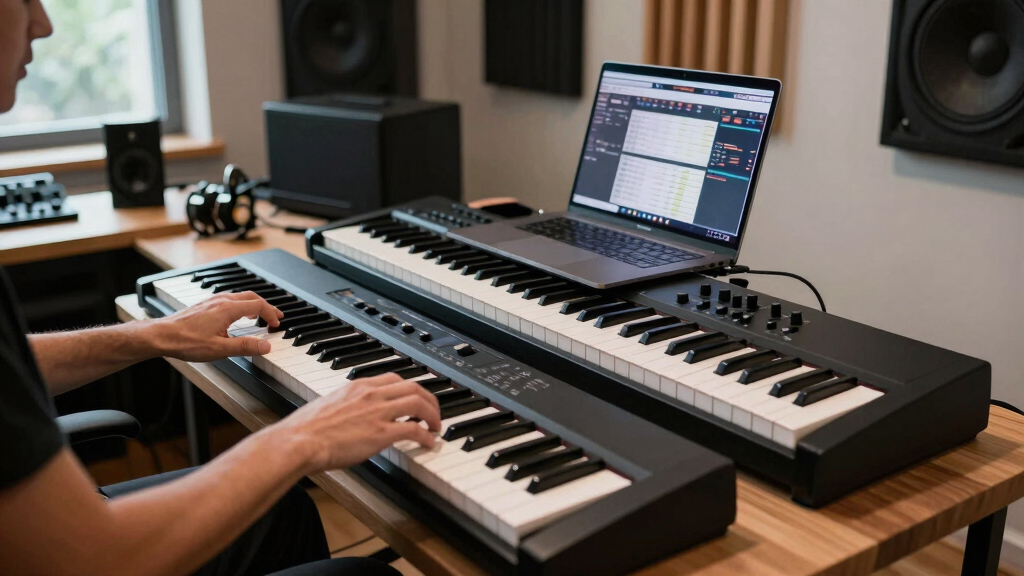
TL;DR

Get audio and creator gear delivered free with Prime
- Fast, free delivery on millions of items
- Prime Video, Amazon Music and more included
- Member-only deals all year
Choosing the right MIDI keyboard size hinges on your workflow and space. 25 keys are portable for sketching, 49 keys balance size and playability, and 61 keys suit performers needing more range. Knowing your priorities makes the decision clear.
Ever try to jam on a tiny keyboard and feel limited? Or struggle with a giant setup that’s hard to move? The size of your MIDI keyboard isn’t just about space—it’s about how you create. Picking the right number of keys can boost your workflow or hold you back. This guide cuts through the confusion, helping you find the perfect fit—whether you’re sketching ideas on the go or performing live on stage.
By understanding what each size offers—25, 49, or 61 keys—you’ll make smarter choices. No fluff, just straightforward advice rooted in real-world use. Ready to find your perfect match? Let’s go.
25 keys excel for portability, quick sketches, and beginners on a tight budget.
49 keys offer a versatile middle ground—great for most producers who want a balance of range and size.
61 keys suit performers and composers needing more expressive control and full-range playing.
Consider your space, budget, and musical goals before choosing size—bigger isn’t always better.
Features like weighted keys and extra controls vary by size, impacting playability and workflow.
25 vs 49 vs 61 Keys
Choosing a MIDI keyboard is less about getting the most keys and more about protecting your creative flow. Go compact for fast sketches, choose 49 for an adaptable studio, or step up to 61 for expressive performance.
Match the footprint to the music
Each jump in size reduces octave switching and expands what both hands can do at once—but also demands more space, money, and transport effort.
25 keys
Fast, lightweight and approachable. Ideal for capturing ideas, triggering samples and controlling synths from almost anywhere.
- Backpack-friendly footprint
- Lowest typical entry cost
- Frequent octave shifts
- Limited two-hand voicings
49 keys
Enough room for chords, melodies and basslines without turning your workstation into a dedicated piano setup.
- Comfortable two-hand workflow
- Fits most production desks
- Often adds pads and faders
- Still manageable for gigs
61 keys
More natural for layered voicings, split instruments and expressive arrangements where constant octave switching breaks concentration.
- Broad live-playing range
- Complex chords feel natural
- More room and cost required
- A protective case is advisable
More keys, fewer interruptions
The practical gain is continuity: a wider playing range keeps your hands on the music instead of reaching for octave buttons.
The real-world trade-offs
All three sizes can control virtual instruments and hardware synths. The difference is how naturally each one supports your preferred way of working.
| Decision factor | 25 keys | 49 keys | 61 keys |
|---|---|---|---|
| Travel portability | ✓ Excellent | ~ Manageable | ✗ Case recommended |
| Small-desk fit | ✓ Effortless | ✓ Usually comfortable | ~ Measure first |
| Two-hand playing | ✗ Restricted | ✓ Practical | ✓ Natural |
| Octave switching | ✗ Frequent | ~ Occasional | ✓ Minimal |
| Live performance | ~ Focused parts | ✓ Versatile | ✓ Most expressive |
| Typical price tier | Entry level | Entry to mid-range | Mid to high-end |
| Control surface | Usually streamlined | Often well equipped | Often most extensive |
Price guide · Entry $100–$300 · Mid-range $300–$600 · Higher-end $600+
Follow your workflow
A good controller disappears beneath your hands. Use this chain to connect your environment, playing style and key-action needs.
Where will it live?
Backpack or tiny desk points to 25. A standard desk favors 49. A fixed studio welcomes 61.
What will you perform?
Single lines need less range. Two-hand chords, splits and improvisation reward more keys.
Which key action?
Synth action is quick and light. Semi-weighted adds resistance. Piano players may prefer weighted action.
Remove the friction
Select the smallest controller that comfortably supports the music you regularly make.
Default to 49—then justify moving smaller or larger.
Choose 25 when mobility is non-negotiable. Choose 61 when expressive two-hand playing is central. For the broad middle—production, songwriting, arranging and occasional performance—49 keys deliver the strongest balance.
Before you buy
Key count is only one part of the instrument. Check dimensions, action, controls, software integration and connectivity before committing.
Can I start with 25 and upgrade later?
Yes. Most controllers are plug-and-play, so moving to a larger model is straightforward. Confirm connection type and software compatibility.
Are weighted keys worth paying for?
They are valuable for piano technique and dynamic control. For synths, beats and software control, semi-weighted or synth action may feel faster.
When do I need 73 or 88 keys?
Consider them for classical repertoire, detailed jazz voicings or piano-centered live work. For most electronic production, 61 is already ample.
What Does 25, 49, and 61 Keys Actually Mean for Your Music?
25, 49, and 61 keys refer to the number of keys on a MIDI controller. Each size offers a different range and feel, impacting how you play and what you can do. Think of it like choosing a backpack—smaller ones are lighter but hold less, bigger ones carry more but are bulkier.
25 keys usually span just 2 octaves (C to B). This limited range is ideal for quick sketches, controlling software, or triggering samples, but it constrains harmonic complexity. The tradeoff is that you sacrifice the ability to play full chords or complex arrangements without shifting octaves frequently. This can lead to a more fragmented workflow, especially if you’re used to a full piano range. 49 keys extend to about 4 octaves, offering a balance—enough for melodies, basslines, and basic chords, reducing the need for constant octave shifts. This range enables more fluid playing and songwriting, making it suitable for most styles. 61 keys nearly reach 5 octaves, allowing for more expressive and full-range playing, suitable for live performances, jazz improvisation, or classical compositions. The additional keys reduce the need to shift and provide a more natural playing experience, but they come at a higher cost and size.
Choosing between them involves considering how much harmonic and melodic flexibility you need. Smaller controllers limit your range but excel in portability and simplicity. Larger controllers expand your creative potential but can be cumbersome. Your choice impacts your workflow, performance style, and even your creative ideas—so pick the size that aligns with your musical goals.
As an affiliate, we earn on qualifying purchases.
How Portability and Space Shape Your Choice
If you’re always on the move, a 25-key MIDI controller can slip into a backpack and go anywhere. It’s about the size of a small notebook, weighing less than 3 pounds. This ultra-portability means you can create whenever inspiration strikes—on a train, in a cafe, or in tight studio corners—without sacrificing much functionality for quick sketches or control tasks. However, the small size limits your playing range, which might hinder more complex musical ideas.
Need more room? A 49-key model is still portable but offers a more comfortable playing experience—about the length of a standard sheet of paper in width. It fits comfortably on most desks and is manageable in small to medium studios. This size strikes a good balance, allowing you to perform more naturally and explore a wider range of musical ideas without the bulk of larger controllers.
61-key controllers are bigger—roughly the size of a large hardcover book. They’re still manageable if you have a dedicated studio space, but lugging them around requires a sturdy case and some effort. The larger size provides a more authentic piano experience, which is especially beneficial if you’re performing or recording complex pieces. The tradeoff is that they are less portable, making them better suited for fixed setups rather than frequent travel.
For example, a producer traveling to gigs might prefer a 25-key controller for ease of transport. Conversely, a home studio owner dedicated to composing or live performance might opt for 61 keys for comfort and versatility.
49 key MIDI keyboard with weighted keys
As an affiliate, we earn on qualifying purchases.
As an affiliate, we earn on qualifying purchases.
What Can You Actually Play on Each Size?
Think of each size as a different toolkit for your musical ideas. With 25 keys, you’re primarily sketching melodies or controlling synths—like a remote control with limited buttons. Chord voicings and basslines are possible but require workarounds, such as octave shifts or transposing, which can interrupt your flow. This size is ideal for quick ideas, triggering samples, or controlling software parameters, but it can frustrate those wanting to perform complex arrangements seamlessly.
49 keys open up more possibilities. You can comfortably play chords, basslines, and melodies without constantly shifting octaves. It’s akin to having a mini piano at your fingertips—great for songwriting, arranging, and quick improvisation. This size supports a broader musical range, reducing the cognitive load of managing octaves and allowing you to focus on creativity rather than technical limitations.
61 keys give you the full range of a typical piano, making it suitable for complex compositions, live performances, or jazz improvisation. You can play full chords, bass, and melodies simultaneously—like sitting at a real piano. This expanded range enables more expressive playing, nuanced dynamics, and the ability to handle intricate arrangements, which is especially valuable for performers and composers working on detailed pieces.
For example, a producer working on electronic music might find 49 keys sufficient for most tasks, while a classical pianist or jazz musician would prefer 61 or more for authentic expression and full-range playing. Your choice impacts your creative flexibility and how naturally you can realize your musical ideas.
61 key MIDI keyboard for performers
As an affiliate, we earn on qualifying purchases.
As an affiliate, we earn on qualifying purchases.
Frequently Asked Questions
Can I upgrade from a smaller to a larger MIDI keyboard later?
Absolutely. Many producers start with a 25-key controller and upgrade as their needs grow. Just check your software and hardware compatibility; most controllers are plug-and-play.Is it worth paying extra for weighted keys on a 61-key controller?
If you play piano or want a more realistic feel, weighted keys are worth it. They help develop finger strength and control. For basic melodies or controlling software, semi-weighted or synth-action keys often suffice.How do I know if I need more than 61 keys?
If you’re recording complex classical pieces, jazz improvisations, or playing live gigs with full voicings, consider 73 or 88 keys. For most electronic music production, 61 is enough.As an affiliate, we earn on qualifying purchases.
Conclusion
Choosing the right MIDI keyboard size isn’t about the biggest or cheapest—it’s about what fits your workflow. Think about where you’ll use it, what you want to play, and how much space you have. The perfect size makes creating music easier, faster, and more fun.
In the end, your ideal MIDI controller should feel like an extension of your hands—not a hurdle. Whether it’s a tiny travel buddy or a full-sized studio partner, pick what helps your music flow naturally.
Halloween Picks
halloween
As an affiliate, we earn on qualifying purchases.