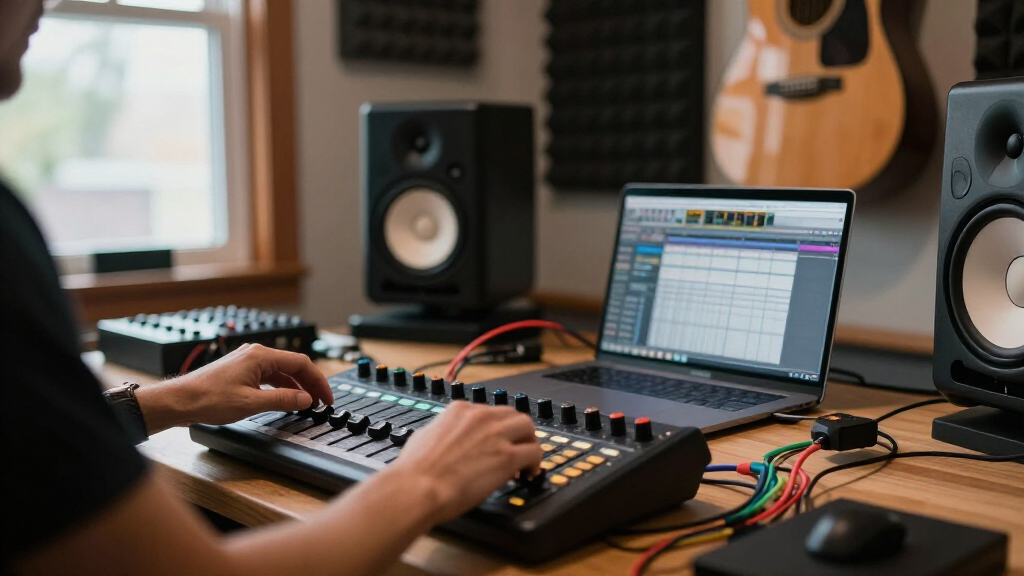

TL;DR

Get audio and creator gear delivered free with Prime
- Fast, free delivery on millions of items
- Prime Video, Amazon Music and more included
- Member-only deals all year
Making faders follow your session means setting up your controller to stay in sync with your DAW’s track selection, automation, and banking. Using the right protocol, motorized faders, and bidirectional feedback makes your mixing smoother, more precise, and faster. A well-mapped controller can handle hundreds of tracks through banks, with reliable automation and instant recall.
Imagine working on a complex mix, with dozens of tracks. Your hands dance over the faders, but they never quite match what you’re hearing in the DAW. You press a button, and suddenly, your hardware controls jump to the right tracks, levels, and plugins. That’s session-aware control. It might sound simple, but making your faders follow your session takes some setup—getting the right protocol, understanding banking, and ensuring bidirectional feedback. If you’ve ever struggled with faders moving out of sync or automation fighting your touch, this guide is for you. You’ll learn how to map your controller so it stays in perfect harmony with your project, saving you time and frustration every session.
Whether you’re using a basic MIDI controller or a high-end motorized surface, understanding how to make your faders follow your session transforms your workflow. It’s about turning hardware into a true extension of your DAW—smooth, responsive, and reliable. Let’s walk through how to set this up, what to watch out for, and how to get your session to stay perfectly in sync.
Use protocols like EUCON or MCU for deep, reliable session following with bidirectional feedback.
Banking allows a small set of faders to control hundreds of tracks—learn to set it up properly.
Motorized faders are worth it if you need precise automation recall and smooth adjustments.
High-resolution message protocols make fine edits feel natural, especially during automation rides.
Always verify your MIDI routing and protocol settings when faders don’t follow or jump unexpectedly.
Making Faders Follow Your Session
Session-aware control means your hardware stays in sync with track selection, automation, and banking — turning a controller into a true extension of your DAW. Smooth, responsive, and reliable, even across hundreds of tracks.
What actually keeps your faders in sync?
Mapping isn’t just assigning a fader to a track — it’s choosing a communication method. Static MIDI Learn fixes “fader 1 = track 1 volume.” Deeper integrations like MCU and EUCON create a real dialogue between hardware and DAW: banking, automation modes, displays, and track colors, all in real time.
MIDI CC (7/14-bit)
Good for fixed controls. 7-bit offers 128 values — fine for basic volume, but stepping artifacts appear during delicate automation rides. 14-bit messages double resolution to 16,384 steps.
Mackie Control Universal
Widely supported across every major DAW. Handles track banking, transport, automation modes, pan, sends, displays, and motorized-fader feedback out of the box.
HUI
Historically significant and still used with Pro Tools, but limited resolution and feature set mean less fluid, deep session following in modern workflows.
EUCON
Avid’s high-resolution Ethernet protocol transmits rich metadata: track names, colors, automation states, and device focus. Ideal for complex, immersive session following.
Native APIs / Scripts
Direct access to track names, colors, selection state, navigation, and contextual controls. Often the most seamless experience — the controller feels like part of the DAW itself.
OSC
Common in custom controllers, tablets, and advanced remote systems. Highly flexible and personalized, but demands more configuration and networking knowledge.
Session-awareness comparison
Sending simple MIDI messages may control parameters — but it won’t provide the dynamic, real-time session awareness efficient workflows demand. Here’s how the major protocols stack up.
| Protocol | Banking | Automation Modes | Display Feedback | Resolution | Setup Effort |
|---|---|---|---|---|---|
| MIDI CC 7-bit | ✗ | ✗ | ✗ | 128 steps | Minimal |
| MIDI CC 14-bit | ✗ | ~ | ✗ | 16,384 steps | Low |
| HUI | ✓ | ✓ | ~ | Limited | Low |
| MCU | ✓ | ✓ | ✓ | Moderate | Low–Med |
| EUCON | ✓ | ✓ | ✓ | High (Ethernet) | Medium |
| Native Scripts | ✓ | ✓ | ✓ | High | Technical |
| OSC | ~ | ~ | ~ | Configurable | High |
Resolution changes how mixing feels
Standard MIDI CC offers 128 values — enough for rough volume, but audible stepping during fine automation rides. High-resolution methods eliminate the staircase. Pitch bend messages are often used for faders precisely because they carry more resolution than ordinary CC.
The secret sauce for big sessions
Think of your control surface as a set of window panes into a sprawling city. An eight-fader controller sees one district at a time — banking flips between neighborhoods. A session-aware system updates the bank automatically to follow your focus, creating the illusion of a full console.
Bank 1
Faders 1–8 control tracks 1–8. Names, colors, and levels reflected on the surface.
Bank Shift
Press bank right — faders now address tracks 9–16. Assignments update instantly.
Channel Nudge
Navigation shifts assignments one track at a time for fine-grained positioning.
Auto-Follow
Advanced systems bank to the selected track, mixer scroll, or visible tracks automatically.
A closed control loop, not a one-way street
Reliable session following requires two-way communication. A controller configured only as a MIDI input can control the DAW but never receives updates — faders drift out of sync, displays go stale, and feedback loops cause jitter when routing is misconfigured.
Real-time sync — no surprises
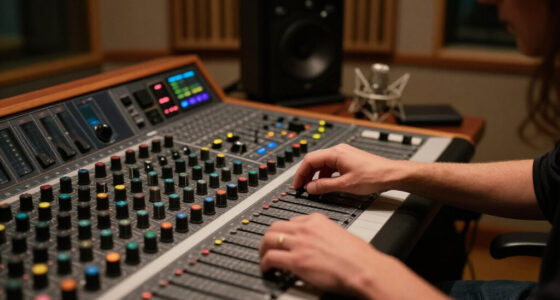
Motorized faders physically glide to match current levels, automation playback, bank changes, project recalls, and mode switches. Non-motorized faders can’t recall positions, so the DAW must reconcile them using one of three takeover behaviors.
Jump Mode
The software value immediately snaps to the hardware position — or the hardware jumps to the DAW value. Fast, but abrupt level changes can disrupt your workflow.
Pickup / Soft Takeover
Nothing changes until the hardware fader crosses the stored software value. Prevents abrupt changes and surprise volume spikes during playback.
Scaled / Relative Takeover
The DAW gradually reconciles hardware and software positions, smoothing the transition between the two worlds over time.
The Motorized Advantage
Motorized faders are like roller-coaster tracks guiding your hand smoothly along the ride — instant recall, precise automation, zero guesswork. Endless encoders with LED rings handle changing assignments more gracefully than non-motorized faders.
Five rules for faders that follow
Use protocols like EUCON or MCU for deep, reliable session following with bidirectional feedback.
Banking lets a small set of faders control hundreds of tracks — set it up properly, and know what it follows: mixer order, selection, or visible tracks.
Motorized faders are worth it for precise automation recall and smooth, physically-guided adjustments.
High-resolution protocols (14-bit, EUCON) make fine edits feel natural — especially during automation rides.
When faders don’t follow or jump unexpectedly, always verify MIDI routing and protocol settings first — check input/output ports and control-surface entries.
What mapping methods actually keep your faders in sync?
Mapping isn’t just assigning a fader to a track. It’s about choosing the right communication method. Basic MIDI mapping is simple: Fader 1 always controls Track 1 volume. But it’s static—no automatic follow. Deeper integrations, like MCU or EUCON, create a dialogue between your hardware and DAW. They support track banking, automation, and even display feedback. For example, EUCON on an Avid controller can show track names, colors, and automation states in real time. Native scripts often provide the most seamless experience—your controller becomes a natural extension of your DAW.
Some protocols are better suited for session awareness:
- **MIDI CC (14-bit or 7-bit):** Good for fixed controls, limited for follow behavior. 7-bit MIDI is often enough for basic volume adjustments but lacks the nuance for precise automation and dynamic session following. 14-bit MIDI doubles the resolution, reducing stepping artifacts during fine adjustments, which is crucial during delicate automation rides.
- **Mackie Control Universal (MCU):** Widely supported, handles banking, automation, and feedback. Its design considers session awareness, enabling the controller to follow track selections and automation seamlessly, but it still relies on the protocol’s ability to support bidirectional communication.
- **HUI:** Older but still used, especially with Pro Tools. While historically significant, HUI’s limited resolution and feature set mean it’s less capable of deep session following, often leading to less fluid control in modern workflows.
- **EUCON:** High-res Ethernet protocol, excellent for detailed control. Its ability to transmit high-resolution data and rich metadata makes it ideal for complex session following, including track colors, automation states, and device focus, thus providing a more immersive mixing experience.
- **Native APIs/Scripts:** Deep integration with track info, colors, and device focus. Many DAWs now support scripting languages that allow custom control setups, enabling precise session following tailored to your workflow—though this requires some technical setup.
- **OSC:** Used in custom setups, tablets, and advanced remote systems. Its flexibility allows for highly personalized control, but it demands more configuration and knowledge of network protocols.
Choosing the right protocol is critical because it determines whether your hardware can actively follow your session. Sending simple MIDI messages may control parameters but won’t provide the dynamic, real-time session awareness needed for efficient workflows. You need a system capable of both sending and receiving data, establishing a two-way communication that keeps your hardware and DAW perfectly synchronized, reducing manual adjustments and streamlining your mixing process.
As an affiliate, we earn on qualifying purchases.
Why track banking is the secret sauce for big sessions
Think of your control surface as a set of window panes into a sprawling city. An eight-fader controller can only view a small district at a time. Banking is how you flip between neighborhoods—tracks 1-8, then 9-16, and so forth. A robust session-aware system automatically updates the bank to follow your current focus, making large sessions manageable. This dynamic shifting means your hardware faders always control the relevant tracks, reducing the need for manual reassignments and keeping your workflow fluid.
For instance, in Ableton Live, the control surface might bank to the currently selected track, offering immediate control. In Pro Tools, it can follow the mixer’s scroll position or be set to a custom bank. Understanding whether your system follows the mixer’s bank, the visible tracks, or the last selected track helps you organize your session more effectively. Proper banking setup minimizes cognitive load—no more hunting for the right fader or losing track of automation states—allowing you to focus purely on mixing decisions.
Most controllers rely on banking because a handful of faders can’t directly handle hundreds of tracks. When properly configured, banking creates the illusion of a full console, where your hardware controls a dynamic subset of tracks that update as your session changes. This capability is essential for large projects, enabling quick access, efficient editing, and seamless automation editing without constantly switching hardware configurations.
As an affiliate, we earn on qualifying purchases.
Motorized faders mean real-time sync — no surprises
Motorized faders physically move to match your DAW’s current levels, providing immediate visual and tactile feedback. This real-time synchronization is essential during automation and dynamic mixing, as it confirms the hardware’s position in the session’s current state. For example, when an automation clip changes a volume, the motorized fader glides smoothly to the new level, eliminating guesswork and enabling precise adjustments. This immediate feedback loop helps you understand how automation is shaping your mix without constantly referring back to the screen.
Nonmotorized faders, on the other hand, lack this physical movement, which can lead to disconnection between what you see and what’s happening in the DAW. They require modes like soft takeover or jump to prevent sudden jumps—soft takeover waits until your hardware fader crosses the current DAW value before updating, which can introduce delays or confusion. Jump mode instantly moves the hardware fader to match the DAW value, risking abrupt jumps that disrupt your workflow.
Imagine riding a roller coaster—motorized faders are like the tracks guiding your hand smoothly along the ride, while nonmotorized faders are more manual and prone to jarring movements. For automation-heavy workflows, motorized faders reduce surprises, improve accuracy, and create a more natural mixing experience. They are especially beneficial when editing complex automation curves or performing precise gain rides, ensuring your hardware always reflects the software’s current state seamlessly.
As an affiliate, we earn on qualifying purchases.
Feedback loops: Making sure the hardware and DAW stay in sync
Bidirectional feedback is the core mechanism that ensures your control surface accurately reflects the DAW’s state. It creates a continuous loop: when you move a fader, the DAW updates the corresponding parameter; when the DAW changes a parameter—via automation, track selection, or bank shift—the hardware receives that update and moves accordingly. This two-way communication is vital because it prevents discrepancies that can cause confusion or misadjustments during mixing.
Without reliable feedback, your hardware controls can become outdated or misleading. For example, if you switch tracks and your fader remains in the wrong position, you risk making edits based on incorrect assumptions. Conversely, if automation moves a level but the hardware fader doesn’t reflect this change, it can lead to accidental overwrites or inconsistent automation rides. Achieving seamless feedback requires protocols like MCU or EUCON and proper configuration of ports and routing. When set up correctly, this loop operates invisibly, allowing you to trust your hardware as an extension of the software—making complex sessions more manageable and reducing cognitive load.
In essence, feedback loops transform a simple control surface into a dynamic, intelligent interface that always stays in sync with your project’s current state. This synchronization is the backbone of session-aware control, enabling real-time, precise adjustments without manual synchronization or guesswork.
As an affiliate, we earn on qualifying purchases.
High resolution vs. standard MIDI: How precise do your faders need to be?
Standard MIDI CC messages are limited to 128 discrete levels—meaning each step is roughly 0.78 dB. While this is often sufficient for broad volume adjustments, it can feel coarse during delicate automation or gain rides, where subtle changes matter. Higher-resolution methods, like 14-bit MIDI (offering over 16,000 levels), pitch bend messages, or Ethernet protocols like EUCON, dramatically improve the smoothness and accuracy of control. These high-res options reduce stepping artifacts, allowing for finer, more natural adjustments that closely match the DAW’s automation curves.
Imagine riding a volume fader—using 7-bit MIDI feels like scrolling through a coarse photo slider with noticeable jumps. Upgrading to 14-bit MIDI or EUCON is akin to turning a dial smoothly without perceptible steps. This difference is especially important when performing detailed automation, such as fades, gain rides, or subtle level tweaks, where precision directly impacts the quality of your mix. The tradeoff is that high-res protocols can require more processing power and compatible hardware, but the payoff is more natural, trustworthy control, especially in nuanced editing scenarios.
Mechanical fader quality, DAW smoothing algorithms, and update rates also influence perceived precision. High-resolution messaging complements these factors, enabling your hardware control to match your creative intent more faithfully. In complex projects or critical edits, prioritizing high-resolution protocols can be the difference between a cumbersome workflow and a fluid, intuitive experience.
Different “follow” behaviors—what do they really mean?
When a control surface claims to “follow” your session, it can encompass a variety of behaviors tailored to different workflow needs. Understanding these nuances helps you set up your system for maximum efficiency:
- Following the currently selected track ensures that your hardware always reflects the track you’re actively working on, which is ideal for editing single tracks or detailed adjustments.
- Banking to the active mixer view dynamically shifts the hardware controls to match the visible tracks in your mixer window, streamlining large session management.
- Tracking the visible tracks on screen allows the controller to adapt as you scroll through your session, maintaining relevant control without manual reassignments.
- Following the last touched parameter emphasizes quick editing, where controls jump to the most recent control point, ideal for fast automation tweaks.
- Focusing on the current plug-in or device lets you control specific effects or instruments without manual switching, improving workflow in complex sessions.
- Controlling a specific folder, group, or VCA enables focused mixing of related tracks, simplifying complex arrangements.
- Custom mappings allow tailored behaviors based on your specific workflow, combining elements of the above for personalized control.
Each approach has tradeoffs. For example, following the last touched parameter can cause controls to jump unexpectedly, disrupting flow. Conversely, banking to the visible tracks helps manage large sessions but may introduce delays if not configured correctly. Recognizing these differences allows you to choose behaviors that reduce cognitive load and enhance your efficiency—crucial in high-pressure mixing environments. Always verify what your DAW and controller support, and customize your setup to match your preferred workflow for optimal results.
Mapping your control surface: The practical step-by-step plan
Getting your control surface to follow your session involves some planning. Here’s a simple process:
- Update your DAW and controller firmware to the latest version. Compatibility updates often include critical fixes for session awareness features.
- Choose the protocol that best supports session awareness—native, MCU, EUCON, or custom script. Consider your hardware’s capabilities and your workflow needs to select the most suitable option.
- Set up the correct MIDI or network ports, ensuring bidirectional communication. Proper routing prevents feedback issues and latency.
- Configure banking: assign faders to track banks, and set whether they follow the selected track, the mixer view, or another criterion. Thoughtful bank setup reduces manual adjustments during sessions.
- Enable motorized faders and touch sensing if automation is a priority. These features enhance real-time feedback and control precision.
- Test feedback: move a track fader, then check if the DAW updates accordingly. Move automation or switch tracks, and verify the hardware reflects those changes. Troubleshoot any discrepancies by reviewing protocol settings and routing.
- Adjust mapping for controls that need fixed assignments—like transport, record arm, or plugin bypass. Customizing these controls ensures quick access without interference from session following.
- Save your layout as a template for future sessions. This preserves your setup and allows rapid deployment across projects.
This structured approach ensures your setup is reliable, predictable, and tailored to your workflow. Keep it simple: map controls where they provide the most value, and avoid overcomplicating the configuration. A clean, well-thought-out setup saves time and reduces frustration during critical mixing sessions.
Troubleshooting: Fixing common session following issues
Faders control the wrong tracks? Likely causes include an offset in banking, hidden tracks, or custom mixer views. If faders move but the DAW doesn’t reflect it, check your MIDI routing or protocol settings. Motorized faders jumping or jittering? Make sure feedback ports are correctly configured, and update firmware if needed.
If only one fader works, verify your protocol supports multiple channels or that your software is set to multi-channel mode. Banking not matching visible tracks? Adjust your control surface’s bank settings or check if the DAW maintains separate control-surface banks from the mixer scroll.
Remember—many issues stem from mismatched protocols, outdated scripts, or routing errors. Carefully review your setup and test each step methodically. Patience and systematic troubleshooting are key to resolving session following problems effectively.
What’s new and what’s coming: The future of session-aware control
Modern controllers and DAWs are constantly evolving, introducing features that deepen session integration. Native scripts now expose track colors, device chains, clip launching, and contextual parameters, making control more visual and intuitive. Ethernet protocols like EUCON and OSC support higher resolution, faster feedback, and richer metadata—enabling more dynamic and informative interfaces. MIDI 2.0, still emerging, promises even greater resolution, bandwidth, and bidirectional communication, potentially transforming how hardware interacts with software in real time.
Many systems now support hybrid workflows—touchscreens, tablets, motorized faders, and traditional MIDI controllers working together. Custom scripting and profile-based setups allow tailored control environments suited to specific projects or workflows. The trend points toward more intelligent, flexible, and visually rich control surfaces that adapt seamlessly to your session’s needs, reducing setup time and increasing creative focus.
Staying informed about these advancements means you can future-proof your setup, adopting new tools and protocols as they mature. This evolution ensures your control environment remains efficient, expressive, and aligned with the latest industry standards—making your workflow more intuitive and inspiring.
Key facts you should always remember about session following
- MIDI Learn is fixed; control-surface protocols offer session awareness. Relying solely on MIDI Learn limits your control, as it doesn’t support dynamic session following or bidirectional feedback.
- Motorized faders are essential for physically recalling DAW values during automation, providing immediate visual confirmation and reducing manual adjustments.
- High-resolution protocols like EUCON or 14-bit MIDI significantly improve the smoothness and accuracy of fader movements, especially during detailed automation.
- Banking is how you manage large sessions—faders control a subset of tracks, shifting as needed to provide quick access to different parts of the project.
- Bidirectional feedback is the backbone of reliable session following, ensuring hardware and software stay perfectly synchronized in real time.
- Compatibility depends on proper routing, protocol choice, and script support. Mismatched setups can cause lag, jumps, or desynchronization, so careful configuration is crucial.
- Updates to DAWs, firmware, or scripts can change how your system behaves. Regularly check for updates and test your setup after upgrades to maintain optimal performance.
Frequently Asked Questions
Do I need motorized faders to make session following work?
Not necessarily. Nonmotorized faders with soft takeover or jump modes can do the job for simple adjustments. However, for automation, recall, and precise feedback, motorized faders greatly enhance control accuracy. They physically move to match the DAW’s current levels, providing immediate visual confirmation and reducing guesswork, especially during complex automation or detailed editing.
Can any MIDI controller automatically follow the selected DAW track?
No. Support depends on the protocol, scripts, and native integration. Fixed MIDI mappings control parameters statically, but to enable dynamic, session-aware follow behavior, your controller must support protocols like MCU, EUCON, or custom scripting that facilitate bidirectional communication and context sensitivity.
Why do my faders jump to different tracks after I press Bank?
This behavior occurs because banking assigns your hardware faders to a specific set of tracks. When you change banks, controls shift to new tracks, which can seem abrupt. Proper setup—such as configuring banking to follow the mixer view or last touched track—ensures smooth transitions, maintaining your workflow without unexpected jumps.
Can the bank follow the mixer window automatically?
Sometimes. It depends on your DAW’s capabilities and the control surface’s support for automatic banking. Some systems link surface banking directly to the mixer scroll, providing seamless control, while others require manual configuration or custom scripts. Check your hardware and DAW documentation for specific support options.
What’s the difference between MCU and HUI?
Both are control protocols but differ significantly. MCU is more modern, supporting higher resolution, richer feedback, and broader automation features, making it suitable for deep session following. HUI, developed earlier, offers basic control and is primarily compatible with older systems like Pro Tools. While HUI is simpler and less capable, it remains useful for legacy setups. Your choice depends on your DAW’s support and your control requirements.
Conclusion
Making your faders follow your session isn’t just about fancy gear—it’s about setting up your workflow so controls stay in sync, fast and accurate. When done right, this setup feels like your hardware is an extension of your brain, turning complex projects into manageable, intuitive sessions.
Don’t settle for static mappings. Strive to create a control environment that adapts as you work—precise, responsive, and effortless. Your next mix will thank you for it.
HALLOWEEN Halloween Picks
halloweenhalloween
As an affiliate, we earn on qualifying purchases.