TL;DR

Get audio and creator gear delivered free with Prime
- Fast, free delivery on millions of items
- Prime Video, Amazon Music and more included
- Member-only deals all year
32-bit float recording offers a massive dynamic range, making digital clipping almost irrelevant. It allows you to record loud sounds without distortion, simplifying gain management and post-production. However, good gain staging still matters for the best quality.
Ever had a recording clip so badly that it sounded like a harsh buzz or a muffled explosion? That’s the old world of fixed-bit recording, where exceeding 0 dB meant disaster. But with 32-bit float, that nightmare fades. This format makes clipping a thing of the past — or at least, much less of a problem.
If you’re into portable or field recording, understanding how 32-bit float works can save you from stressing over level calibration. It’s a game-changer for capturing unpredictable, loud, or dynamic sources without losing quality. Let’s break down what makes this format so revolutionary and how you can take advantage of it in your own recordings.
32-bit float recording captures a wider dynamic range, making digital clipping almost irrelevant.
Exceeding 0 dBFS in 32-bit float isn’t permanent damage; data remains recoverable, unlike fixed-point formats.
Good gain staging still matters, but 32-bit float offers a safety net during unpredictable recordings.
Larger file sizes are a tradeoff for the extra flexibility and safety during editing.
Use 32-bit float for live, outdoor, or dynamic sources where unpredictable peaks happen.
32 Bit Float Recording Explained: Why Clipping Stops Mattering
A vast digital level range lets recoverable peaks travel above 0 dBFS inside the file. The result: less frantic gain riding, more confidence around unpredictable sound—and one important reminder that analog overload still cannot be repaired.
A movable scale for audio levels
Fixed-point audio allocates every sample within a rigid numerical container. Floating point adds an exponent—a movable scale that can represent extremely small and extremely large values while retaining useful precision.
A hard file ceiling
In a 16-bit or 24-bit fixed-point file, samples cannot exceed full scale. Push beyond the limit and the waveform is flattened into permanent digital distortion.
Values above full scale
A 32-bit float file can encode values above 0 dBFS. Lowering the clip gain in a compatible editor can reveal the intact waveform instead of a squared-off peak.
A wider safety net
Sudden shouts, snare hits, engines, and impacts become easier to capture. You spend less time chasing meters and more time placing the microphone well.
The scale changes dramatically
These bars compare theoretical numerical range, not the usable noise performance of a microphone or recorder. Real-world quality remains bounded by analog electronics, converter design, and acoustic noise.
Visual bars use the published theoretical figures on a shared linear scale. The shorter fixed-point bars include minimum widths for legibility.
Fixed-point vs. 32-bit float
Neither format automatically sounds “better.” The real advantage of floating point is operational: it provides more room for level mistakes and a more forgiving post-production path.
| Feature | 24-bit fixed point | 32-bit floating point |
|---|---|---|
| Dynamic range | ~Approximately 144 dB theoretical | ✓More than 1,500 dB theoretical |
| Samples over 0 dBFS | ✕Cannot be stored intact | ✓Can be stored and reduced later |
| Digital file clipping | ✕Permanent flattened waveform | ✓Often non-destructive in the file |
| Level-setting pressure | ~Requires reliable headroom | ✓More forgiving of sudden peaks |
| File size | ✓Smaller and more efficient | ~About 33% larger per sample |
| Best use | ✓Controlled studio sessions | ✓Live, field, effects, and documentary work |
From sudden peak to usable mix
The traceability chain shows exactly where the safety net applies. The crucial handoff is between undamaged capture hardware and the floating-point file.
Sudden loud transient
A snare, shout, impact, or engine arrives well above the expected level.
Hardware stays clean
The microphone, preamp, and converter preserve the waveform without analog overload.
Float file holds the peak
The sample value may exceed the normal 0 dBFS reference inside the file.
Lower clip gain
Reduce the recording level in a compatible DAW before fixed-point export or playback.
Waveform restored
The peak returns below full scale with its shape and transient detail intact.
Use the safety net intelligently
32-bit float reduces monitoring stress, but microphone placement, clean hardware, sensible gain, and software compatibility still determine whether the recording succeeds.
Five habits to keep
- 01Leave analog headroom. Do not deliberately max out the microphone input or preamp.
- 02Use clean signal paths. A float file cannot reverse distortion created before digitization.
- 03Confirm native support. Check the recorder and DAW before a critical session.
- 04Normalize in post. Pull over-level clips down before processing or exporting.
- 05Budget storage. Expect larger files and somewhat heavier processing.
The bottom line: clipping moved—it did not vanish.
Floating-point file peaks above 0 dBFS can often be recovered by lowering their level.
Analog, microphone, and converter overload remain destructive and cannot be fixed later.
Use 32-bit float when levels are unpredictable; 24-bit remains excellent for controlled work.
Good gain staging still protects signal quality, monitoring, plugins, storage, and workflow.
What is 32 Bit Float Recording — and Why Does It Matter?
At its core, 32-bit float recording is a way to store audio that can handle a much wider range of levels without distortion. Unlike traditional 24-bit or 16-bit files, it uses floating-point math to represent sound. This means it can record extremely quiet sounds and very loud ones in the same file, with a safety margin that’s practically limitless.
Imagine recording a live concert or a noisy street scene. With fixed-point formats, you’d have to carefully set your gain, avoiding peaks that push the level past 0 dB. With 32-bit float, even if a sudden loud shout exceeds your input levels, it doesn’t turn into digital trash. Instead, the data remains intact, and you can fix or adjust it during editing.
This expanded dynamic range significantly reduces the risk of losing critical audio details due to overdriven signals. It allows you to focus more on capturing the scene naturally, without constantly monitoring levels, because the format inherently provides a safety buffer. The tradeoff, however, is that 32-bit float files are larger and require more processing power to handle, which might impact storage and workflow considerations. Overall, this technology shifts the paradigm from meticulous level control to more relaxed, intuitive recording—especially valuable in unpredictable environments.
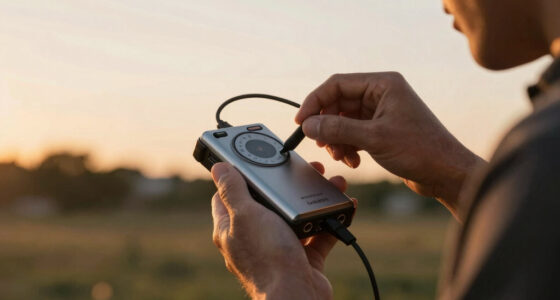
32-bit float portable audio recorder
As an affiliate, we earn on qualifying purchases.
As an affiliate, we earn on qualifying purchases.
How 32 Bit Float Makes Clipping Less of a Headache
Clipping occurs when the audio signal exceeds the maximum level the recording system can handle, defined as 0 dBFS in digital systems. In traditional fixed-point formats, once this threshold is crossed, the waveform gets ‘clipped,’ resulting in harsh distortion that cannot be undone. This is a critical limitation that forces careful gain staging and level monitoring during recording.
In contrast, 32-bit float recording employs a floating decimal point in its data representation, which effectively means the system can handle a vastly wider dynamic range. When a loud sound pushes the level over 0 dBFS, the data doesn’t clip in the destructive way it does with fixed-point formats. Instead, the signal is stored with an internal headroom that allows for the peaks to be ‘smoothed out’ mathematically during processing, preserving the original waveform’s integrity.
This means that even if a loud transient exceeds the nominal maximum, the recorded data remains intact and can be recovered or adjusted during editing. The implications are profound: you no longer need to obsessively set levels to avoid clipping, reducing stress and the risk of losing valuable audio information. However, it’s important to recognize that while digital clipping is less of an issue, analog overloads or preamp distortions still matter. The format’s safety net applies mainly to digital signals, not hardware limitations. This approach empowers you to capture dynamic, unpredictable sounds with confidence, knowing that the format itself provides a robust buffer against clipping artifacts.
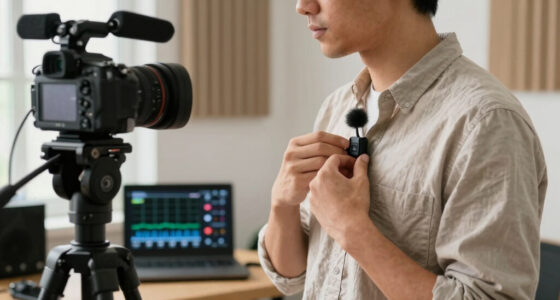
field recording device with high dynamic range
As an affiliate, we earn on qualifying purchases.
As an affiliate, we earn on qualifying purchases.
Comparison Table: Fixed-Point vs. 32 Bit Float
| Feature | Fixed-Point (e.g., 24-bit) | 32 Bit Float |
|---|---|---|
| Dynamic Range | Approx. 144 dB | Over 1500 dB |
| Clipping Damage | Permanent distortion if exceeded | Non-destructive; recoverable |
| Ideal Use Cases | Studio recording, where levels are controlled | Live, unpredictable sources, field recording |
| File Size | Smaller, more efficient | Larger, more data-heavy |
Having this clarity helps you decide whether 32-bit float is right for your setup or if sticking with traditional formats makes sense.
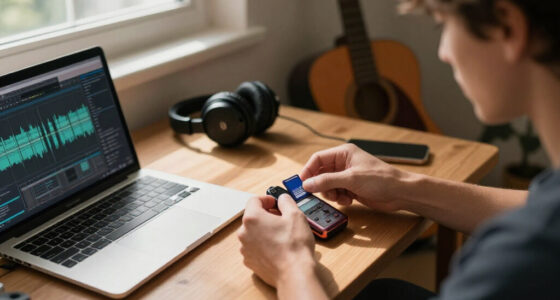
digital audio recorder for outdoor use
As an affiliate, we earn on qualifying purchases.
As an affiliate, we earn on qualifying purchases.
Practical Tips for Using 32 Bit Float in the Field
Here’s how to make the most of 32-bit float recording in real-world scenarios:
- Set levels high, but not too high. You want peaks to be loud enough that they’re captured well, but avoid maxing out your input gain.
- Use quality gear. Many portable recorders support 32-bit float natively. If yours does, you’re set.
- Don’t rely solely on the format. Good mic technique and gain staging still matter. Think of 32-bit float as a safety net, not a free pass.
- Check your files. Make sure your DAW or editing software supports 32-bit float. Many do now, but some older programs might not.
- Post-process with confidence. You can normalize, compress, or ride levels without worrying about clipping artifacts.
Real-world example: recording a live band outdoors. The drummer’s snare hits can spike past your known levels. With 32-bit float, you capture those peaks without distortion, then tame them during mixing.
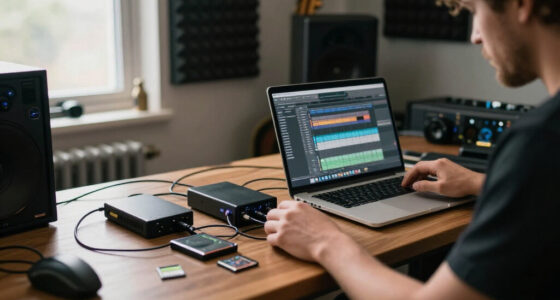
professional audio recording equipment
As an affiliate, we earn on qualifying purchases.
As an affiliate, we earn on qualifying purchases.
What You Still Need to Keep in Mind
Even with 32-bit float, some habits are worth holding onto. It’s not a free pass to ignore proper gain staging. Overloading your input can still cause issues during processing, especially with less flexible editing setups.
For example, if your input levels are so high that they clip in the analog domain before digitization, you might still get distortion that can’t be fixed later. Think of 32-bit float as a safety cushion, not a license to be sloppy.
Additionally, larger files demand more storage and processing power. If you’re working on a low-powered device or have limited storage, consider whether the benefits outweigh the costs for each project. While the format provides incredible flexibility, it’s essential to balance your workflow needs with the resources available to you.
Frequently Asked Questions
Can I record in 32-bit float on any portable recorder?
No, not every device supports 32-bit float natively. Check your recorder’s specs. Many advanced portable recorders now include this feature, but some cheaper or older models do not.Will recording in 32-bit float take up more storage space?
Yes, 32-bit float files are larger than 24-bit or 16-bit files. Expect roughly 25-50% bigger files, which means more storage and processing power needed.Is 32-bit float better than 24-bit for all recordings?
Not necessarily. It’s ideal for unpredictable, loud, or outdoor recordings but can be overkill for quiet, controlled studio work. Consider your needs before choosing.Can I convert 32-bit float recordings to standard formats without losing quality?
Yes, but converting to lower bit depths like 24 or 16 bits reduces headroom and dynamic range. Do it carefully during post-processing to preserve as much quality as possible.Does 32-bit float mean I don’t need to worry about levels at all?
While it reduces risk, proper gain staging still produces cleaner, better-sounding recordings. Use 32-bit float as a safety net, not a license to ignore good technique.Conclusion
Embracing 32-bit float opens up new possibilities for portable recording. You can focus more on capturing the moment and less on obsessing over perfect levels. Think of it as having a safety harness — not a free pass to jump without checking your gear, but a cushion if you fall.
Next time you hit record in the field, remember: loud isn’t the enemy anymore. With 32-bit float, your recordings can handle the wildest sounds without turning into digital noise.
Halloween Picks
halloween
As an affiliate, we earn on qualifying purchases.