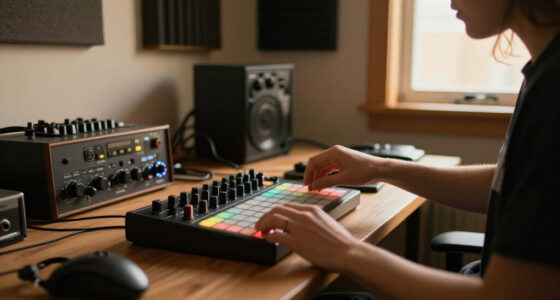
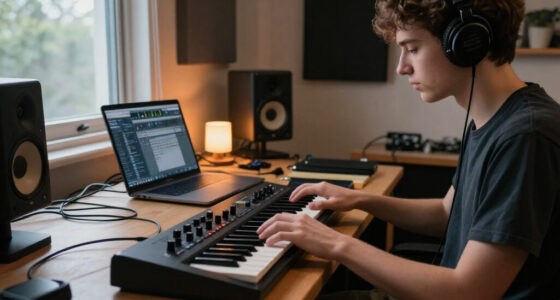
For compact powered studio subwoofers, I’d put the KRK S8.4 at the top for studio-focused control, while the PreSonus Eris Sub 8BT stands out for Bluetooth convenience and the Edifier T5s for a simpler, lower-output setup. The main tradeoff is between deeper, stronger bass and a cabinet that fits a small room without crowding your desk or overwhelming nearfield monitors. Inputs, crossover controls, and room placement can matter as much as driver size when you want bass that supports rather than masks a mix. This list also includes larger 10-inch options and compact everyday-use models, so the right pick depends on your room, workflow, and sound level. Read on for the full breakdown and a guide to choosing the best fit.

Get audio and creator gear delivered free with Prime
- Fast, free delivery on millions of items
- Prime Video, Amazon Music and more included
- Member-only deals all year
Complete the kit


Key Takeaways
- The KRK S8.4 is the strongest studio-oriented all-rounder in this lineup: it combines an 8-inch format with controls designed to integrate bass into a monitoring setup.
- The KRK S10.4 is the larger-room alternative: its 10-inch driver favors greater low-frequency presence, but demands more floor space and careful level matching.
- The PreSonus Eris Sub 8BT is the connectivity standout: Bluetooth adds convenience, though wireless playback is not a substitute for a dependable wired monitoring path.
- The Edifier T5s and Monoprice 60-Watt model suit modest setups: their lower-output positioning can make sense in small rooms, but they are less suited to demanding, high-level monitoring.
- Some listings are duplicate variants rather than different designs: the Audioengine S8 appears twice, as do the Edifier T5s in black and brown, so color should not be mistaken for a performance distinction.
| Audioengine S8 Powered 8-Inch Subwoofer, 250W, White |  | Best for Flexible Placement | Woofer diameter: 8 inches | Power output: 250 watts | Frequency response: 27 Hz | VIEW LATEST PRICE | See Our Full Breakdown |
| Rockville APM10D 10-Inch Powered Studio Subwoofer, Dark Wood |  | Best for Broad Studio Connectivity | Woofer diameter: 10 inches | Amplifier: Class D | Power: 200W RMS; 400W peak | VIEW LATEST PRICE | See Our Full Breakdown |
| Edifier T5s Powered Subwoofer, 70W RMS, 8-Inch Woofer, Black |  | Best Value for Straightforward RCA Setups | Woofer diameter: 8 inches | Amplifier output: 70W RMS | Frequency response: 35 Hz | VIEW LATEST PRICE | See Our Full Breakdown |
| PreSonus Eris Sub 8BT 8-Inch Bluetooth Studio Subwoofer, Black |  | Best for Bluetooth and Mixed Sources | Driver size: 8 inches | Frequency response: Down to 30 Hz | Bluetooth: Bluetooth 5.0 | VIEW LATEST PRICE | See Our Full Breakdown |
| KRK S8.4 Generation 4 8-Inch Powered Studio Subwoofer |  | Best for Focused Studio Monitoring | Woofer diameter: 8 inches | Woofer material: Glass aramid composite | Amplifier: Class D | VIEW LATEST PRICE | See Our Full Breakdown |
| KRK S10.4 Generation 4 10-Inch Powered Studio Subwoofer |  | Best for Larger Studio Monitors | Woofer: 10-inch glass-aramid composite | Amplifier: Class D | Power: 160 watts | VIEW LATEST PRICE | See Our Full Breakdown |
| Monoprice 60-Watt Powered 8-Inch Subwoofer | 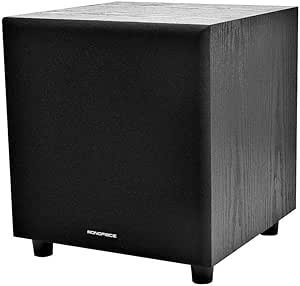 | Best for Mixed Stereo and Surround Setups | Driver: 8 inches | Power output: 60 watts RMS | Frequency response: 50–250 Hz | VIEW LATEST PRICE | See Our Full Breakdown |
| Ortizan V8 Compact 60W Active Subwoofer, White |  | Best for Compact Desktop Setups | Woofer: 5.24-inch long-throw | Maximum output power: 60 watts | Amplifier: Class D | VIEW LATEST PRICE | See Our Full Breakdown |
| Audioengine S8 250W Powered 8-Inch Subwoofer |  | Best for High-Output Compact Bass | Woofer: 8 inches | Power output: 250 watts | Frequency response: 27 Hz | VIEW LATEST PRICE | See Our Full Breakdown |
| Edifier T5s Powered Subwoofer, 70W RMS, 8-Inch Woofer, Brown |  | Best for Simple Wired Speaker Matching | Woofer: 8 inches | Power output: 70W RMS | Frequency response: Down to 35 Hz | VIEW LATEST PRICE | See Our Full Breakdown |
| compact powered studio subwoofer | Frequency response | Warranty | Connectivity |
|---|---|---|---|
| Audioengine S8 Powered 8-Inch | 27 Hz | 3 years | — |
| Rockville APM10D 10-Inch Power | 150 Hz (as listed) | 1 year | — |
| Edifier T5s Powered Subwoofer | 35 Hz | 2 years | Wired RCA |
| PreSonus Eris Sub 8BT 8-Inch B | Down to 30 Hz | — | — |
| KRK S8.4 Generation 4 8-Inch P | — | — | XLR |
| KRK S10.4 Generation 4 10-Inch | — | — | Wired TRS and XLR |
| Monoprice 60-Watt Powered 8-In | 50–250 Hz | — | — |
| Ortizan V8 Compact 60W Active | — | 2 years | Bluetooth and RCA |
| Audioengine S8 250W Powered 8- | 27 Hz | 3 years | Wired RCA |
| Edifier T5s Powered Subwoofer | Down to 35 Hz | — | — |
More Details on Our Top Picks
Audioengine S8 Powered 8-Inch Subwoofer, 250W, White
I’d choose the Audioengine S8 when a compact sub needs to support more than a fixed studio setup. Its 250-watt output and stated 27 Hz response give it a deeper-bass brief than the Edifier T5s, whose response is listed at 35 Hz. The down-firing design can also make placement easier when a front-facing driver is inconvenient, and compatibility with the optional Audioengine W3 kit allows wireless placement. Those conveniences come with a tradeoff: the supplied connection details are less studio-specific than the Rockville APM10D’s XLR and TRS options. I’d also verify the 27 Hz figure against the manufacturer’s full specifications before choosing it for critical low-frequency monitoring. Its sleep mode suits a system that sits idle between sessions, but this remains a corded subwoofer.
Pros:- 250-watt powered output in an 8-inch format
- Down-firing design offers an alternative to front-facing placement
- Compatible with the Audioengine W3 wireless subwoofer kit
- Sleep mode reduces power use when idle
Cons:- The listed 27 Hz response lacks further measurement details in the supplied specifications
- Studio connection types are not specified in the supplied product data
- Requires corded electric power
Best for: Producers or desktop listeners who want an 8-inch sub with substantial stated power and the option of wireless placement using the compatible W3 kit.
Not ideal for: Studio users who need clearly specified balanced XLR or TRS integration, or buyers who require a subwoofer that operates without mains power.
- Woofer diameter:8 inches
- Power output:250 watts
- Frequency response:27 Hz
- Enclosure material:Metal
- Audio output mode:Mono
- Power source:Corded electric
- Wireless option:Compatible with Audioengine W3 kit
- Warranty:3 years
Our verdict“Choose the S8 if flexible placement and high stated output matter more than documented balanced studio connections.”
Rockville APM10D 10-Inch Powered Studio Subwoofer, Dark Wood
The Rockville APM10D is the connectivity-first choice here: its XLR, ¼-inch TRS, and RCA connections make it easier to fit into varied studio signal chains than the RCA-only Edifier T5s. The 10-inch driver and 200W RMS Class D amplifier also give it a larger-output approach than the smaller 8-inch KRK S8.4. Rear volume, crossover, phase, and treble controls let you shape the match to your monitors, while the front-firing port suits setups where rear clearance is limited. The main caveat is the supplied frequency-response figure: it lists 150 Hz without a lower extension, so it does not establish how far down the bass reaches. Its larger cabinet is also less compact than the 8-inch options.
Pros:- XLR, ¼-inch TRS, and RCA connections suit a range of studio gear
- 200W RMS Class D amplifier with 400W peak rating
- Crossover, phase, volume, and treble controls support system adjustment
- Front-firing port can simplify placement near a rear wall
Cons:- Listed frequency response of 150 Hz does not specify low-bass extension
- 10-inch format is less compact than the 8-inch models in this roundup
- One-year warranty is shorter than the Audioengine S8’s three-year coverage
Best for: Home-studio owners with XLR or TRS monitor connections who want a 10-inch sub and hands-on rear-panel tuning controls.
Not ideal for: Buyers prioritizing a small footprint or a clearly documented low-frequency extension, since the supplied response figure gives no lower limit.
- Woofer diameter:10 inches
- Amplifier:Class D
- Power:200W RMS; 400W peak
- Frequency response:150 Hz (as listed)
- Crossover frequency:50–150 Hz
- Inputs and outputs:RCA, XLR, ¼-inch TRS
- Enclosure material:MDF wood
- Warranty:1 year
Our verdict“Pick the APM10D if your priority is flexible studio connectivity and a 10-inch driver, not the smallest cabinet or a well-documented bass floor.”
Edifier T5s Powered Subwoofer, 70W RMS, 8-Inch Woofer, Black
The Edifier T5s makes a practical case for a compact, uncomplicated system: its 70W RMS amplifier is built in, and the adjustable low-pass filter and phase selector give you basic tools to blend bass with your speakers. Its stated 35 Hz response is a useful point of comparison with the KRK S8.4 and PreSonus Eris Sub 8BT, both listed to reach 30 Hz. RCA input and output keep hookup simple, but they limit flexibility beside the Rockville APM10D’s balanced XLR and TRS connections. The 18mm MDF cabinet, auto-standby, and included cables help make setup approachable. Still, the supplied guidance says systems without a subwoofer output need main speakers with a line input, so it will not suit every speaker arrangement.
Pros:- Built-in 70W RMS Class D amplifier needs no external receiver
- Adjustable low-pass filter and 0°/180° phase selector aid speaker matching
- MDF cabinet with front-firing driver and side-firing port
- Auto-standby and included RCA and 3.5mm-to-RCA cables simplify setup
Cons:- RCA-only connectivity offers fewer studio connection options than the Rockville APM10D
- 35 Hz stated response is not as low as the 30 Hz figures for the KRK and PreSonus
- Some speaker setups require a line input on the main speakers
Best for: First-time subwoofer buyers with RCA-equipped speakers or a dedicated sub output who want basic crossover and phase adjustment.
Not ideal for: Studio owners who rely on balanced XLR or TRS connections, need wireless audio, or want the deeper stated extension of the 30 Hz models.
- Woofer diameter:8 inches
- Amplifier output:70W RMS
- Frequency response:35 Hz
- Low-pass filter:30–160 Hz
- Phase selector:0°/180°
- Connectivity:Wired RCA
- Cabinet material:18mm MDF
- Auto-standby:After 15 minutes of inactivity
- Warranty:2 years
Our verdict“The T5s suits RCA-based desktop or home studios seeking adjustable bass without the connection range or deeper stated reach of higher-spec alternatives.”
PreSonus Eris Sub 8BT 8-Inch Bluetooth Studio Subwoofer, Black
For a studio desk that also serves as a casual listening station, I’d favor the PreSonus Eris Sub 8BT. Its Bluetooth 5.0 sits alongside balanced TRS, RCA, and auxiliary inputs, giving it more source options than the RCA-only Edifier T5s. The stated extension to 30 Hz also reaches lower than the Edifier’s 35 Hz figure, while crossover and tuning controls help adapt the sub to monitors and room placement. A front-panel headphone output with a built-in amplifier is a useful desk-side extra that the KRK S8.4 listing does not provide. The compromise is that it is not the most compact 8-inch cabinet in this group, and Bluetooth is listed with a 10-meter range. Its plastic-and-metal enclosure may also be a less appealing fit for buyers seeking a wood cabinet.
Pros:- Bluetooth 5.0 plus balanced TRS, RCA, and auxiliary inputs
- Stated bass extension reaches 30 Hz
- Crossover and tuning controls support monitor and room matching
- Front-panel headphone output includes a built-in amplifier
Cons:- Bluetooth range is listed as 10 meters
- Plastic-and-metal enclosure may not suit buyers seeking a wood cabinet
- At 9.8 × 12.7 × 11.7 inches, it takes more desk or floor space than a very small sub
Best for: Desktop producers and listeners who switch between wired monitors, auxiliary devices, and Bluetooth sources, and want headphone access at the sub.
Not ideal for: Buyers who need a very small enclosure, prefer a wood cabinet, or depend on Bluetooth beyond the listed 10-meter range.
- Driver size:8 inches
- Frequency response:Down to 30 Hz
- Bluetooth:Bluetooth 5.0
- Inputs:¼-inch TRS balanced, RCA unbalanced, ⅛-inch TRS stereo aux
- Headphone output:Front-panel output with built-in amplifier
- Dimensions:9.8 × 12.7 × 11.7 inches
- Weight:8000 g
- Power-saving mode:Activates after 40 minutes idle
Our verdict“Choose the Eris Sub 8BT if you want one compact studio sub to handle balanced monitors, auxiliary sources, Bluetooth, and headphone listening.”
KRK S8.4 Generation 4 8-Inch Powered Studio Subwoofer
The KRK S8.4 is the monitoring-focused pick for buyers who value defined bass and a direct way to check mixes without the sub. Its four-position crossover helps match different monitors, and the footswitch bypass lets a producer compare a mix with and without low-frequency reinforcement from the listening position. That workflow is more studio-specific than the PreSonus Eris Sub 8BT’s Bluetooth and headphone conveniences. The glass-aramid composite woofer, Class D amplifier, and stated 30 Hz extension put it on serious monitoring terms for an 8-inch model. But the maximum output is listed at 109 watts, far below the Audioengine S8’s 250-watt rating, and the footswitch is not included. XLR connectivity is also less varied than the Rockville APM10D’s XLR, TRS, and RCA set.
Pros:- Glass-aramid composite 8-inch woofer
- Four-position crossover supports monitor matching
- Footswitch bypass enables quick comparison with and without sub bass
- Stated bass extension reaches 30 Hz
Cons:- Maximum output is listed as 109 watts, below the Audioengine S8’s 250-watt rating
- Footswitch required for bypass control is not included
- XLR connectivity is less varied than the Rockville APM10D’s inputs
Best for: Mixers with XLR-based studio monitors who want selectable crossover settings and footswitch-controlled bass bypass for checking low-end balance.
Not ideal for: Buyers who want Bluetooth, multiple input types, higher stated amplifier power, or a footswitch included in the box.
- Woofer diameter:8 inches
- Woofer material:Glass aramid composite
- Amplifier:Class D
- Maximum output power:109 watts
- Bass extension:30 Hz
- Maximum SPL:112 dB
- Crossover:Four-position selectable
- Connectivity:XLR
- Dimensions and weight:16.12 × 11.5 × 11 inches; 26.5 pounds
Our verdict“The S8.4 is a strong fit for focused mix monitoring if you value crossover choice and bypass control over broad connectivity or extra output.”
KRK S10.4 Generation 4 10-Inch Powered Studio Subwoofer
The KRK S10.4 is the studio-focused choice here for buyers who need more headroom and bass reach than a small desktop sub can provide. Its 10-inch glass-aramid woofer, 160-watt Class D amplifier, and stated 28 Hz extension suit monitoring setups where low-frequency detail matters; the four-position crossover helps match it to different monitor systems. Compared with the KRK S8.4, this larger model is the better fit for rooms and monitors that can make use of added output, but it also takes more space. The front-firing port allows more placement flexibility than a down-firing design, while TRS and XLR connections are a stronger match for studio gear than the Monoprice 8-inch subwoofer’s home-system inputs. The tradeoffs are wired-only connectivity and a footswitch for bypass that is sold separately.
Pros:- 10-inch glass-aramid woofer and 160-watt Class D amplification are suited to controlled, higher-output studio playback.
- Four-position crossover supports integration with a range of monitor systems.
- TRS and XLR connections suit common studio signal chains.
- Front-firing port offers flexible placement compared with down-firing designs.
Cons:- Larger 10-inch format takes more space than the KRK S8.4 or compact desktop options.
- Footswitch control requires a separately purchased footswitch.
- Wired connectivity only; no wireless playback support.
Best for: Producers with larger nearfield monitors who want a studio-oriented sub with balanced TRS or XLR connections and adjustable crossover matching.
Not ideal for: Desktop users with limited floor space, or anyone seeking wireless playback or footswitch control without buying an extra accessory.
- Woofer:10-inch glass-aramid composite
- Amplifier:Class D
- Power:160 watts
- Bass extension:28 Hz
- Maximum SPL:117 dB
- Crossover:Four-position selectable
- Connectivity:Wired TRS and XLR
- Port:Front-firing
Our verdict“Choose the KRK S10.4 if your studio needs more output and bass extension than a compact 8-inch monitor sub can provide.”
Monoprice 60-Watt Powered 8-Inch Subwoofer
The Monoprice 8-inch subwoofer earns its place for buyers whose system may include a stereo amplifier or surround receiver rather than a dedicated studio-monitor chain. Its high-level and left/right line-level inputs give it broader connection options than the KRK S10.4, whose TRS and XLR connections target studio equipment. Adjustable gain and crossover controls help tune the handoff to the main speakers, and impedance-matching circuitry is designed to avoid changing the amplifier’s load. That flexibility comes with a clear limit for studio bass work: its stated response starts at 50 Hz, well above the KRK’s 28 Hz extension and the Audioengine S8’s 27 Hz figure. The 60-watt output and floor-standing cabinet make this a practical add-on for modest systems, not the strongest pick for checking deep low-frequency content in a mix.
Pros:- High-level and left/right line-level inputs accommodate a range of stereo and surround systems.
- Adjustable crossover and gain help match the subwoofer to connected speakers.
- Impedance-matching circuitry is designed to avoid changing the amplifier’s load.
- Wood cabinet with a front-facing driver and sound port.
Cons:- 50 Hz lower frequency limit leaves the deepest bass outside its stated response.
- 60-watt output is modest beside the 160-watt KRK S10.4 and 250-watt Audioengine S8.
- Floor-standing cabinet is less suited to tight desktop setups.
Best for: Home-studio owners using a stereo amplifier or surround receiver who need high-level inputs and straightforward crossover and gain adjustment.
Not ideal for: Mix engineers who need to monitor deep sub-bass, since the stated lower response limit is 50 Hz.
- Driver:8 inches
- Power output:60 watts RMS
- Frequency response:50–250 Hz
- Adjustable crossover:50–150 Hz
- Inputs:High-level and left/right line-level
- Enclosure:Wood
- Dimensions:13.75 × 11.75 × 11.75 inches
- Mounting:Floor standing
Our verdict“Pick the Monoprice if connection flexibility for a stereo or surround system matters more than reproducing the lowest studio frequencies.”
Ortizan V8 Compact 60W Active Subwoofer, White
For a crowded desk or shelf, the Ortizan V8 is the smallest-footprint choice in this group: its 5.24-inch long-throw woofer sits in a cabinet measuring 10.91 × 8.46 × 8.46 inches and weighing 8.4 pounds. That makes it easier to place near a desktop system than the larger KRK S10.4 or floor-standing Monoprice, though it cannot offer the same studio-specific crossover setup or the KRK’s stated 28 Hz bass extension. The V8 pairs a Class D amplifier rated up to 60 watts with Bluetooth and RCA connectivity, giving it broader source options than wired-only studio subs. Its published frequency-response entry, “20 KHz,” does not specify a low-frequency limit, so I would not rely on that figure to judge sub-bass reach. It is a compact add-on, not a clearly specified reference tool for critical low-end decisions.
Pros:- Small, lightweight cabinet suits desktop and shelf placement.
- 5.24-inch long-throw woofer is paired with a Class D amplifier rated up to 60 watts.
- Bluetooth and RCA connectivity offer more source flexibility than wired-only options.
- Includes vibration pads for placement on a desk or shelf.
Cons:- Published frequency-response entry does not provide a usable low-frequency limit for judging sub-bass reach.
- Mono output and limited studio integration details make it less suited to reference monitoring than the KRK S10.4.
- Not waterproof.
Best for: Desktop producers and gamers with limited space who want a small active subwoofer that accepts Bluetooth or RCA sources.
Not ideal for: Mixers who need clearly specified deep-bass response, balanced studio connections, or detailed crossover matching with monitor speakers.
- Woofer:5.24-inch long-throw
- Maximum output power:60 watts
- Amplifier:Class D
- Connectivity:Bluetooth and RCA
- Audio output mode:Mono
- Dimensions:10.91 × 8.46 × 8.46 inches
- Weight:8.4 pounds
- Warranty:2 years
Our verdict“Choose the Ortizan V8 when desktop size and Bluetooth matter more than precise, well-documented studio bass performance.”
Audioengine S8 250W Powered 8-Inch Subwoofer
The Audioengine S8 combines an 8-inch driver with a stated 250 watts of output and bass response to 27 Hz, making it the high-output alternative to the smaller, lower-powered Edifier T5s. That extra output and low-frequency reach can suit a compact room where a subwoofer needs to support music, gaming, or home theater as well as studio playback. Its down-firing design can simplify placement when a front-facing driver is awkward, though it offers less direct visibility of the driver than the KRK S10.4’s front-firing arrangement. The S8 uses RCA rather than the balanced TRS/XLR connections found on the KRK, so it is a less natural fit for some professional monitor chains. RCA is wired by default; wireless operation requires the separate Audioengine W3 adapter kit. Sleep mode is useful for an always-connected setup, but this is more of a versatile audio sub than a studio-first integration choice.
Pros:- 250-watt output and stated 27 Hz response offer more headroom and bass reach than the Edifier T5s.
- 8-inch format keeps it more compact than the KRK S10.4.
- Down-firing design can make placement easier in some rooms.
- Sleep mode powers the unit down when it is not in use.
Cons:- RCA connection is less suited to balanced studio signal chains than the KRK S10.4’s TRS and XLR inputs.
- Wireless use requires the separate Audioengine W3 adapter kit.
- Mono output and home-audio emphasis may not suit buyers seeking studio-specific integration controls.
Best for: Small-room creators who want substantial bass output for both studio playback and home entertainment, and whose system uses RCA connections.
Not ideal for: Studio owners who need balanced TRS or XLR connections, or buyers expecting wireless operation without an additional adapter.
- Woofer:8 inches
- Power output:250 watts
- Frequency response:27 Hz
- Design:Down-firing
- Connectivity:Wired RCA
- Wireless compatibility:Audioengine W3 adapter kit
- Signal-to-noise ratio:95 dB
- Warranty:3 years
Our verdict“Choose the Audioengine S8 if you want strong compact bass for mixed studio and home use and your setup can connect over RCA.”
Edifier T5s Powered Subwoofer, 70W RMS, 8-Inch Woofer, Brown
The Edifier T5s takes a restrained, straightforward approach: an 8-inch woofer, 70 watts RMS, and a low-pass filter adjustable from 30 to 160 Hz. A 0°/180° phase selector adds a practical way to address bass cancellation when the sub and speakers are positioned differently. Compared with the Audioengine S8, the T5s has much less stated power and reaches down to 35 Hz rather than 27 Hz, but its filter and phase controls make speaker matching more explicit. The 18 mm MDF cabinet and auto-standby suit a fixed home or desktop audio setup, while the brown finish may fit buyers who prefer furniture-style gear. Its connections are wired RCA, and system integration can be restrictive if the main speakers lack a line-in when no subwoofer output is available. This is a sensible match for compatible speakers, not a flexible wireless hub.
Pros:- Adjustable 30–160 Hz low-pass filter supports speaker matching.
- 0°/180° phase selector helps address placement-related bass cancellation.
- 18 mm MDF cabinet is designed to reduce resonance.
- Auto-standby activates after 15 minutes of inactivity.
Cons:- 35 Hz bass response and 70-watt RMS output are more modest than the Audioengine S8’s stated reach and power.
- RCA-only connections exclude Bluetooth, USB, and optical sources.
- Connection setup can be restrictive when the main speakers lack a line-in and the source lacks a subwoofer output.
Best for: Home-studio owners with RCA-compatible speakers who want adjustable crossover and phase controls in a compact, conventional wired setup.
Not ideal for: Users whose main speakers lack line-in and whose source has no subwoofer output, or buyers seeking Bluetooth, USB, or optical connections.
- Woofer:8 inches
- Power output:70W RMS
- Frequency response:Down to 35 Hz
- Low-pass filter:30–160 Hz
- Phase selector:0°/180°
- Cabinet:18 mm MDF
- Connections:RCA signal in/out
- Auto-standby:After 15 minutes of inactivity
Our verdict“Pick the Edifier T5s if your RCA-based speakers are compatible and you value crossover and phase adjustment over high output or wireless features.”
How We Picked
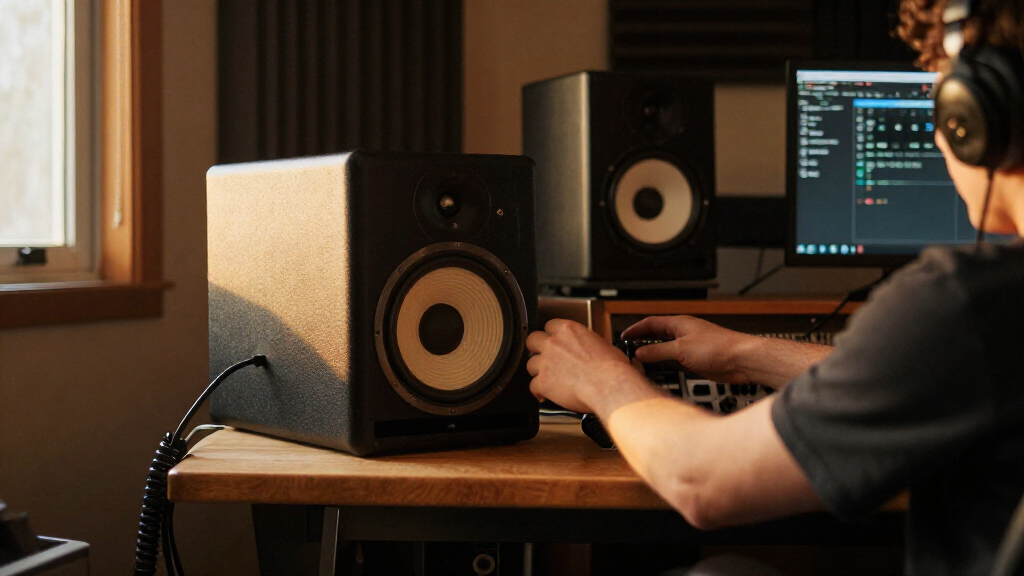
I ranked these compact powered studio subwoofers by how well their size, output, controls, and connections suit a nearfield monitoring setup. I gave more weight to studio-use features and practical integration than to driver size alone: a subwoofer that can be matched to the monitors and room is more useful than one that only produces more bass. I also considered whether the stated power and form factor appear appropriate for small-room listening, and how readily each model could fit into a desktop or compact studio arrangement.
The ranking separates studio-focused choices from models that lean toward everyday listening, simple setups, or greater output. That is why the KRK models lead for monitoring-oriented use, while the Eris Sub 8BT earns distinction for connectivity and the lower-output options fit more modest needs. Product names and finishes reveal that some entries are repeated models in different colors; those do not receive separate performance credit. Where the supplied product details do not establish a feature or capability, I avoid treating it as a proven advantage.
| compact powered studio subwoofer | Connectivity |
|---|---|
| Audioengine S8 Powered 8-Inch | — |
| Rockville APM10D 10-Inch Power | — |
| Edifier T5s Powered Subwoofer | Wired RCA |
| PreSonus Eris Sub 8BT 8-Inch B | — |
| KRK S8.4 Generation 4 8-Inch P | XLR |
| KRK S10.4 Generation 4 10-Inch | Wired TRS and XLR |
| Monoprice 60-Watt Powered 8-In | — |
| Ortizan V8 Compact 60W Active | Bluetooth and RCA |
| Audioengine S8 250W Powered 8- | Wired RCA |
| Edifier T5s Powered Subwoofer | — |
Factors to Consider When Choosing Compact Powered Studio Subwoofers
Choosing a compact subwoofer is less about buying the biggest driver that fits and more about getting a controlled bass extension that works with your monitors, room, and workflow. I’d settle the system and placement questions before comparing headline wattage.
Match the Subwoofer to Your Monitors and Room
A subwoofer that is too powerful for small nearfield monitors can dominate the listening position, while an undersized model may add little useful extension. Think about listening distance, room volume, and the monitors’ low-frequency reach as a system rather than judging the subwoofer alone. Small untreated rooms can exaggerate bass at particular spots, so more output may make accuracy harder rather than better. Leave room to adjust level and crossover after installation; the first setting is rarely the final one. If you mainly work at low listening levels in a compact room, a restrained 8-inch model may be easier to integrate than a 10-inch cabinet.
Treat Crossover and Level Controls as Mixing Tools
The crossover determines which low frequencies go to the subwoofer and which remain with the main monitors, while level matching keeps bass from becoming a misleading reference. A common mistake is to set the sub by how exciting it sounds instead of whether it blends with the monitors. Check what controls and routing the specific model provides before assuming it can manage your speaker signal in the way your setup needs. Make small changes and listen to familiar material across different genres. For critical work, confirm bass decisions on headphones or another playback system as well.
Choose Connections for Your Actual Signal Path
List the outputs on your interface, mixer, or monitor controller before buying, then compare them with the subwoofer’s inputs and outputs. Extra wireless convenience can be useful for casual playback, but a stable wired connection is generally the straightforward choice for a studio monitoring chain. Avoid assuming that Bluetooth support means the sub can sit neatly between your interface and monitors; verify the available connections and signal routing. If you switch often between production and general listening, flexible connectivity may justify a compromise elsewhere. For a fixed desk setup, simple compatible cabling can be more valuable than extra features you will rarely use.
Plan for Placement, Not Just Cabinet Dimensions
A compact cabinet still needs a sensible position, access to its controls, and enough breathing room around it. Low frequencies interact with walls and corners, so placing a subwoofer wherever it fits can create uneven bass at the chair. Leave space to test more than one location before committing to a permanent setup. A position near the desk may be convenient, but it is not automatically the most accurate listening spot. Measure the cabinet and cable reach together, and remember that a heavier or larger 10-inch model can be less convenient to move during placement tests.
Pay for the Features That Improve Your Workflow
Spending more makes sense when it buys useful studio controls, better system integration, or output suited to a larger room—not simply a bigger number on a specification sheet. If you mix bass-heavy material or need stronger low-frequency playback, a larger model may be worth the added footprint. For occasional editing in a small room, a simpler 8-inch option may cover the need without adding excess output. Check whether a claimed feature solves a real problem in your setup, such as accommodating your signal chain or making level adjustment easier. Also account for the cost of stands, cables, and room treatment if those are needed to make the system perform well.
Frequently Asked Questions
Is an 8-inch subwoofer enough for a small studio?
For many small nearfield rooms, an 8-inch subwoofer can add useful low-frequency extension without taking up the space of a larger cabinet. Whether it is enough depends on your monitors, listening level, and the kind of material you produce. A larger driver does not automatically give you more accurate bass, especially in a room with strong low-frequency peaks. Compare the subwoofer’s controls and connections with your existing monitor chain before choosing by size alone. The KRK S8.4 and the lower-output 8-inch options in this roundup serve different needs, so room fit and intended volume should guide the choice.
Should I choose the KRK S10.4 over an 8-inch model?
The S10.4 makes more sense when you want stronger low-frequency presence and have the room and placement flexibility for a larger cabinet. It is not automatically the better studio choice: in a compact untreated room, its added output may make bass harder to judge consistently. An 8-inch model is usually easier to accommodate on a modest setup and may be simpler to blend with smaller monitors. Consider how loud you work and whether your material depends on very low bass before moving up in size. If you cannot position and level-match the larger sub carefully, its extra capacity may not help your mixes.
Can I use Bluetooth for studio monitoring?
Bluetooth can be handy for casual playback or quick listening, but I would not make it the core connection in a critical monitoring chain. Wireless playback can add delay or other signal-path differences that complicate editing and timing-sensitive work. For production decisions, check that your wired interface or monitor-controller connection works with the subwoofer and your speakers. The Eris Sub 8BT’s Bluetooth support is best viewed as an extra convenience rather than a reason to skip checking its wired integration. If you mostly produce, prioritize a dependable wired signal path first.
Are the two Audioengine S8 listings different subwoofers?
The supplied listings describe the Audioengine S8 as an 8-inch, 250-watt powered subwoofer in both cases, so the names do not establish a performance difference. Before buying, compare the exact model number, finish, included accessories, and seller listing details. The same caution applies to the black and brown Edifier T5s entries: the finish changes, but the stated core specifications are the same. I would treat repeated color variants as one design when comparing performance. Choose between them based on availability, finish, and verified package details rather than assuming one color sounds different.
Do I need a studio subwoofer if my monitors already have strong bass?
Not necessarily. A subwoofer can help you hear low-frequency content that your monitors do not reproduce clearly, but it also adds another speaker that needs setup and level matching. If your monitors already cover the range you work in and you can check the lowest bass on another playback system, a sub may bring more complexity than benefit. It is more compelling for bass-heavy production or for identifying low-end problems that smaller monitors conceal. Start by checking your monitors’ actual low-frequency performance and your room behavior rather than buying a subwoofer by default.
Conclusion
My best overall pick is the KRK S8.4 for buyers who want a compact, studio-oriented subwoofer with a clear monitoring role. For best value, I’d look at the Edifier T5s or Monoprice 60-Watt model when the room and listening levels are modest; neither is the right choice for demanding high-output work. The best premium choice is the KRK S10.4 for listeners who need more low-frequency presence and can accommodate its larger cabinet. For beginners, the Eris Sub 8BT offers a flexible starting point, especially if Bluetooth is useful for noncritical playback, while its wired setup should still serve studio work. For specific needs, choose the Audioengine S8 if its stated 250-watt, 8-inch format suits your system, and treat the duplicate Audioengine and Edifier color listings as finish variants rather than separate upgrades. Match the sub to your monitors and room before choosing by wattage or driver size.