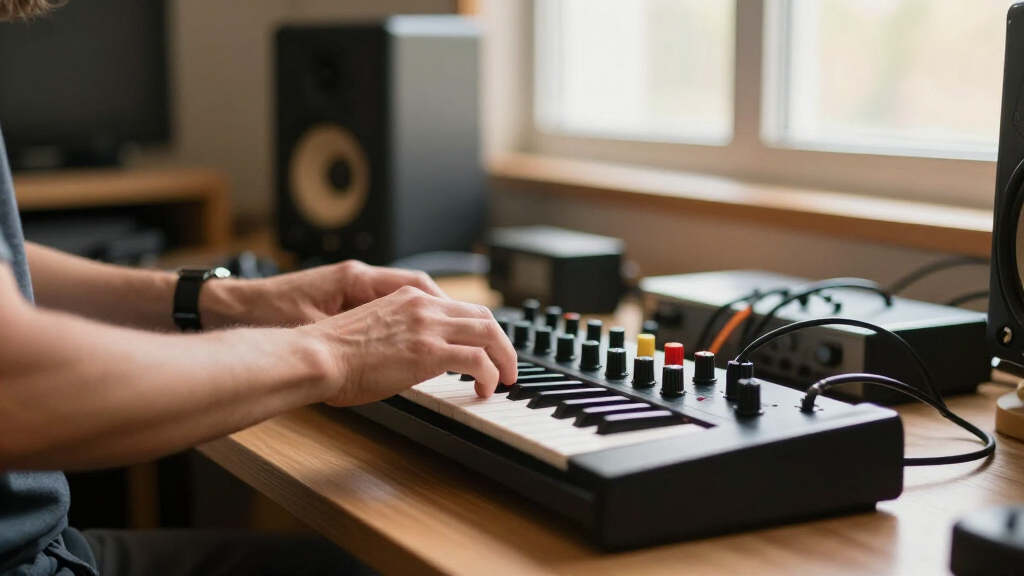
For a versatile desktop synthesizer, I’d start with the Roland SH-4d: its multiple synth engines and self-contained workflow suit varied studio needs. The Korg Minilogue xd Module is a strong pick for hands-on polyphonic analog sounds, while the ASM Hydrasynth Desktop gives sound designers a broader digital palette. The main choice is between focused analog character, flexible digital sound design, and the immediacy of a compact instrument with built-in sequencing. I also weigh patching, keyboard needs, and whether a synth can cover more than one role in a setup. Read on for how all 14 options compare and which tradeoffs matter for your setup.

Get audio and creator gear delivered free — and shop member deals
- Fast, free delivery on millions of items
- Access to Prime Big Deal Days deals on October 6–7
- Prime Video, Amazon Music and more included
Complete the kit


Key Takeaways
- The SH-4d is the most flexible all-rounder here, while the Minilogue xd Module offers a more direct route to hands-on analog polyphony.
- The Hydrasynth Desktop and Leviasynth favor deep digital sound design; their range suits players willing to spend time shaping patches.
- Mavis, Crave, Subharmonicon, and Labyrinth reward patching, but their semi-modular workflows make them less straightforward as general-purpose polyphonic synths.
- Minitaur is a specialist bass choice, so buyers seeking chords or broad sound coverage should look elsewhere in this lineup.
- Several listings name keyboard models rather than desktop modules, including the Korg wavestate 37-key; check the exact version and footprint before buying.
| MOOG Mavis Semi-Modular Analog Synthesizer |  | Best for Hands-On Modular Exploration | Model number: MOD-WK-MAVIS-U | Synthesis: Semi-modular analog | Oscillator and filter: Moog oscillator and filter circuits | VIEW LATEST PRICE | See Our Full Breakdown |
| Roland SH-4d Compact Desktop Synthesizer |  | Best Overall for Versatile Desktop Production | Model: SH-4d | Sound engine: 11 oscillator models | Parts: 4 independent parts | VIEW LATEST PRICE | See Our Full Breakdown |
| Moog Subharmonicon Semi-Modular Analog Polyrhythmic Synthesizer |  | Best for Experimental Polyrhythms | Model: MOD-SUBH | Type: Semi-modular analog tabletop synthesizer | Oscillators: 2 VCOs with 2 subharmonic generators each | VIEW LATEST PRICE | See Our Full Breakdown |
| Korg Minilogue xd Module Polyphonic Analog Synth with 16-Step Sequencer |  | Best for Polyphonic Analog Desktop Playing | Model: MINILOGUE XD | Format: Desktop synthesizer module | Voice modes: Poly, unison, chord, arpeggiator/latch | VIEW LATEST PRICE | See Our Full Breakdown |
| Moog Minitaur Analog Bass Synthesizer |  | Best Compact Bass Specialist | Model: Minitaur (TBP-002) | Synthesis: Analog, monophonic | Oscillators: 2 voltage-controlled oscillators | VIEW LATEST PRICE | See Our Full Breakdown |
| Behringer PHARA-O MINI Mini Synthesizer for Compact Sound Design |  | Best Compact Pick | Brand: Behringer | Model: PHARA-O MINI | Model number: 0722-AAU | VIEW LATEST PRICE | See Our Full Breakdown |
| Korg WaveState Wave Sequencing Synthesizer 37-Key with 64 Stereo Voices |  | Best for Sequenced Sound Design | Brand: Korg | Model: WaveState | Keys: 37 full-size keys | VIEW LATEST PRICE | See Our Full Breakdown |
| ASM Leviasynth Desktop Synthesizer |  | Best for Advanced Hybrid Synthesis | Voices: 16 | Oscillators per voice: 8 | Waveforms: More than 300 | VIEW LATEST PRICE | See Our Full Breakdown |
| ASM Hydrasynth Desktop Synthesizer |  | Best for Hands-On Desktop Performance | Model: HSDR | Synthesis: Wavetable | Oscillators: 3 | VIEW LATEST PRICE | See Our Full Breakdown |
| Behringer UB-Xa 16-Voice Multi-Timbral Polyphonic Desktop Analog Synthesizer |  | Best for Vintage Polyphonic Tones | Model: UB-Xa | Polyphony: 16 voices | Oscillators: 32 | VIEW LATEST PRICE | See Our Full Breakdown |
| Waldorf Protein 8 Voice Wavetable Synthesizer with MPE and USB-C |  | Best for Expressive Digital Textures | Voices: 8 | Layers: 4 | Sound engine: Wavetable | VIEW LATEST PRICE | See Our Full Breakdown |
| Sequential Take 5 Polyphonic Desktop Synthesizer Module |  | Best for Compact Analog Polyphony | Voices: 5 | Oscillators: 2 VCOs | Filter: Resonant 4-pole low-pass | VIEW LATEST PRICE | See Our Full Breakdown |
| Behringer CRAVE Analog Semi-Modular Synthesizer with 3340 VCO, Classic Ladder Filter, 32-Step Sequencer, and 16-Voice Poly Chain |  | Best for Budget-Friendly Semi-Modular Patching | Oscillator: 3340 VCO | Filter: Classic ladder filter | Sequencer: 32-step | VIEW LATEST PRICE | See Our Full Breakdown |
| Moog Labyrinth Semi-Modular Analog Synthesizer |  | Best for Generative Sound Exploration | Synthesis: Parallel generative synth | Sequencers: Dual | Oscillators: Dual | VIEW LATEST PRICE | See Our Full Breakdown |
| desktop synthesizer | Weight | Model | Dimensions |
|---|---|---|---|
| MOOG Mavis Semi-Modular Analog | — | — | — |
| Roland SH-4d Compact Desktop S | — | SH-4d | — |
| Moog Subharmonicon Semi-Modula | — | MOD-SUBH | — |
| Korg Minilogue xd Module Polyp | 8.5 pounds | MINILOGUE XD | 23.5 × 11.55 × 5.9 inches |
| Moog Minitaur Analog Bass Synt | 1.2 kg | Minitaur (TBP-002) | 5.12 × 8.74 × 3.15 inches |
| Behringer PHARA-O MINI Mini Sy | 0.65 kg | PHARA-O MINI | 9.21 x 6.1 x 2.56 inches |
| Korg WaveState Wave Sequencing | — | WaveState | 22.2 x 6.46 x 10.24 inches |
| ASM Leviasynth Desktop Synthes | 1.47 pounds | — | — |
| ASM Hydrasynth Desktop Synthes | 19.8 pounds | HSDR | 24 x 13 x 6 inches |
| Behringer UB-Xa 16-Voice Multi | 13.6 pounds | UB-Xa | 22.5 x 12.15 x 7.9 inches |
| Waldorf Protein 8 Voice Waveta | 0.9 kg | — | — |
| Sequential Take 5 Polyphonic D | 10.5 pounds | — | 22.5 x 9.5 x 7.1 inches |
| Behringer CRAVE Analog Semi-Mo | 4 pounds | — | 3.94 x 3.94 x 3.94 inches |
| Moog Labyrinth Semi-Modular An | — | — | — |
More Details on Our Top Picks
MOOG Mavis Semi-Modular Analog Synthesizer
The MOOG Mavis makes sense for a desktop setup where building and rerouting a sound is part of the appeal. Its oscillator, filter, and diode wavefolder provide a broad analog starting point, while the patch bay and Eurorack compatibility let buyers carry ideas into a larger modular rig. Compared with the Moog Subharmonicon, Mavis is the more direct choice for shaping a single sound; the Subharmonicon instead centers on interlocking rhythms and subharmonic tuning. Mavis also has a small keyboard with glide and pitch control, so it can make sounds without an external controller. The tradeoff is that this is a build-it-yourself kit: assembly adds a hurdle before playing, and its compact format offers less room for controls than larger tabletop instruments.
Pros:- Moog oscillator and filter circuits with a diode wavefolder offer varied analog timbres.
- Patch bay and Eurorack compatibility support expansion into a modular setup.
- Built-in keyboard includes glide and pitch control for expressive note input.
- Included assembly components and patch cables support a self-contained build.
Cons:- Assembly is required and may be challenging for buyers new to electronics.
- A compact keyboard and monophonic-style sound design are less suited to chord-focused playing.
- The supplied data does not specify physical dimensions or weight.
Best for: Synth newcomers or modular hobbyists who want to assemble a compact analog instrument and learn sound shaping through patching.
Not ideal for: Players who need an immediately playable instrument, broad polyphony, or a polished multitimbral sequencer without assembly.
- Model number:MOD-WK-MAVIS-U
- Synthesis:Semi-modular analog
- Oscillator and filter:Moog oscillator and filter circuits
- Wave shaping:Diode wavefolder
- Eurorack format:44HP
- Power supply:12 V DC
- Included accessories:Patch cables, assembly tools, power supply
- Warranty:1 year manufacturer
Our verdict“Choose Mavis if you want a buildable Moog desktop synth that can grow into a Eurorack setup and are comfortable assembling it.”
Roland SH-4d Compact Desktop Synthesizer
The Roland SH-4d is the most flexible all-rounder in this group for players who want several sound-making approaches and sequencing in one desktop unit. Its 11 oscillator models, four parts, and pattern sequencer can cover layered tracks and evolving phrases without relying on the more specialized patching of the MOOG Mavis or the Subharmonicon’s ratio-driven patterns. Up to 60 voices of polyphony also give it more room for sustained chords and overlapping parts than the monophonic Moog Minitaur. A broad effects section and USB-C audio/MIDI connection suit both performance and computer-based work. The tradeoff is density: the extensive controls and sound options require time to learn, while buyers seeking a simple, immediate bass box may find the Minitaur more focused.
Pros:- Eleven oscillator models cover distinct synthesis approaches in one instrument.
- Four independent parts and up to 60 voices support layered arrangements and chords.
- Multitimbral pattern sequencer stores up to 128 patterns.
- USB-C audio/MIDI and multiple audio and clock connections support varied setups.
Cons:- The dense interface and range of sound options can take time to learn.
- The supplied data gives limited detail on included accessories and warranty terms.
Best for: Electronic musicians who want one portable desktop instrument for layered parts, pattern sequencing, effects, and studio or live use.
Not ideal for: Beginners seeking a minimal interface or bass players who mainly need a straightforward monophonic instrument.
- Model:SH-4d
- Sound engine:11 oscillator models
- Parts:4 independent parts
- Polyphony:Up to 60 voices
- Sequencer:Multitimbral pattern sequencer, 128 patterns
- Effects:Reverb, chorus, delay, and MFX
- USB:USB-C audio/MIDI interface
- Connections:Phones, outputs, mix in, external clock in, MIDI
Our verdict“Pick the SH-4d if you want a single desktop synth to handle varied sounds, multiple parts, and sequencing.”
Moog Subharmonicon Semi-Modular Analog Polyrhythmic Synthesizer
The Moog Subharmonicon is for buyers who want a desktop synth to generate unusual musical structures, not just conventional keyboard parts. Two VCOs each feed two subharmonic generators, while four rhythm generators interact with two four-step sequencers; the result can produce shifting patterns from a small amount of programming. That makes it more rhythmically exploratory than the MOOG Mavis, whose appeal lies more in hands-on tone shaping and modular patching. MIDI and a broad patch bay connect it to other gear, and its 60HP format can move into Eurorack. The distinctive ratio-based tuning and timing are also the main barrier: they reward experimentation but can feel less predictable than the Roland SH-4d’s pattern workflow. Its short sequencers favor loops and evolving cycles over long arrangements.
Pros:- Subharmonic generators create distinctive tonal combinations beyond a standard two-oscillator voice.
- Four rhythm generators and two sequencers create interlocking pattern possibilities.
- Patch bay, MIDI, and 60HP Eurorack format support integration with other instruments.
- Includes power supply, MIDI adapter, patch cables, and patch sheet overlays.
Cons:- Ratio-based tuning and timing can be difficult to predict for beginners.
- Two four-step sequencers are limited for arranging longer phrases internally.
- Its specialized workflow is less versatile for conventional polyphonic parts than the Roland SH-4d.
Best for: Experimental producers and modular musicians who want a compact analog source of interlocking rhythms and unusual tuned patterns.
Not ideal for: Players who need conventional chord playing, straightforward song-length sequencing, or an easy first synth workflow.
- Model:MOD-SUBH
- Type:Semi-modular analog tabletop synthesizer
- Oscillators:2 VCOs with 2 subharmonic generators each
- Sequencers:2 four-step sequencers
- Rhythm generators:4
- Format:60HP Eurorack compatible
- Connectivity:MIDI and patch bay
- Warranty:1 year manufacturer
Our verdict“Choose the Subharmonicon if unusual analog polyrhythms matter more to you than conventional sequencing or chord performance.”
Korg Minilogue xd Module Polyphonic Analog Synth with 16-Step Sequencer
The Korg Minilogue xd Module suits desktop players who want analog character with the ability to play chords. Its voice modes span polyphony, unison, chord, and arpeggiator/latch, giving it a more performance-oriented range than the monophonic Moog Minitaur. Built-in reverb, delay, and chorus add space and movement without requiring separate effects, and the OLED oscilloscope gives a visual cue while shaping sounds. Compared with the Roland SH-4d, the Minilogue xd is a more focused option for analog polyphonic playing, while the Roland offers more oscillator models, parts, and pattern capacity. This module also needs a power adapter and USB connection for its stated connectivity, and its control layout may take time to learn. The supplied data does not specify its voice count or sequencer details beyond the product title.
Pros:- Poly, unison, chord, and arpeggiator/latch modes support varied playing styles.
- Built-in reverb, delay, and chorus provide effects without extra hardware.
- OLED oscilloscope display helps visualize sound while editing.
- Micro tuning allows precise pitch adjustments.
Cons:- Its feature-rich interface can be demanding for beginners.
- USB B connectivity and included AC adapter mean it needs cabling and external power.
- Compared with the SH-4d, it offers a narrower set of sound engines and parts.
Best for: Keyboardists and electronic musicians who want a compact desktop module for analog chords, arpeggios, and hands-on sound editing.
Not ideal for: Buyers focused on modular patching, a simple bass-only instrument, or extensive multitimbral sequencing.
- Model:MINILOGUE XD
- Format:Desktop synthesizer module
- Voice modes:Poly, unison, chord, arpeggiator/latch
- Effects:Reverb, delay, and chorus
- Display:OLED oscilloscope display
- Dimensions:23.5 × 11.55 × 5.9 inches
- Weight:8.5 pounds
- Connector:USB B
- Power:DC 9 V AC adapter included
Our verdict“Choose the Minilogue xd module if chord-capable analog playing and onboard effects matter more than a broad multitimbral toolkit.”
Moog Minitaur Analog Bass Synthesizer
The Moog Minitaur earns its place by doing one desktop job with focus: producing analog bass. Its two voltage-controlled oscillators and genuine Moog low-pass filter give it a dedicated, hands-on voice, while preset management and a software editor help move between saved sounds. At 1.2 kg and just over eight inches wide, it takes less desk space than the Korg Minilogue xd module, which is built for chord-capable playing. The Minitaur is also a simpler fit than the Roland SH-4d for a setup that already has sequencing and effects elsewhere. That focus brings clear limits: it is monophonic, has no built-in effects, and the supplied description does not list extra waveforms. Buyers looking for chords, varied synthesis engines, or an all-in-one production hub should look to the Korg or Roland instead.
Pros:- Two VCOs and a genuine Moog low-pass filter provide a dedicated analog bass voice.
- Compact dimensions and 1.2 kg weight suit crowded desks and portable rigs.
- Hands-on controls support direct adjustment during sound shaping.
- Preset management and software editor help store and recall sounds.
Cons:- Monophonic design limits it to single-note parts.
- No built-in effects or additional waveforms are listed in the supplied product data.
- Requires an external 12 V DC power adapter.
Best for: Bass-focused producers and performers who want a compact analog voice with hands-on controls and preset recall.
Not ideal for: Players who need chords, onboard effects, broad sound-engine variety, or a self-contained sequencing workstation.
- Model:Minitaur (TBP-002)
- Synthesis:Analog, monophonic
- Oscillators:2 voltage-controlled oscillators
- Filter:Moog low-pass filter
- Presets:128
- Dimensions:5.12 × 8.74 × 3.15 inches
- Weight:1.2 kg
- Connector:USB Type B
- Power:12 V DC adapter included
Our verdict“Choose the Minitaur when compact, hands-on analog bass is your priority and you already have tools for chords, effects, and sequencing.”
Behringer PHARA-O MINI Mini Synthesizer for Compact Sound Design
The PHARA-O MINI is the smallest-footprint choice here, measuring about 9.21 x 6.1 inches and weighing 0.65 kg. That makes it easier to fit into a crowded desktop setup than the larger ASM Hydrasynth Desktop, though the supplied details say much less about its synthesis engine and hands-on controls. Its alloy steel body suggests a sturdier shell than its size might imply, and MIDI connectivity gives it a place in a controller-based rig. The tradeoff is that the available information does not establish how it works as a standalone instrument, and full functionality may depend on a MIDI connection. Compared with the Korg WaveState, it is the more space-conscious option, but buyers seeking documented sequencing, effects, or a broad sound-design feature set have more to go on with Korg.
Pros:- Small footprint fits tight desktop setups
- Light 0.65 kg weight makes it easy to reposition
- Alloy steel body material
- MIDI connectivity supports integration with a controller-based rig
Cons:- Available product details provide little guidance on the synthesis engine and controls
- Full functionality may require a MIDI connection
- Included power supply details are not provided
Best for: Desktop musicians who need a very small MIDI-connected synth for a crowded workstation.
Not ideal for: Buyers who want a clearly documented standalone instrument, included power details, or extensive editing and sequencing features.
- Brand:Behringer
- Model:PHARA-O MINI
- Model number:0722-AAU
- Body material:Alloy steel
- Dimensions:9.21 x 6.1 x 2.56 inches
- Weight:0.65 kg
- Connector:MIDI
Our verdict“Choose the PHARA-O MINI when desk space matters most and you are comfortable checking its MIDI and power requirements before buying.”
Korg WaveState Wave Sequencing Synthesizer 37-Key with 64 Stereo Voices
The WaveState is the most directly performance-ready instrument in this group: its 37 full-size keys let you play without adding a controller, while 64 stereo voices and wave sequencing support layered, evolving sounds. Fourteen simultaneous effects give patches room to develop without relying entirely on external processing. Against the ASM Hydrasynth Desktop, the WaveState puts keys and its sequencing approach at the center, while the Hydrasynth offers pressure-sensitive pads and wavetable shaping in a desktop format. The tradeoff is its limited keyboard range for pianists, and the supplied specifications do not list a built-in display for detailed editing. Its listed 16-ounce weight is notably light for a keyboard synth, though buyers should confirm that figure against the actual unit before planning a portable setup.
Pros:- Wave sequencing supports evolving, layered sound design
- 37 full-size keys allow direct playing without an external controller
- 64 stereo voices provide room for dense arrangements
- Fourteen simultaneous effects expand onboard sound shaping
Cons:- 37 keys may feel restrictive for broad piano parts
- Product details do not list a built-in display for detailed editing
- Listed weight is only 16 ounces, so buyers should verify it before relying on portability plans
Best for: Composers and keyboard players who want evolving wave-sequenced sounds, onboard keys, and layered stereo voices in one instrument.
Not ideal for: Pianists who need a wider keyboard, or sound designers who prefer a documented display-led editing workflow and a pad-based desktop layout.
- Brand:Korg
- Model:WaveState
- Keys:37 full-size keys
- Voices:64 stereo voices
- Simultaneous effects:14
- Sample storage:Gigabytes of samples
- Connectivity:USB
- Dimensions:22.2 x 6.46 x 10.24 inches
- Listed weight:16 ounces
Our verdict“Pick the WaveState if you want an expressive keyboard and wave sequencing in one instrument, and can work within 37 keys.”
ASM Leviasynth Desktop Synthesizer
The Leviasynth targets sound designers who want considerable control inside a desktop instrument: 16 voices, eight oscillators per voice, more than 300 waveforms, and both analog and digital filters offer a broad palette for layered patches. Its three-track sequencer adds a route for building parts on the unit, while the multi-color touch screen is intended to make an unusually deep engine easier to program. Compared with the ASM Hydrasynth Desktop, this model emphasizes a larger stated oscillator and waveform set, while the Hydrasynth has a clearer performance focus with its 24 pressure-sensitive pads. That breadth brings a learning curve, especially for beginners, and the provided specs omit dimensions and detailed connectivity. Buyers should weigh the creative range against the time required to shape and manage complex patches.
Pros:- Eight oscillators per voice and more than 300 waveforms enable broad sound design
- Combines analog and digital filters
- Three-track sequencer supports in-unit part building
- Touch screen and MPE support offer direct editing and expressive control
Cons:- Extensive synthesis options may overwhelm beginners
- Provided specs omit dimensions and connectivity details
- The listed package dimensions are large, so desk fit should be checked
Best for: Experienced electronic musicians and sound designers who want extensive oscillator choices, MPE support, and sequencing in a desktop synth.
Not ideal for: Beginners seeking a simple first synth, or buyers who need confirmed dimensions and connectivity before arranging a tightly planned desktop setup.
- Voices:16
- Oscillators per voice:8
- Waveforms:More than 300
- Filters:Analog and digital
- Sequencer:3-track
- Display:Multi-color touch screen
- Expressive control:MPE support
- Weight:1.47 pounds
- Package dimensions:22 x 13.6 x 6.2 inches
Our verdict“Choose the Leviasynth for deep hybrid sound design and sequencing if you are ready to learn a complex instrument.”
ASM Hydrasynth Desktop Synthesizer
The Hydrasynth Desktop gives a sound designer a playable surface as well as a flexible synthesis engine. Its 24 polyphonic pressure touch pads make it possible to perform expressive parts without an external keyboard, a practical distinction from the Behringer UB-Xa, whose supplied details describe a 61-key instrument rather than a pad-based desktop layout. Three oscillators, dual wave mutators, and two filters provide several stages for reshaping a sound, and the included rack ears help place it in a standard 19-inch rack. The tradeoff is size and weight: at a listed 19.8 pounds and 24 inches wide, it is better suited to a fixed studio station than frequent travel. It also remains a module rather than a standalone keyboard, so players who prefer keys should compare it with Korg’s WaveState.
Pros:- Twenty-four pressure-sensitive pads enable expressive playing without an external controller
- Three oscillators, dual wave mutators, and two filters offer flexible sound shaping
- Rack ears support installation in a standard 19-inch rack
- USB connectivity is specified
Cons:- Listed weight of 19.8 pounds makes it cumbersome to move often
- Desktop and rack format lacks a built-in keyboard
- Some functions require an AAA battery
Best for: Studio performers and sound designers who want expressive pad playing, wavetable shaping, and rack-mount flexibility in a desktop module.
Not ideal for: Keyboard-first players or musicians who need a light, compact synth to carry between locations.
- Model:HSDR
- Synthesis:Wavetable
- Oscillators:3
- Wave mutators:2
- Filters:2
- Performance surface:24 polyphonic pressure touch pads
- Connectivity:USB
- Dimensions:24 x 13 x 6 inches
- Weight:19.8 pounds
Our verdict“Choose the Hydrasynth Desktop if expressive pads and rack-ready wavetable design matter more than portability or built-in keys.”
Behringer UB-Xa 16-Voice Multi-Timbral Polyphonic Desktop Analog Synthesizer
The UB-Xa is aimed at players who want vintage-style analog polyphony and room to store their own sounds. Its 16 voices, 32 oscillators, eight vintage modes, and multimode filter provide a broader analog palette than the PHARA-O MINI’s sparsely documented sound engine. With 512 user preset slots, it also suits musicians who build a library of patches for songs or sets. The comparison with the ASM Hydrasynth Desktop is a choice of direction: UB-Xa centers on warm, vintage analog character and a 61-key format, while Hydrasynth focuses on wavetable shaping and touch-pad performance. At 22.5 inches wide it needs a substantial surface, and the supplied data conflicts on whether it has a built-in keyboard, so buyers should verify the exact configuration before choosing it for a controller-free setup.
Pros:- Sixteen-voice polyphony supports layered analog parts
- Eight vintage modes give access to varied classic-style tones
- 512 user preset slots make patch storage practical
- MIDI and USB connectivity support studio integration
Cons:- The 22.5-inch width needs a generous desktop footprint
- Product details conflict on whether a built-in keyboard is included
- Sixteen voices may limit especially dense arrangements
Best for: Keyboard players seeking a vintage-leaning analog poly synth with multiple modes and ample preset storage.
Not ideal for: Buyers with limited desk space, or shoppers who need certainty about whether their unit includes a keyboard before purchase.
- Model:UB-Xa
- Polyphony:16 voices
- Oscillators:32
- Vintage modes:8
- Filter:Multimode VCF
- User presets:512 slots
- Connectivity:MIDI, USB
- Dimensions:22.5 x 12.15 x 7.9 inches
- Weight:13.6 pounds
Our verdict“Pick the UB-Xa for vintage-oriented analog polyphony and preset depth if you have room and confirm the keyboard configuration.”
Waldorf Protein 8 Voice Wavetable Synthesizer with MPE and USB-C
Eight wavetable voices, four layers, and MPE support give the Protein room to move from punchy bass to layered pads and shifting digital textures. Its modulation matrix, envelopes, and LFOs let sound designers shape that range, while the arpeggiator and step sequencer make it easier to build patterns without adding another device. Compared with the Sequential Take 5, the Protein favors modern digital timbres and expressive control over vintage analog character. USB-C and MIDI also suit compact studio desks and mobile rigs. The tradeoff is a narrower sonic palette: buyers seeking classic analog tones may prefer the Take 5 or Moog Labyrinth. Its modulation depth can also take time to learn, so it is a better fit for curious sound designers than anyone wanting a simple, immediate preset instrument.
Pros:- Eight voices and four layers support broad, layered sounds
- MPE and polyphonic aftertouch enable expressive control
- Arpeggiator and step sequencer support onboard pattern creation
- USB-C and MIDI suit compact studio and mobile setups
Cons:- Wavetable-based sound is less suited to buyers seeking classic analog character
- The modulation options may take time to learn
Best for: Sound designers and electronic musicians who want a lightweight desktop instrument for layered wavetable sounds and MPE expression
Not ideal for: Players focused on classic analog tones or a simple hands-on instrument with little sound-design setup
- Voices:8
- Layers:4
- Sound engine:Wavetable
- Expressive control:MPE, polyphonic aftertouch
- Sequencing:Arpeggiator, step sequencer
- Sound shaping:Modulation matrix, envelopes, LFO
- Connectivity:USB-C, MIDI
- Weight:0.9 kg
Our verdict“Choose the Protein for portable, expressive wavetable sound design; choose the Take 5 if vintage analog tone matters more.”
Sequential Take 5 Polyphonic Desktop Synthesizer Module
The Take 5 packs five analog voices, dual VCOs, and a resonant four-pole low-pass filter into a desktop module aimed at players who want classic, playable synth tones. Two LFOs and two envelopes give it room for movement and shaping, while its compact form takes less setup space than a keyboard-equipped instrument. Compared with the Waldorf Protein, it trades layered wavetable variety and MPE for a more traditional analog voice. That makes it a natural choice for basses, leads, and warm chords, though its five-voice limit can constrain dense arrangements. It also has no built-in keyboard, so budget desk space and a controller into the setup. The interface may take some learning, but players who want immediate access to analog controls may find it more inviting than the patch-heavy Moog Labyrinth.
Pros:- Five-voice analog polyphony supports chords and layered parts
- Dual VCOs and resonant four-pole filter deliver a classic analog signal path
- Two LFOs and two envelopes provide sound-shaping flexibility
- Compact module format fits a desktop studio
Cons:- Five voices can limit dense arrangements and sustained chords
- No built-in keyboard means an external controller is needed
- The interface may take time to learn
Best for: Keyboard players building a compact studio who want five-voice analog sounds and already own a MIDI controller
Not ideal for: Arrangers who need many simultaneous voices, or buyers who want a self-contained synth with built-in keys
- Voices:5
- Oscillators:2 VCOs
- Filter:Resonant 4-pole low-pass
- Modulation:2 LFOs, 2 envelopes
- Dimensions:22.5 x 9.5 x 7.1 inches
- Weight:10.5 pounds
- Connectivity:USB
- Materials:Stainless steel, plastic
Our verdict“Pick the Take 5 for compact, classic analog polyphony if you have a controller and can work within five voices.”
Behringer CRAVE Analog Semi-Modular Synthesizer with 3340 VCO, Classic Ladder Filter, 32-Step Sequencer, and 16-Voice Poly Chain
The CRAVE brings a 3340 VCO, ladder filter, and 32-step sequencer to a small desktop format, making it an accessible entry into analog sequencing and semi-modular patching. Its straightforward voice path is less expansive than the Moog Labyrinth’s dual generative sequencers and patch bay, but that simplicity can help buyers focus on shaping a single analog line. The advertised 16-voice poly chain offers a way to expand the setup, though this unit’s compact form and limited connectivity make it a less natural hub for a large patch system. The small footprint suits crowded desks, yet leaves less room for hands-on patching. Choose it for direct bass, lead, and sequenced parts; skip it if you need broad integration or a multitimbral desktop centerpiece.
Pros:- 3340 VCO and ladder filter provide an analog oscillator-and-filter signal path
- 32-step sequencer supports longer patterns
- Compact footprint fits crowded desktop setups
- Poly chain capability offers an expansion path
Cons:- Limited connectivity restricts integration with larger patch setups
- Small controls and patch area can constrain hands-on work
- Semi-modular workflow may require learning basic patching
Best for: Beginners and budget-conscious producers who want to learn analog sequencing and patching in a small desktop setup
Not ideal for: Synth players seeking extensive patch connectivity, spacious controls, or a flexible multi-part studio centerpiece
- Oscillator:3340 VCO
- Filter:Classic ladder filter
- Sequencer:32-step
- Poly chain:16-voice capability
- Type:Analog semi-modular synthesizer
- Weight:4 pounds
- Dimensions:3.94 x 3.94 x 3.94 inches
- Connector:2.5 mm jack
Our verdict“Choose the CRAVE for compact analog sequencing and an approachable introduction to patching; look elsewhere for broader routing and expansion.”
Moog Labyrinth Semi-Modular Analog Synthesizer
The Labyrinth centers on dual generative sequencers, dual oscillators, and a voltage-controlled wavefolder, giving it a distinctive role among these desktop synths: it can produce evolving patterns and timbres without relying on a conventional keyboard performance. Its patch bay opens up routes for customization and integration, while the VC filter adds another stage for shaping the sound. Compared with the Behringer CRAVE, it offers a more elaborate generative and patching environment; compared with the Sequential Take 5, it favors exploratory sequences over traditional polyphonic playing. That flexibility comes with a steeper learning curve, and the listed data gives no dimensions or weight to establish how easily it travels. It makes the most sense for sound explorers who enjoy patching and evolving patterns, rather than beginners seeking immediate, familiar control.
Pros:- Dual generative sequencers create evolving patterns
- Dual oscillators and voltage-controlled wavefolder offer varied timbral shaping
- Patch bay supports customization and setup integration
- Includes power supply, patch cables, and manual
Cons:- Complex controls can create a learning curve for beginners
- Generative workflow may not suit conventional keyboard-led playing
- Product data does not specify dimensions or weight for portability planning
Best for: Experienced electronic musicians and sound designers who want generative sequences and hands-on semi-modular patching
Not ideal for: New synth buyers seeking a simple keyboard-style instrument or players who prioritize a clearly documented portable setup
- Synthesis:Parallel generative synth
- Sequencers:Dual
- Oscillators:Dual
- Wave shaping:Voltage-controlled wavefolder
- Filter:Voltage-controlled
- Patch bay:Included
- Included components:Synthesizer, power supply, patch cables, manual, registration card
- Warranty:1 year manufacturer
Our verdict“Choose the Labyrinth for patchable, generative analog exploration; the Take 5 is a clearer fit for conventional polyphonic playing.”

How We Picked
I compared the 14 instruments by how well they serve as desktop synthesizers: their sound range, voice count, hands-on control, sequencing and patching options, and the space and setup they demand. I also considered how easily each could fill a clear role in a studio, from bass specialist to polyphonic centerpiece. A long feature list mattered less than whether those features create useful choices during actual music making.
The ranking favors versatility and approachable workflows near the top, while specialist instruments rank for the buyers they serve especially well. That puts the SH-4d ahead as a broadly capable compact instrument, with the Minilogue xd Module and Hydrasynth Desktop close behind for distinct analog and digital strengths. Focused or experimental instruments can still be the better personal fit, but their narrower scope, learning curve, or keyboard configuration affects their place in a general roundup.
Factors to Consider When Choosing Desktop Synthesizers
Before choosing a desktop synth, I’d map it to the job it needs to do in your setup. A module that complements your existing keyboard can be a better buy than a more capable instrument that duplicates sounds you already have.
Match Polyphony to the Parts You Play
Count the notes you need at once, then account for how you play them. Bass lines and lead parts often work well with a monophonic instrument, while sustained chords and layered pads need more voices. Polyphony can also run out sooner when a patch uses long releases or multiple layers, so the advertised voice count does not tell the whole story. If you record one part at a time, a smaller voice count may be manageable; if you perform chords live, interruptions from voice stealing can be frustrating. Avoid paying for extensive polyphony when your music mostly calls for single-note lines. Check whether the synth can layer or split parts if you expect it to cover several roles.
Decide How Much Patching You Want
Patch points let you route signals and modulation in unusual ways, but they also put more decisions in your hands. That freedom pays off when you enjoy experimenting or want a synth to respond to modular gear. A fixed signal path can be quicker for players who want to save a sound, adjust a few controls, and get back to writing. A common mistake is choosing a semi-modular design for its possibilities without making room in your routine to explore them. Think about whether you want patching to be the main activity or an occasional option. If you connect to a modular system, check the signal levels and input/output types before relying on compatibility.
Treat the Sequencer as Part of the Instrument
A built-in sequencer can turn a desktop synth into an independent idea-making station, but step count alone does not determine its usefulness. Consider how easily you can enter notes, change timing, save patterns, and perform variations. A sequencer that encourages quick edits may matter more than one with a longer pattern limit. If you already use a DAW or external hardware sequencer, onboard sequencing may be a bonus rather than a deciding factor. Check how patterns synchronize and whether the workflow suits your preferred clock source. Do not assume every sequencer is equally useful for live improvisation and detailed arrangement.
Plan Around the Whole Studio Setup
“Desktop” describes a format, not a promise that an instrument will fit neatly beside your other gear. Measure the available surface and leave room for cables, controls, and your hands. Product names can also cover different configurations: a keyboard model and a module can have very different footprints and playing workflows. Decide whether you need keys on the instrument or will use a controller, and check the exact version before ordering. Then look at the connections you will actually use, such as MIDI, USB, audio outputs, and pedal or expression inputs. A compact synth that needs extra gear to operate may take more setup space than its case suggests.
Choose a Sound-Design Learning Curve You’ll Use
Deep modulation, multiple synthesis methods, and large preset libraries offer range, but they can slow down quick decisions if the interface hides basic changes. Before buying, ask whether you prefer to begin with a preset and refine it, or build sounds from an initialized patch. Clear controls help when you need to change a filter or envelope mid-session without breaking concentration. A complex instrument is a better fit when learning its architecture is part of the appeal. For a second or third synth, compare its strengths with what you already own so its range adds something distinct. This helps avoid paying for breadth that mostly repeats your existing setup.
Pay for a Distinct Role, Not a Spec Sheet
Extra voices, sound engines, and modulation options are valuable when they solve a real limitation in your music. They matter less if a focused instrument gives you a character or workflow you will use more often. Compare the cost of adding a specialist to what a flexible synth would replace in your setup, including any external controller or sequencer you may need. For bass, percussion, or experimental rhythm duties, a narrow instrument may contribute more than an all-purpose model. For a first desktop synth, broad coverage can reduce the need to buy several devices. Make the call based on the sounds and parts you plan to create, not the longest feature list.
Frequently Asked Questions
Can I use a desktop synthesizer without a MIDI keyboard?
Often, yes: many desktop instruments can be played or sequenced from onboard controls, a built-in sequencer, or a computer. A MIDI keyboard makes melodic input more natural, especially for chords and expressive playing. Before choosing a module, check whether it accepts the MIDI connection you plan to use and whether you need an adapter. Also check if the instrument has useful hands-on controls when no keyboard is connected. If you expect to perform, include the controller and its footprint in your setup plan.
Is a semi-modular synth a good first desktop synthesizer?
It can be, particularly if learning signal flow and experimenting with sound are part of the goal. A normalled semi-modular synth can produce sounds without patch cables, giving beginners a starting point before they explore alternate routings. The tradeoff is that these instruments may offer fewer voices and less conventional polyphony than a general-purpose synth. If you mainly want ready-to-play chords or broad preset coverage, a fixed-path polyphonic model may be easier to live with. Choose based on whether you want to explore how sounds are built or reach finished parts quickly.
Should I choose analog or digital for my first desktop synth?
Choose by workflow and musical role, since either approach can cover more ground than its label suggests. Analog models often make oscillator, filter, and envelope controls direct to understand, while digital synths can offer a wider range of synthesis methods and modulation. Some analog-focused instruments are deliberately narrow, and some digital ones reward detailed programming. Listen for the sounds you want and check how quickly you can reach them from the interface. If you already own one type, a different approach may add more useful contrast than another instrument with overlapping strengths.
Do I need a built-in sequencer if I use a DAW?
No, but a sequencer can still help you sketch patterns without opening a project or keep a hardware setup running on its own. The useful question is whether you want to compose patterns on the synth or prefer to edit notes and automation in your DAW. Check how the instrument syncs to external clock and whether its onboard sequencer can send MIDI if you want it to control other gear. Some players value immediate pattern changes for performance, while others rarely touch onboard sequencing. Paying for sequencing features makes sense when they change how you work, not just because they appear on a specification sheet.
How can I tell whether a listed synth is actually a desktop module?
Read the full model name and configuration details rather than relying on a roundup label. A product listing may pair a keyboard instrument with desktop-synth search terms, and the keyboard version takes more room and is played differently from a module. Confirm the dimensions, included controls, and whether a keyboard is attached. Also check what is included in the box, since photos can show optional stands or accessories. When a model name specifies keys, as with the 37-key wavestate listing here, factor that form into your decision.
Conclusion
For the broadest range of studio duties, I’d choose the Roland SH-4d as best overall. The Korg Minilogue xd Module is my best value pick for direct analog polyphony and tactile control, while the ASM Hydrasynth Desktop is the best premium choice for players who want deep digital sound design. Beginners who want a more exploratory, hands-on route can start with the Behringer CRAVE, provided its monophonic, patch-focused approach fits their music. For specific needs, I’d choose the Moog Minitaur for bass, the Subharmonicon for polyrhythmic experiments, or the Waldorf Protein for wavetable sounds with MPE support. Match the pick to the parts you make most often, and verify the exact form factor before committing desk space.
Fall Picks
fall essentials
As an affiliate, we earn on qualifying purchases.

![Amazing Graze [Stan Kelly]](https://artzartz.com/wp-content/uploads/2026/10/amazing-graze-stan-kelly-featured-260x140.jpg)