
TL;DR

Get audio and creator gear delivered free — and shop member deals
- Fast, free delivery on millions of items
- Access to Prime Big Deal Days deals on October 6–7
- Prime Video, Amazon Music and more included
Soundproofing blocks sound from traveling between rooms, focusing on mass and airtightness. Acoustic treatment improves how sound behaves inside a space, reducing echoes and resonance. Knowing which to use depends on your specific noise problem.
When it comes to managing sound, most people confuse blocking noise with controlling how sound behaves inside a room. You might think adding foam panels will keep your neighbors out, but that’s not quite right. Or, you might want to prevent your music from bothering others, but still have a lively, clear sound inside.
Understanding the difference between soundproofing and acoustic treatment is essential. They tackle different problems with different tools. Getting this right saves you money, effort, and endless frustration. Whether you’re building a studio, a home theater, or just trying to keep the noise down, this guide will clarify what works where and why.
Soundproofing aims to block sound between rooms using mass, airtightness, and decoupling—think of it as building a barrier.
Acoustic treatment manages sound within a space—absorbing echoes, controlling resonance, and shaping clarity.
Measure your problem first: is the issue outside noise or inside sound quality? Your approach depends on that.
Don’t rely solely on foam panels for soundproofing; they mostly improve internal acoustics, not isolation.
Set realistic goals—perfect soundproofing is rare. Focus on reducing the biggest noise paths first.
Soundproofing vs Acoustic Treatment
They solve two different problems. Soundproofing blocks sound traveling between rooms; acoustic treatment shapes reflections, resonance, and clarity inside the room. Diagnose the path before buying the product.
Is sound crossing a boundary—or misbehaving inside it?
The same room can need both strategies. Start by listening for where the problem occurs, then identify the dominant path and define a realistic goal.
You hear another space
Traffic, neighbors, music, footsteps, plumbing, or voices cross through walls, doors, floors, ceilings, ducts, and structural connections.
- Goal: privacy or reduced noise transfer
- Action: soundproof the boundary and paths
- Think: barrier, seal, separation
problem?
You hear the room
Echoes, harsh reflections, flutter, bass buildup, muddiness, and uneven decay reduce speech intelligibility or musical clarity.
- Goal: balanced, controlled sound
- Action: treat reflections and resonance
- Think: absorb, trap, diffuse
Listen
Is the disturbance outside noise, internal echo, or both?
Locate
Check doors, walls, ceilings, floors, ducts, corners, and reflection points.
Measure
Observe level, frequency character, leakage, and reverberation.
Define success
Choose silence reduction, privacy, intelligibility, or tonal balance.
Same subject. Different physics, products, and measurements.
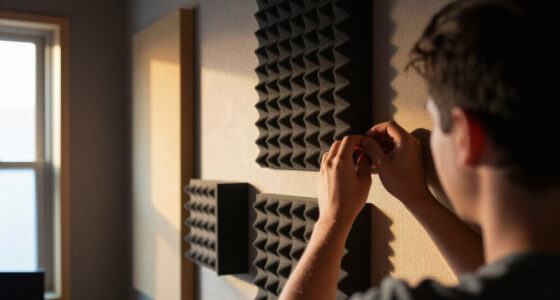
Foam panels are visible and easy to buy, which is why they are often mistaken for isolation products. Their primary role is controlling reflections—not stopping transmission.
| Feature | Soundproofing | Acoustic treatment |
|---|---|---|
| Main goal | Block sound transmission between spaces | Control sound behavior inside one room |
| Typical methods | Mass, airtightness, decoupling, damping | Absorption, bass trapping, diffusion |
| Products | Extra drywall, isolation clips, resilient channels, seals | Panels, ceiling clouds, bass traps, diffusers |
| Measurements | STC, OITC, IIC, transmission loss | NRC, absorption coefficient, RT60 |
| Usually structural? | ✓Yes | ~Often no |
| Can thin foam solve it? | ✕Generally no | ~Only some higher-frequency reflections |
Four soundproofing principles must work as one system.
Premium materials cannot compensate for a major untreated path. Isolation is undermined by weak doors, open ventilation, penetrations, rigid structural bridges, and careless gaps.
Mass
Dense assemblies resist vibration. Multiple drywall layers, masonry, concrete, and specialized barriers make sound transmission more difficult.
Decoupling
Separated layers interrupt direct vibration paths. Double studs, staggered studs, clips, and correctly installed channels reduce structural transfer.
Damping
Viscoelastic compounds between rigid layers convert part of the vibrational energy into heat, improving isolation across useful frequency ranges.
Airtightness
Sound travels through gaps much like air. Seal seams, outlets, door perimeters, ceiling joints, penetrations, and service openings.
The weakest-path rule
A heavy, decoupled wall may still disappoint when sound bypasses it through a hollow-core door, ventilation opening, ceiling void, shared floor, or untreated outlet. Inspect the whole boundary.
Acoustic treatment controls energy already inside the space.
Treatment changes reflections, decay, resonance, and spatial character. Placement and thickness matter as much as panel count.
Porous panels
Reduce mid- and high-frequency reflections. Greater thickness and an air gap extend useful absorption toward lower frequencies.
Bass traps
Address low-frequency buildup near corners and boundaries, helping reduce boomy or uneven bass response.
Diffusers
Break up strong reflections without removing all their energy, preserving spaciousness while reducing obvious echoes.
Ceiling clouds
Control reflections from hard ceilings above listening, recording, performance, conference, and work areas.
Conceptual frequency reach
Relative—not a product specificationToo much shallow absorption can deaden high frequencies while leaving low-frequency resonance uncontrolled. The room becomes dull and boomy at the same time.
Not all noise travels the same way.
A wall upgrade may have little effect if the dominant route is through a floor, ceiling, door, duct, adjoining wall, or rigid structural connection.
Airborne noise
Voices, television, music, traffic, and barking move through air before exciting a boundary.
Impact noise
Footsteps, dropped objects, and furniture movement directly excite floors and connected structures.
Structure-borne
Machinery, speakers, plumbing, and appliances transfer vibration through framing and services.
Flanking transmission
Sound bypasses the intended barrier through ducts, floors, ceilings, junctions, and adjoining walls.
Measure isolation
Use transmission-focused ratings to evaluate how a tested assembly reduces airborne or impact sound. Field results may be lower than laboratory ratings.
Measure room behavior
Use absorption and decay metrics to understand reflection control, reverberation, and how quickly sound energy diminishes inside the room.
From complaint to verified result
One blocks. The other shapes.
Soundproofing protects the boundary between spaces. Acoustic treatment refines the listening environment inside one space. Critical studios, theaters, rehearsal rooms, and offices often need both—but each requires its own diagnosis, budget, and success measure.
What’s the real goal? Soundproofing keeps noise out or in — acoustic treatment refines sound inside
Soundproofing is about stopping sound from crossing room boundaries. It’s like building a fortress—heavy, sealed, and decoupled. Acoustic treatment, on the other hand, shapes how sound behaves inside a space—dampening echoes, balancing frequencies, and making speech or music clearer.
Imagine a musician’s studio. You want to prevent sound leaking to neighbors—that’s soundproofing. But inside, you want the room to sound warm, not echoey—that’s acoustic treatment. They address different problems with different methods.
As an affiliate, we earn on qualifying purchases.
How to tell if you need soundproofing or acoustic treatment
- Listen carefully: Is the issue outside noise or sound clarity inside?
- Identify the source: Is it neighbors, traffic, or your own recordings?
- Measure the problem: Use a decibel meter or just note if sound leaks through walls, doors, or ceilings.
- Set your goal: Do you want silence, privacy, or better sound quality?
If noise crosses room boundaries, focus on soundproofing. If sound within the room is problematic—echoes, muddiness—treat with acoustics.
acoustic panels for room treatment
As an affiliate, we earn on qualifying purchases.
As an affiliate, we earn on qualifying purchases.
Compare: Soundproofing vs Acoustic Treatment — What really makes a difference?
| Feature | Soundproofing | Acoustic Treatment |
|---|---|---|
| Main goal | Block sound transmission between spaces | Control sound behavior inside a room |
| Typical methods | Mass, airtightness, decoupling, damping | Absorption, bass traps, diffusion |
| Products | Heavy drywall, isolation clips, sealants | Absorptive panels, diffusers, bass traps |
| Measurement focus | STC, IIC, transmission loss | NRC, RT60, absorption coefficient |
| Often structural? | Yes | Often no |
As an affiliate, we earn on qualifying purchases.
Four principles of effective soundproofing you can’t ignore
- Mass: Heavy walls, barriers, dense materials slow sound passing through. The more mass, the harder it is for sound waves to penetrate, which is why thick concrete or multiple layers of drywall are popular. But increasing mass alone can be costly and impractical for some spaces.
- Decoupling: Isolating layers prevents vibrations from traveling directly through the structure. This means separating the inner wall from the outer one with resilient channels or clips, which reduces vibration transfer. Without decoupling, even heavy walls can transmit sound via vibrations, undermining your efforts.
- Damping: Viscoelastic materials turn vibrational energy into heat, reducing noise. Applying damping compounds between layers of drywall can significantly improve sound isolation, especially at lower frequencies. The tradeoff is added complexity and cost, but it’s often worth it for critical spaces.
- Airtightness: Gaps and leaks are your enemy—seal everything tightly. Small cracks around outlets, seams, or doors can drastically reduce the effectiveness of your soundproofing. Using proper sealants and gaskets ensures that your barrier remains airtight, maximizing its performance.
For example, a double-stud wall with resilient clips, sealed outlets, and a heavy door can block most traffic noise. Skipping the decoupling or leaving gaps ruins the effort.
As an affiliate, we earn on qualifying purchases.
How acoustic treatment shapes your room’s sound — and what it can’t do
Acoustic treatment manages how sound waves bounce, reflect, and resonate inside a space. Thick panels absorb high and mid frequencies, bass traps tame low-end booms, and diffusers scatter reflections. These tools help you create a more balanced, clear sound environment, which is crucial for recording, mixing, or enjoying music at home.
However, acoustic treatment does not prevent sound from escaping the room. Its primary purpose is to improve the internal sound quality, not isolation. This means that while your room may sound perfect to your ears, it can still leak noise to neighbors or other rooms. Recognizing this helps set realistic expectations and guides you to combine treatments with proper soundproofing if needed.
Conclusion
Remember: soundproofing and acoustic treatment serve different masters. One blocks, the other shapes. Knowing which problem you face determines your tools and your budget. Start with a clear diagnosis, then build from there.
Imagine your space as a musical instrument—tighten the strings (soundproofing) or fine-tune the sound inside (acoustic treatment). Both matter, but choosing the right one makes all the difference.
Fall Picks
fall essentials
As an affiliate, we earn on qualifying purchases.