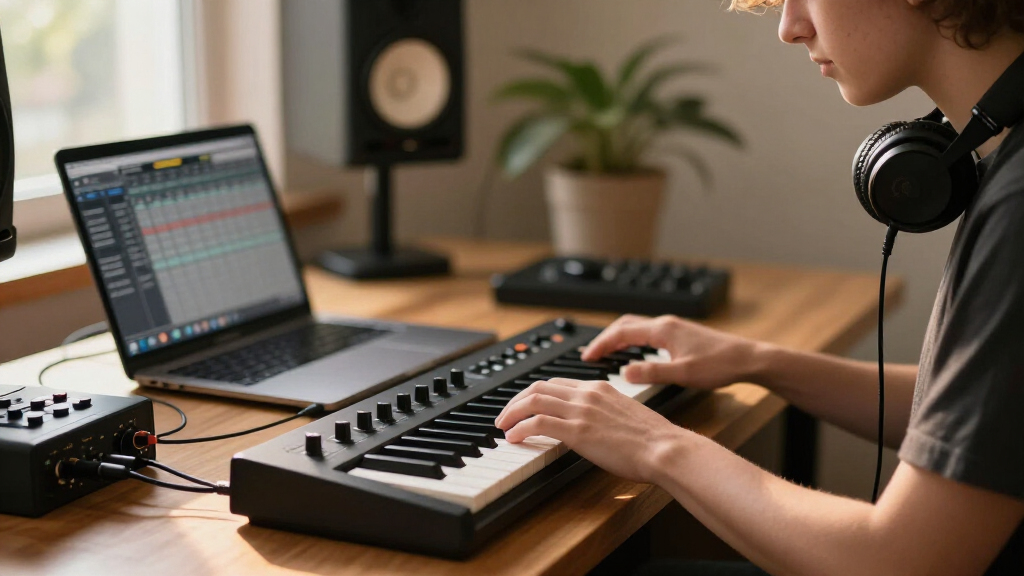

MIDI keyboard controllers range from palm-sized 25-key units to full 88-key boards, and the right one depends on whether you produce at a desk, travel with a laptop, or play piano parts with two hands. For most producers, the Novation Launchkey 49 MK4 stands out as the best overall pick thanks to its tight DAW integration, responsive pads, and scale and chord modes that speed up songwriting. If you want the lowest possible price, the Donner N-25 and M-Audio Keystation Mini 32 MK3 cover the basics well; if you need real piano feel, the M-Audio Keystation 88 MK3 is the full-size option here. The main tradeoff in this category is between portability and playability — smaller boards fit in a backpack but force hand-shifting, while larger boards offer expression at the cost of desk space and budget. Extra features like drum pads, faders, and onboard sounds add cost that beginners may not need yet. Read on for the full breakdown of all 15 controllers and which one fits your setup.

Get audio and creator gear delivered free — and shop member deals
- Fast, free delivery on millions of items
- Access to Prime Big Deal Days deals on October 6–7
- Prime Video, Amazon Music and more included
Complete the kit


Key Takeaways
- The Novation Launchkey MK4 lineup (49 and 61 keys) earned the top spots because deep DAW integration and creative modes like scales and chords deliver more day-to-day value than raw key count alone.
- Budget 25-key models from Donner and M-Audio proved that sub-$60 controllers are genuinely usable — but every one of them compromises on drum pads, knobs, or key feel, so they suit sketching rather than finished production.
- The Akai MPK Mini family shows how much difference one feature makes: the MPK Mini Play MK3’s onboard sounds make it the only controller here you can play away from a computer entirely.
- The M-Audio Keystation series remains the clear choice for players who prioritize piano-style playing over production features — the 88 MK3 is the only fully weighted option in this roundup.
- Arturia‘s MiniLab 3 and MiniLab 37 emerged as the best middle ground for small studios: compact footprints with software bundles and rotary encoders that cheap mini keyboards omit.
| M-Audio Keystation Mini 32 MK3 USB MIDI Controller |  | Best for Learning on the Go | Keys: 32 miniature velocity-sensitive keys | Compatibility: Windows and Mac | Connection: USB | VIEW LATEST PRICE | See Our Full Breakdown |
| Donner DMK-25 Pro 25-Key USB-C MIDI Keyboard Controller |  | Best for Hands-On Beat Making | Keys: 25 | Drum pads: 8 | Display: OLED | VIEW LATEST PRICE | See Our Full Breakdown |
| M-Audio Keystation 88 MK3 USB MIDI Controller |  | Best for Full-Range Piano Parts | Keys: 88 full-size, velocity-sensitive semi-weighted keys | Connectivity: USB | Controls: Volume fader, transport and directional buttons, pitch and modulation wheels, octave buttons | VIEW LATEST PRICE | See Our Full Breakdown |
| M-Audio Keystation 49 MK3 USB MIDI Controller |  | Best Straightforward Full-Size Pick | Keys: 49 full-size velocity-sensitive keys | Connectivity: USB-MIDI, plug-and-play and class-compliant | Compatibility: Mac, PC, and iOS via separately sold Apple USB Camera Adapter | VIEW LATEST PRICE | See Our Full Breakdown |
| Akai Professional MPK Mini Plus 37-Key USB MIDI Keyboard Controller |  | Best for Hybrid Hardware Setups | Keys: 37 mini keys with Gen 2 dynamic keybed | Range: 3 octaves | Pads: 8 RGB MPC pads | VIEW LATEST PRICE | See Our Full Breakdown |
| Novation Launchkey 49 MK4 USB MIDI Keyboard Controller |  | Best Full-Featured Mid-Size Controller | Number of Keys: 49 | Keybed: Semi-weighted | Pads: 16 FSR pads with polyphonic aftertouch | VIEW LATEST PRICE | See Our Full Breakdown |
| Arturia MiniLab 37 MIDI Keyboard Controller |  | Best Compact Desktop Controller | Keys: 37 slim keys | Pads: 2×4 layout (8 pads) | Display: Real-time mini display | VIEW LATEST PRICE | See Our Full Breakdown |
| Akai Professional LPK25 25-Key USB MIDI Keyboard Controller |  | Best Bare-Bones Portable Option | Keys: 25 mini keys | Connectivity: USB (bus-powered) | Arpeggiator: Built-in with clock | VIEW LATEST PRICE | See Our Full Breakdown |
| Novation Launchkey 61 MK4 USB MIDI Keyboard Controller |  | Best for Two-Handed Players | Number of Keys: 61 | Keybed: Semi-weighted | Pads: 16 FSR pads with polyphonic aftertouch | VIEW LATEST PRICE | See Our Full Breakdown |
| Donner N-25 Mini MIDI Keyboard Controller, 25 Velocity-Sensitive Keys |  | Best Budget Starter Pick | Number of Keys: 25 | Key Type: Velocity-sensitive mini keys | Connectivity: USB-MIDI | VIEW LATEST PRICE | See Our Full Breakdown |
| Akai Professional MPK Mini MK3 25-Key USB MIDI Keyboard Controller |  | Best Pocket-Sized Studio Workhorse | Keys: 25 velocity-sensitive mini keys | Pads: 8 backlit velocity-sensitive MPC-style pads | Knobs: 8 assignable 360-degree knobs | VIEW LATEST PRICE | See Our Full Breakdown |
| Akai Professional MPK Mini Play MK3 25-Key USB MIDI Keyboard Controller |  | Best for Playing Away From the Computer | Keys: 25 Gen 2 dynamic keys | Drum pads: 8 velocity-sensitive backlit MPC pads | Display: OLED | VIEW LATEST PRICE | See Our Full Breakdown |
| Arturia MiniLab 3 MIDI Controller, White |  | Best for Simple DAW Control | Keys: Velocity-sensitive slim keys | Drum pads: 8 | Faders: 4 | VIEW LATEST PRICE | See Our Full Breakdown |
| Akai Professional MPK Mini IV 25-Key USB-C MIDI Keyboard Controller, Black |  | Best Upgraded Compact Controller | Keys: 25 velocity-sensitive mini keys | Knobs: 8 assignable 360-degree knobs | Pads: 8 velocity- and pressure-sensitive MPC pads with RGB feedback | VIEW LATEST PRICE | See Our Full Breakdown |
| M-Audio Keystation 61 MK3 USB MIDI Controller |  | Best for Two-Handed Playing on a Budget | Keys: 61 full-size, velocity-sensitive semi-weighted keys | Controls: Volume fader, transport and directional buttons, pitch and modulation wheels, octave buttons | Pedal input: Sustain pedal | VIEW LATEST PRICE | See Our Full Breakdown |
| midi keyboard controller | Keys | Connectivity | Controls |
|---|---|---|---|
| M-Audio Keystation Mini 32 MK3 | 32 miniature velocity-sensitive keys | — | Pitch bend and modulation buttons, octave controls, volume knob, sustain button |
| Donner DMK-25 Pro 25-Key USB-C | 25 | — | Arpeggio, note repeat, chord, pitch and modulation touch bar, 4 wheels, 6 transport controllers |
| M-Audio Keystation 88 MK3 USB | 88 full-size, velocity-sensitive semi-weighted keys | USB | Volume fader, transport and directional buttons, pitch and modulation wheels, octave buttons |
| M-Audio Keystation 49 MK3 USB | 49 full-size velocity-sensitive keys | USB-MIDI, plug-and-play and class-compliant | Volume fader, transport and directional buttons, pitch and modulation wheels, octave up/down buttons |
| Akai Professional MPK Mini Plu | 37 mini keys with Gen 2 dynamic keybed | USB, CV/Gate, MIDI I/O | — |
| Novation Launchkey 49 MK4 USB | — | USB and MIDI | — |
| Arturia MiniLab 37 MIDI Keyboa | 37 slim keys | — | DAW-integrated pads and faders |
| Akai Professional LPK25 25-Key | 25 mini keys | USB (bus-powered) | Octave up/down buttons, sustain button |
| Novation Launchkey 61 MK4 USB | — | USB and MIDI | — |
| Donner N-25 Mini MIDI Keyboard | — | USB-MIDI | Programmable banks, arpeggiator, sustain, octave, tap tempo, pitch bend |
| Akai Professional MPK Mini MK3 | 25 velocity-sensitive mini keys | USB | Four-way pitch and modulation joystick; built-in arpeggiator |
| Akai Professional MPK Mini Pla | 25 Gen 2 dynamic keys | USB MIDI; USB Type B to A cable included | 4 encoder knobs, arpeggiator, note repeat |
| Arturia MiniLab 3 MIDI Control | Velocity-sensitive slim keys | — | — |
| Akai Professional MPK Mini IV | 25 velocity-sensitive mini keys | USB-C and full-size MIDI Out | — |
| M-Audio Keystation 61 MK3 USB | 61 full-size, velocity-sensitive semi-weighted keys | USB | Volume fader, transport and directional buttons, pitch and modulation wheels, octave buttons |
More Details on Our Top Picks
M-Audio Keystation Mini 32 MK3 USB MIDI Controller
The Keystation Mini 32 MK3 keeps the essentials within reach for a beginner learning keyboard parts or a producer who needs a small travel controller. Its 32 velocity-sensitive mini keys take up less desk space than the full-size keys on the M-Audio Keystation 49 MK3, while selectable velocity curves let players adjust how strongly the keys respond. Pitch and modulation buttons, octave controls, a volume knob, and a sustain button cover basic performance needs without adding much bulk. The tradeoff is the compact key size: it is less comfortable for extended practice or piano-style playing than the 49-key model. MPC Beats and Melodics lessons give new users a way to start making music and learning, but this controller still needs a computer for sound.
Pros:- Compact 32-key layout is easy to carry and fit on a crowded desk
- Selectable velocity curves let players tailor the keys’ response
- Pitch, modulation, octave, volume, and sustain controls cover basic playing needs
- Includes MPC Beats and access to interactive Melodics lessons
Cons:- Mini keys feel cramped for players used to a conventional keyboard
- The 32-key range limits two-handed parts and broader piano passages
- Requires a computer and music software to produce sound
Best for: Beginners who want an easy-to-carry controller for learning basic parts and sketching ideas at a computer
Not ideal for: Piano players who need full-size keys or a wider range for two-handed practice
- Keys:32 miniature velocity-sensitive keys
- Compatibility:Windows and Mac
- Connection:USB
- Velocity response:Selectable velocity curves
- Controls:Pitch bend and modulation buttons, octave controls, volume knob, sustain button
- Included software:MPC Beats
- Learning content:Access to 60 interactive MIDI keyboard lessons from Melodics
- Power and drivers:No additional power supply or drivers required
Our verdict“Choose it for portable beginner practice and simple computer-based parts if mini keys suit your playing style.”
Donner DMK-25 Pro 25-Key USB-C MIDI Keyboard Controller
The Donner DMK-25 Pro puts more performance controls on a small controller than the straightforward M-Audio Keystation Mini 32 MK3. Eight drum pads, four wheels, transport controls, an OLED display, and dedicated arpeggio, note repeat, and chord functions give producers several ways to shape ideas without reaching for a mouse. Its 16 scale modes can also help players explore melodies while avoiding notes outside a chosen scale. The 25-key range is narrower than the Keystation Mini’s 32 keys, so it favors short phrases and beat-focused work over longer parts. USB-C connects it to a computer or compatible mobile device, but it does not generate sound by itself; mobile users may also need a separate adapter. DAW software is required for playback and production.
Pros:- Eight drum pads add a direct way to enter beats
- OLED display and multiple performance controls make settings easier to access
- Sixteen scale modes support melodic exploration
- Includes access to 40 keyboard teaching courses
Cons:- The 25-key range is restrictive for longer or two-handed parts
- Requires a computer or mobile device running DAW software to make sound
- Some mobile devices may need a separately purchased adapter
Best for: Computer or mobile DAW users who want pads, scale tools, and hands-on controls in a compact setup
Not ideal for: Players who need a wider keyboard range, standalone sounds, or a ready-to-connect mobile setup without extra adapters
- Keys:25
- Drum pads:8
- Display:OLED
- Connection:USB-C
- Scale modes:16
- Controls:Arpeggio, note repeat, chord, pitch and modulation touch bar, 4 wheels, 6 transport controllers
- Compatibility:PC and mobile devices; compatible with various DAWs
- Sound generation:Requires a connected computer or mobile device running DAW software
Our verdict“Pick it for compact, control-heavy beat making when you already have a compatible device and DAW.”
M-Audio Keystation 88 MK3 USB MIDI Controller
For players who want a full piano range at a computer, the Keystation 88 MK3 offers 88 full-size, velocity-sensitive semi-weighted keys. That range makes it better suited to broad two-handed parts than the M-Audio Keystation 49 MK3, which takes up less space but requires more octave changes. USB connectivity and familiar pitch and modulation wheels, transport controls, and a volume fader help it serve as a straightforward workstation controller. The tradeoff is its size: an 88-key board needs substantial desk or stand space, so it is a poor fit for a compact setup. Its semi-weighted action also differs from a fully weighted piano keyboard. A sustain pedal input supports expressive playing, while bundled instruments and production software offer a useful starting set.
Pros:- Full-size 88-key range supports broad two-handed parts without frequent octave changes
- Velocity-sensitive semi-weighted keys allow dynamic playing
- Pitch and modulation wheels, transport controls, and volume fader support DAW work
- Includes MPC Beats, Ableton Live Lite, and several virtual instruments
Cons:- Full-length layout requires substantial desk or stand space
- Semi-weighted action may not suit players seeking a fully weighted piano feel
- iOS connection requires a separately sold Apple to USB Camera Adapter
Best for: Keyboard players composing piano and instrument parts at a computer who have room for a full-length controller
Not ideal for: Mobile producers or desk users with limited space, and pianists who require fully weighted keys
- Keys:88 full-size, velocity-sensitive semi-weighted keys
- Connectivity:USB
- Controls:Volume fader, transport and directional buttons, pitch and modulation wheels, octave buttons
- Sustain pedal input:Yes
- Compatibility:Mac, PC, and iOS devices with Apple to USB Camera Adapter
- Included software:MPC Beats, Ableton Live Lite, Mini Grand, Xpand!2, TouchLoops, Velvet
Our verdict“Choose it for full-range computer-based playing if you have room for an 88-key controller and prefer semi-weighted action.”
M-Audio Keystation 49 MK3 USB MIDI Controller
The Keystation 49 MK3 is a practical middle ground for players who want full-size keys without giving a desk over to an 88-key controller. Its 49 velocity-sensitive keys provide more room for melodic parts than the Keystation Mini 32 MK3, while keeping the footprint smaller than the Keystation 88. Pitch and modulation wheels, transport and directional buttons, octave controls, and a volume fader cover common DAW tasks with a familiar layout. Plug-and-play USB keeps setup simple on Mac and PC, and bundled instruments and lessons give new producers a starting point. The tradeoffs are its limited range for extensive two-handed playing and the separately sold sustain pedal; iOS use also requires an adapter.
Pros:- Full-size velocity-sensitive keys offer a more familiar feel than mini-key controllers
- 49-key range balances playable space with a manageable footprint
- Plug-and-play USB connection needs no drivers or external power supply
- Includes music software and access to Skoove and Melodics lessons
Cons:- Limited range can require octave changes for wide two-handed parts
- Sustain pedal is sold separately
- iOS use requires a separately sold Apple USB Camera Adapter
Best for: Home studio beginners and songwriters who want full-size keys, basic DAW controls, and a manageable desk footprint
Not ideal for: Pianists who need an 88-key range or buyers who want a sustain pedal included
- Keys:49 full-size velocity-sensitive keys
- Connectivity:USB-MIDI, plug-and-play and class-compliant
- Compatibility:Mac, PC, and iOS via separately sold Apple USB Camera Adapter
- Controls:Volume fader, transport and directional buttons, pitch and modulation wheels, octave up/down buttons
- Sustain pedal input:1/4-inch (6.3 mm)
- Power:USB-powered; no external power supply required
- Included software:MPC Beats, Ableton Live Lite, Velvet, Xpand2, Mini Grand, Touch Loops
- Lessons:Free online lessons from Skoove and 60+ lessons from Melodics
Our verdict“Pick it for a simple, full-size computer controller if 49 keys cover your parts and you can supply your own sustain pedal.”
Akai Professional MPK Mini Plus 37-Key USB MIDI Keyboard Controller
The Akai MPK Mini Plus stands apart from the USB-focused M-Audio Keystation 49 MK3 by pairing a compact 37-key mini keybed with connections for external gear. CV/Gate and MIDI I/O let it control modular equipment, synths, and sound modules, while the built-in 64-step sequencer offers a way to sketch drum and melody or chord patterns without a computer. Eight RGB pads and assignable knobs add hands-on control in a footprint smaller than a full-size keyboard. That flexibility comes with limits: the mini keys may feel cramped, and the sequencer is confined to two tracks. Three octaves provide more melodic room than a 25-key controller, though the key range and sequencer still favor compact ideas over elaborate arrangements.
Pros:- CV/Gate and MIDI I/O support modular and external hardware connections
- Built-in 64-step sequencer can sketch patterns without a computer
- Three-octave keybed offers more melodic range than 25-key mini controllers
- Eight RGB pads and assignable knobs provide hands-on control
Cons:- Mini keys can feel cramped compared with full-size controllers such as the Keystation 49 MK3
- Sequencer is limited to one drum track and one melody or chord track
- Three octaves still limit broad piano parts
Best for: Producers combining a computer with modular or MIDI hardware who want sequencing and performance controls in one compact controller
Not ideal for: Pianists who prefer full-size keys or arrangers who need a multitrack sequencer in the controller
- Keys:37 mini keys with Gen 2 dynamic keybed
- Range:3 octaves
- Pads:8 RGB MPC pads
- Knobs:8 assignable rotary knobs
- Sequencer:Built-in 64-step sequencer with 1 drum track and 1 melody/chord track, up to 8 notes each
- Connectivity:USB, CV/Gate, MIDI I/O
- Compatibility:Mac and PC; NKS integration
- Included software:MPC Beats, choice of Komplete 15 Select bundle, 60 days of Splice Creator access
Our verdict“Choose it for a compact hybrid rig that needs hardware connections and basic sequencing, provided mini keys work for you.”
Novation Launchkey 49 MK4 USB MIDI Keyboard Controller
The Launchkey 49 MK4 hits a sweet spot the smaller options in this roundup can’t reach: enough keys for genuine two-handed playing, yet still desk-friendly. Its polyphonic aftertouch pads put it a tier above basic models like the M-Audio Keystation 49 MK3, which offers keys and little else. The OLED chord display and Scale/Chord modes translate into faster songwriting — you stay in key and voice chords without theory fluency. Compared with the Launchkey 61 MK4, this version trades range for a footprint that fits tighter setups. The tradeoffs are real: it’s more controller than a pure beginner needs, and the feature depth takes time to learn.
Pros:- Polyphonic aftertouch pads add expressive finger control over software instruments
- Scale, Chord, and arpeggiator tools speed up composition without theory knowledge
- Tight integration with Ableton, Logic, Cubase, and Native Instruments software
- Bundled software, sounds, and Melodics lessons add immediate value
Cons:- Deep feature set involves a learning curve before everything feels intuitive
- Larger footprint than compact 25-key alternatives like the Akai LPK25
Best for: Producers and intermediate players who want deep Ableton and DAW control with room for two-handed parts
Not ideal for: Absolute beginners or travelers — the size and feature set are overkill if you just want to sketch melodies
- Number of Keys:49
- Keybed:Semi-weighted
- Pads:16 FSR pads with polyphonic aftertouch
- Connectivity:USB and MIDI
- Additional Features:Scale and Chord modes, editable arpeggiator, chord detector with OLED display
- Supported Software:Ableton, Logic Pro, Cubase, HUI
Our verdict“This is the pick if you want one mid-size controller that does production, performance, and clip launching without compromise.”
Arturia MiniLab 37 MIDI Keyboard Controller
Arturia’s MiniLab 37 answers a question most mini controllers fumble: can a small board still handle two-handed parts? With 37 slim keys in a shallow footprint, it manages what the 25-key Akai MPK Mini MK3 cannot — melody in the right hand, chords in the left. The real-time mini display and custom DAW mappings give it a polished workflow feel that basic plug-and-play boards skip entirely. Its 2×4 pad layout handles clip launching and finger drumming, though it’s noticeably tighter than the 16 pads on the Launchkey 49 MK4. The honest tradeoff is the slim keybed: players used to full-size semi-weighted keys will feel the difference immediately.
Pros:- 37-key layout allows genuine two-handed playing in a compact body
- Smart DAW integration with pads, faders, and custom mappings
- Built-in arpeggiator and Chord mode for creative sketching
- Lightweight, shallow design suits mobile rigs and cramped desks
Cons:- Slim mini keys feel less substantial than full-size keybeds
- Only 8 pads versus the 16 found on larger controllers
Best for: Bedroom producers and small-studio owners who need two-handed play without surrendering desk space
Not ideal for: Pianists who prioritize key feel — the slim mini keys lack the substance of full-size semi-weighted keybeds
- Keys:37 slim keys
- Pads:2×4 layout (8 pads)
- Display:Real-time mini display
- Controls:DAW-integrated pads and faders
- Features:Built-in arpeggiator, Chord mode, custom DAW mappings, transposition
- Form Factor:Compact, lightweight, shallow desktop design
Our verdict“The most balanced small-format option here if you refuse to give up two-handed playing for portability.”
Akai Professional LPK25 25-Key USB MIDI Keyboard Controller
Simplicity is the whole point of the LPK25. Where the Donner N-25 layers on lessons, banks, and a pitch rocker, Akai strips things down to a 25-key board that plugs in and just works — no drivers, no fuss, bus power from any USB port. The built-in arpeggiator with clock is a surprisingly capable touch at this level, and octave buttons extend the range beyond what 25 keys suggest. Compared with the Arturia MiniLab 37, you lose pads, faders, and display entirely — this is a keyboard, full stop. The most meaningful gap is the missing pitch bend and modulation wheels, which limits expressive playing on lead parts and synth lines.
Pros:- Plug-and-play USB setup with no drivers on Mac or PC
- Built-in arpeggiator with clock adds creative flexibility
- 8 programmable preset slots speed up switching between instruments
- Broad compatibility with every major DAW
Cons:- No pitch bend or modulation wheels
- Mini keys feel small for players accustomed to full-size keys
- No pads, faders, or display — pure keyboard control only
Best for: Laptop producers and songwriters who want a grab-and-go keyboard for sketching ideas anywhere
Not ideal for: Players who shape sound in real time — no pitch bend or mod wheels means less expressive control
- Keys:25 mini keys
- Connectivity:USB (bus-powered)
- Arpeggiator:Built-in with clock
- Preset Slots:8 programmable
- Controls:Octave up/down buttons, sustain button
- Compatibility:Mac, PC; Ableton Live, Logic Pro, FL Studio, Pro Tools, GarageBand, and more
Our verdict“Buy this if you want the simplest possible musical keyboard for your bag; skip it if you need performance controls.”
Novation Launchkey 61 MK4 USB MIDI Keyboard Controller
If the Launchkey 49 MK4 feels cramped, the 61 MK4 is the natural step up — enough keys for proper piano voicings without the footprint commitment of an 88-key board like the M-Audio Keystation 88 MK3, which lacks pads and aftertouch entirely. You get the same polyphonic aftertouch pads, Scale and Chord modes, and OLED chord display, so nothing is sacrificed for the extra octave. For live performers and film scorers, that combination of range and clip-launching control is hard to match in this lineup. The tradeoffs are physical and practical: it demands serious desk real estate, and it relies on a connected computer or USB host — there’s no standalone workflow.
Pros:- 61 semi-weighted keys accommodate genuine piano-style playing
- Polyphonic aftertouch pads work for clip launching and expressive drumming
- Scale, Chord, and arpeggiator tools keep complex parts in key
- Broad integration across Ableton, Logic, Cubase, FL Studio, Reason, and Reaper
Cons:- Large footprint that overwhelms small desks and mobile rigs
- Requires a connected computer or USB-compatible device to function
Best for: Keyboard-trained producers and live performers who need full two-handed range plus performance controls
Not ideal for: Compact desktop setups — the 61-key size dominates a small workspace and travels poorly
- Number of Keys:61
- Keybed:Semi-weighted
- Pads:16 FSR pads with polyphonic aftertouch
- Connectivity:USB and MIDI
- Additional Features:Scale Mode, Chord Modes, arpeggiator, chord detector, OLED display
- Supported Software:Ableton Live, Logic Pro, Cubase, Reason, Reaper, FL Studio, Ardour
Our verdict“The right choice when piano technique matters as much as production control — just measure your desk first.”
Donner N-25 Mini MIDI Keyboard Controller, 25 Velocity-Sensitive Keys
For someone buying their first controller, the Donner N-25 bundles things pricier boards leave out: 40 keyboard lessons, an arpeggiator, and a pitch-bend rocker — the very control the Akai LPK25 omits. Velocity-sensitive keys mean dynamics carry through to your software from day one, and compatibility stretching from Windows and Mac to iOS and Android makes it a true phone-or-tablet starter. Compared with the Donner DMK-25 Pro, this is the simpler, cheaper-feeling sibling; the controls are more basic and the keybed is unmistakably entry-level. The mini keys won’t satisfy experienced players, and mobile users should expect to source an OTG adapter separately — a small annoyance that catches many beginners off guard.
Pros:- 40 included teaching courses give beginners a structured start
- Pitch-bend rocker adds expressive control most budget minis skip
- Works across Windows, Mac, iOS, and Android platforms
- Arpeggiator, sustain, octave, and tap-tempo functions punch above the price bracket
Cons:- Mini keys feel small and less responsive than full-size keybeds
- Connecting to smartphones may require a separate OTG adapter
Best for: Complete beginners, students, and casual players exploring music production on a computer, tablet, or phone
Not ideal for: Experienced keyboardists — mini keys and basic build quality fall short for serious practice or performance
- Number of Keys:25
- Key Type:Velocity-sensitive mini keys
- Connectivity:USB-MIDI
- Controls:Programmable banks, arpeggiator, sustain, octave, tap tempo, pitch bend
- Included Lessons:40 keyboard teaching courses
- Compatible Platforms:Windows, Mac, iOS, Android
- Compatible Software:Cubase LE, Ableton Live, Logic Pro, Pro Tools, Studio One
Our verdict“The most sensible first controller for a curious beginner, as long as expectations match the entry-level keybed.”
Akai Professional MPK Mini MK3 25-Key USB MIDI Keyboard Controller
The MPK Mini MK3 has become the default compact controller for a reason: it squeezes a keyboard, eight MPC pads, eight knobs, and a joystick into a footprint that fits in a backpack. Compared with the bare-bones M-Audio Keystation Mini 32 MK3, this option gives you drum programming and parameter tweaking without touching your mouse, which changes how quickly ideas come together. The bundled MPC Beats software and 2GB of sounds mean a laptop owner can start producing the same day. The tradeoff is the mini key feel — players trained on pianos will find the shallow action cramped, and the lack of aftertouch on the keys limits expressive playing. This model makes the most sense for beatmakers and electronic producers who value portability over key count.
Pros:- Combines keys, MPC pads, knobs, and joystick in one compact unit
- Bundled MPC Beats software and 2GB of sound content get you producing immediately
- NKS support integrates smoothly with Native Instruments instruments
- Four-way joystick handles pitch and modulation without extra controls
Cons:- Mini keys feel shallow and cramped for piano-trained players
- USB-powered only, so it always needs a connected device to make sound
Best for: Electronic producers and beatmakers who want pads, knobs, and keys in one travel-ready controller
Not ideal for: Pianists and melodic players who need full-size, expressive keys — the mini keybed will frustrate them
- Keys:25 velocity-sensitive mini keys
- Pads:8 backlit velocity-sensitive MPC-style pads
- Knobs:8 assignable 360-degree knobs
- Controls:Four-way pitch and modulation joystick; built-in arpeggiator
- Connectivity:USB
- Software:MPC Beats, 3 virtual instruments, 2GB of sound content
Our verdict“The safest first controller for laptop-based producers who want hands-on control of drums and synths in a bag-friendly size.”
Akai Professional MPK Mini Play MK3 25-Key USB MIDI Keyboard Controller
What separates the MPK Mini Play MK3 from the standard MPK Mini MK3 is right in the name: it plays. With a built-in speaker, over 100 internal sounds, and battery power, this is a controller you can pull out on a train or at a friend’s house without a laptop in sight. The OLED display makes browsing those onboard sounds far less painful than button-mashing alternatives, and note repeat is a genuine performance tool for the pads. The compromises are real, though — batteries aren’t included, and the onboard sounds are serviceable rather than inspiring, so this isn’t a replacement for a proper sound library. Compared with the Donner N-25, it costs more but delivers true standalone operation that most mini controllers simply can’t match.
Pros:- Built-in speaker and 100+ internal sounds enable fully standalone playing
- USB or battery power adds genuine portability
- OLED display makes sound browsing and editing straightforward
- Includes MPC Beats, AIR instruments, and Melodics lessons
Cons:- Batteries are not included, adding hidden cost for standalone use
- Only 25 keys limits two-hand playing and arranging
Best for: Musicians who sketch ideas on the couch, while traveling, or anywhere a laptop isn’t practical
Not ideal for: Studio-focused producers who will always be tethered to a computer — the extra money buys standalone features they’ll never use
- Keys:25 Gen 2 dynamic keys
- Drum pads:8 velocity-sensitive backlit MPC pads
- Display:OLED
- Controls:4 encoder knobs, arpeggiator, note repeat
- Internal sounds:Over 100 drum and instrument sounds
- Connectivity:USB MIDI; USB Type B to A cable included
- Power:USB or batteries (not included)
- Included software:MPC Beats, AIR Music Tech instruments, Melodics lessons, NKS bundle selection
Our verdict“The pick for anyone whose best ideas happen away from a desk — a controller that doubles as a portable instrument.”
Arturia MiniLab 3 MIDI Controller, White
Where the MPK Mini MK3 leans on knobs and pads, the MiniLab 3 takes a different approach by adding four faders, which are far more natural for mixing volumes and filter sweeps than endless rotary encoders. This option stands out for producers who want tactile control over tracks and levels rather than maximum pad count, and its clean white finish makes it a visual fit for minimal desk setups. Compared with Akai’s mini offerings, the Arturia feels like a deliberate design choice rather than a feature race — fewer flashy extras, more practical hands-on mixing. The tradeoff is scope: there are no transport controls or screen here, so routine DAW actions still send you back to the mouse, and the compact keybed shares the small-key limitation of every controller in this size class.
Pros:- Four faders make volume and mix control feel direct and intuitive
- Velocity-sensitive keys respond well for a compact keybed
- Eight pads cover basic finger drumming needs
- Compact footprint suits small desks and mobile rigs
Cons:- No transport controls or display, limiting hands-on DAW operation
- Small key count and size restrict expressive two-hand playing
Best for: Home producers who want fader-based mixing control alongside keys in a compact, desk-friendly unit
Not ideal for: Producers who live in their DAW’s transport and menus — no transport buttons or display means frequent mouse trips
- Keys:Velocity-sensitive slim keys
- Drum pads:8
- Faders:4
- Color:White
- Class:Compact 25-key MIDI controller
Our verdict“A focused choice for producers who value faders for mixing over pads and onboard extras.”
Akai Professional MPK Mini IV 25-Key USB-C MIDI Keyboard Controller, Black
The MPK Mini IV is what happens when Akai revisits its own MPK Mini MK3 and fixes the annoyances. The headline additions are a color screen for editing without software, USB-C connectivity, and a full-size MIDI Out port — that last one matters more than it sounds, because it lets you drive hardware synths directly without a computer as intermediary. The pads also gain pressure sensitivity, opening up aftertouch-style expression the MK3 can’t do. Compared with the Donner DMK-25 Pro, this model offers deeper integration and a stronger software bundle, including Ableton Live Lite 12 and Splice access. It still inherits the family tradeoff: 25 mini keys will never suit pianists, and it remains USB-powered, so hardware synth users still need a powered USB source.
Pros:- Full-size MIDI Out enables direct control of hardware synths
- Color screen allows on-device editing without opening software
- Pressure-sensitive pads add expressive aftertouch-style control
- USB-C and mobile compatibility keep it future-proof
Cons:- Mini keys remain cramped for trained players
- USB-powered operation means no true standalone use
Best for: Compact-controller buyers who want modern connectivity and hardware synth control via MIDI Out
Not ideal for: Players who need roomy keys or battery-powered standalone play — the Mini Play MK3 covers the latter better
- Keys:25 velocity-sensitive mini keys
- Knobs:8 assignable 360-degree knobs
- Pads:8 velocity- and pressure-sensitive MPC pads with RGB feedback
- Connectivity:USB-C and full-size MIDI Out
- Power:USB-powered
- Compatibility:Mac, PC, and mobile setups
- Included software:Ableton Live Lite 12, virtual instruments, 30-day Melodics trial, 2 months of Splice
Our verdict“The refined pick for small-controller buyers who want MIDI Out, a screen, and modern USB-C in one package.”
M-Audio Keystation 61 MK3 USB MIDI Controller
Every other controller in this batch asks you to compromise on key count; the Keystation 61 MK3 refuses. With 61 full-size, semi-weighted keys, plus pitch and mod wheels and a sustain pedal input, this model is better suited to actual piano technique than any 25-key option, including the MPK Mini Play MK3 or even Akai’s larger MPK Mini Plus. The volume fader and transport buttons give it enough hands-on control for basic tracking, though it lacks the pads and knobs beatmakers expect. Its real weakness is expressiveness beyond the basics — semi-weighted action sits well below the feel of the Keystation 88 MK3, and iOS users need a separately sold camera adapter. For composers who need range without a large desk or a large budget, though, this hits a sweet spot the mini controllers can’t reach.
Pros:- 61 full-size semi-weighted keys support genuine two-handed playing
- Sustain pedal input enables proper piano expression
- Plug-and-play USB connection needs no drivers or external power
- Bundled software includes Ableton Live Lite, MPC Beats, and structured lessons
Cons:- No drum pads or assignable knobs, limiting hands-on control of synths and DAWs
- iOS use requires a separately sold Apple camera adapter
- Semi-weighted action falls short of the fuller feel on the Keystation 88 MK3
Best for: Piano-oriented producers and composers who need a full two-handed range without buying an 88-key board
Not ideal for: Beatmakers who need finger-drumming pads and knob control — this is a pure keyboard controller with no pads
- Keys:61 full-size, velocity-sensitive semi-weighted keys
- Controls:Volume fader, transport and directional buttons, pitch and modulation wheels, octave buttons
- Pedal input:Sustain pedal
- Connectivity:USB
- Computer compatibility:Mac and PC
- iOS compatibility:Via Apple USB Camera Adapter, sold separately
- Included software:MPC Beats, Ableton Live Lite, Velvet, XPand2, Mini Grand, Touch Loops
- Included lessons:Skoove online lessons and 60+ Melodics app lessons
Our verdict“The value choice for keyboard players who care more about playing parts than programming beats.”
How We Picked
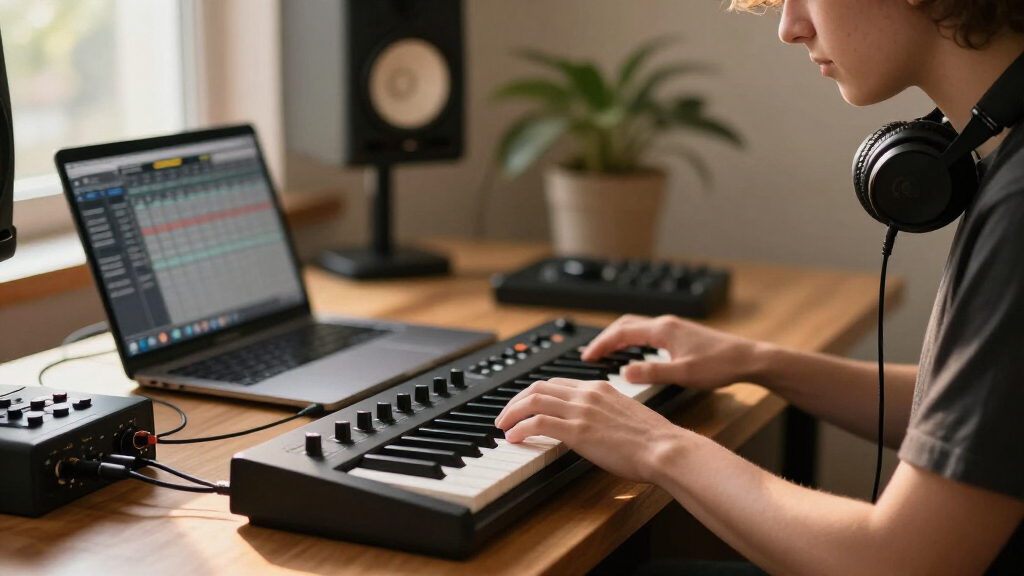
I evaluated these 15 MIDI keyboard controllers against the criteria that actually shape the buying decision: key count and playability (semi-weighted action versus synth-style mini keys), production controls (pads, knobs, faders, and transport), DAW integration (how well the controller maps to Ableton Live, Logic Pro, FL Studio, and similar tools), portability (weight, desk footprint, bus power), and included software value. Because MIDI controllers last for years and rarely become obsolete, build quality and long-term fit mattered more than flashy extras.
The ranking logic follows usefulness per dollar rather than raw feature lists. Full-featured mid-size controllers like the Launchkey MK4 models rank highest because they serve the widest range of tasks — playing, programming drums, mixing, and performing. Basic Keystation boards rank high for specific niches despite fewer bells and whistles, while ultra-compact models sit lower overall not because they are poor products, but because they only fit one scenario: mobile sketching. Every placement reflects who the controller is for, not just what it contains.
Factors to Consider When Choosing Midi Keyboard Controllers
Before picking a specific model, it helps to understand what actually separates MIDI keyboard controllers and which specs change how you work. These are the factors I weighed most heavily, plus the mistakes buyers commonly make with each one.Key Count: Buy for How You Play, Not for Specs
Key count is the single biggest driver of price and desk space, and buyers routinely over- or under-buy here. 25-key controllers work for basslines, leads, and drum programming, but you will constantly shift octaves to play chords with both hands — a workflow friction that adds up over months. 49 keys is the practical sweet spot for most home producers because it covers two-handed playing without dominating a desk. 61 and 88 keys make sense only if you actually play piano-style parts, have the room for a permanently placed board, and are willing to pay and lift accordingly. A common mistake is buying 88 keys for ‘somedom piano skills’ and ending up with a board too large for the actual workspace; the reverse mistake is a pianist buying a mini-key board and fighting the keys on every session.
Key Size and Action: Mini Keys Are a Real Compromise
Mini keys versus full-size keys is a bigger deal than spec sheets suggest. Mini keys (found on the Akai MPK Mini line, Arturia MiniLab, and Donner compact models) have shorter travel and narrower spacing, which makes fast piano-style playing harder and fatigues trained hands. Full-size synth-action keys, like those on the Keystation and Launchkey lines, feel familiar to anyone who has played any keyboard. Fully weighted hammer action — only the Keystation 88 MK3 offers it here — mimics an acoustic piano and matters if technique transfer is a goal. My advice: if you have more than a year of piano background, avoid mini keys entirely, no matter how attractive the portability is. Players who came to production from drums, guitars, or loops will barely notice the difference.
DAW Integration: The Invisible Feature That Matters Most
A MIDI controller is only as good as its mapping to your software, and this is where cheap and mid-priced units genuinely diverge. Novation’s Launchkey line has native integration with Ableton Live — transport, device control, and clip launching work out of the box with no manual assignment. Arturia’s MiniLab controllers ship with tight integration into their own Analog Lab software plus mappings for major DAWs, which is nearly as seamless. Generic controllers like the basic Keystation boards send standard MIDI fine, but every pad and knob beyond pitch and mod wheels needs manual mapping, which can eat an evening per new setup. If you use Ableton Live, paying a little more for native integration saves real time every single session. If you work in a DAW with flexible MIDI learn (like FL Studio or Reaper), this advantage shrinks considerably.
Software Bundles: Where the Hidden Value Lives
Two controllers at similar prices can differ by a wide margin once you count bundled software, and buyers who ignore this often overpay. Akai’s MPK Mini models typically include a genuinely useful production suite — MPC-style software, sounds, and sometimes virtual instruments — which can represent most of the purchase value for someone starting from zero. Arturia includes Analog Lab, giving you thousands of preset sounds that effectively turn the controller into an instrument rather than just an input device. M-Audio’s Keystation boards include a lighter software package, which is part of why they can hit lower prices at larger key counts. The mistake to avoid: paying extra for a bundle of software you already own, or duplicating instruments you’ll never open. Check exactly what’s included for your current library before comparing prices.
Portability and Power: Plan for Your Real Workflow
Nearly every controller here is USB bus-powered, but portability is about more than the cable. A 25-key mini board like the LPK25 or MPK Mini slips into a laptop bag and works in a café, on a plane, or at a friend’s studio; a 61-key board effectively lives wherever you first set it up. Consider also whether you’ll want standalone use: the MPK Mini Play MK3’s battery power and onboard sounds mean it works with headphones and nothing else — a genuine plus for travelers or players without a permanent computer setup. On the flip side, larger boards with more controls draw more power and can be finicky on unpowered USB hubs, a surprisingly common source of ‘my controller keeps disconnecting’ complaints. Match the controller’s footprint to the space you actually have, not the space you wish you had.
Pads, Knobs, and Faders: Only Pay for Controls You’ll Use
Production controls divide buyers into two camps, and it’s worth knowing which one you’re in before spending. Producers who program drums, tweak synth parameters live, or perform benefit enormously from velocity-sensitive pads and assignable encoders — this is why the Launchkey and MPK lines carry them. Players who mostly record MIDI piano and strings from a library touch little beyond pitch and modulation wheels, and for them, a bare-bones board like the Keystation series is the smarter allocation of budget toward more keys. One middle-ground trap: buying a controller with pads and knobs that you never map, because unmapped controls are dead plastic. Be honest about your workflow — if you’ve never felt the urge to tweak a filter cutoff mid-take, skip the control surface and spend the difference on key count or build quality.
Frequently Asked Questions
Should I get a 25-key or 49-key MIDI controller as a beginner?
For most beginners, 49 keys is the better long-term choice because it allows two-handed chord playing without constant octave shifting, which is frustrating while you’re still learning. A 25-key board makes sense if portability is your top priority — commuting with a laptop, producing in small spaces, or traveling — or if your style is loop-based and melody-light. The catch is that 49-key boards with full-size keys cost more and take permanent desk space, so a cramped setup can make the smaller board the wiser pick. If you plan to learn any piano technique alongside production, start at 49 keys; if you see the controller mainly as a note-entry tool for beats, 25 keys will not hold you back.
Do I need drum pads on a MIDI keyboard controller?
You need pads if you program drums by hand, want to finger-drum beats in real time, or perform live launching clips — in those workflows, pads are genuinely faster and more expressive than drawing notes with a mouse. If you mainly use pre-made drum loops or step-sequence in your DAW’s piano roll, pads will sit unused and you can put that budget toward better keys. The quality gap matters too: the pads on the Launchkey MK4 and Akai MPK lines are velocity-sensitive and playable, while pads on the cheapest compact boards tend to feel stiff. A reasonable middle path is starting without pads and adding a dedicated pad controller later if you find yourself wanting them, rather than paying up front for controls you may never map.
Are cheap MIDI controllers under $60 actually good enough?
For note entry and basic sketching, yes — the Donner and M-Audio compact models in this lineup send MIDI just as reliably as pricier boards, and the protocol itself doesn’t degrade with price. What you give up is everything around the notes: key feel, durability, pads, knobs, DAW integration, and software bundles. Cheap mini keys fatigue trained hands, plastic enclosures flex under heavy playing, and any bundled software is usually minimal. The honest answer is that a cheap controller is a fine first controller or travel board, but if you produce daily, you will likely outgrow it within a year and end up buying the mid-range board anyway. Frequent producers should buy the mid-range option once; casual or mobile users can absolutely stay cheap.
Which MIDI keyboard controller works best with Ableton Live?
The Novation Launchkey 49 MK4 or 61 MK4 is the clear answer because of native Ableton integration: clip-launch pads light up with your session view, transport controls work instantly, and device knobs auto-map to whatever instrument or effect you have selected. No manual MIDI mapping is required, which is a real time-saver every session. The Akai MPK Mini models are a solid second choice with usable pads and MPC-style workflow, though mapping is more manual. Arturia’s MiniLab controllers also handle Live well through their control software. If you use a different DAW — Logic, FL Studio, Reaper — the Launchkey still works fine, but its standout advantage narrows, so key feel and control layout should drive your choice instead.
Is a semi-weighted or 88-key controller worth it if I play piano?
If you have genuine piano training, yes — and the Keystation 88 MK3 is the only option in this roundup with a full 88 keys, giving you the full range and hammer action your technique expects. Playing classical or expressive parts on mini keys will fight your hands and limit dynamics, which becomes frustrating quickly. The tradeoffs are real, though: an 88-key board needs dedicated floor space, a stand, and a commitment to keeping it set up, and it lacks the pads and knobs a production-focused board offers. A practical compromise for many players is a 61-key semi-weighted board like the Launchkey 61 MK4 or Keystation 61 MK3, which covers most two-hand repertoire in a smaller footprint. Reserve the 88-key investment for when piano playing is central to how you make music.
Conclusion
After comparing all 15 controllers, the right choice comes down to how you work rather than which spec sheet is longest. Best overall goes to the Novation Launchkey 49 MK4: it hits the balance of playability, DAW integration, pads, and creative tools that serves the widest range of producers, with the Launchkey 61 MK4 as the scaled-up pick for two-hand players. Best value is a split between the Donner N-25 for the tightest budgets and the M-Audio Keystation 49 MK3 if you want full-size keys at a low price. Best for beginners is the Donner DMK-25 Pro, which packs pads, a display, and software into a package that teaches the full production workflow without overwhelming. Best premium pick is the Akai MPK Mini Plus, which brings CV/gate outputs and true hardware depth to a compact format. For specific needs: choose the Keystation 88 MK3 for piano-first playing, the MPK Mini Play MK3 for standalone travel use, the Arturia MiniLab 3 for a small-studio all-rounder with a great software bundle, and the LPK25 or Keystation Mini 32 for pure grab-and-go sketching. Whatever you pick, match the controller to the space and workflow you have today — that’s the decision that determines whether it stays on your desk or ends up in a drawer.
Fall Picks
fall essentials
As an affiliate, we earn on qualifying purchases.