TL;DR

Get audio and creator gear delivered free with Prime
- Fast, free delivery on millions of items
- Prime Video, Amazon Music and more included
- Member-only deals all year
Bi-color LED panels offer simple, adjustable white light ideal for interviews and portraits. RGB panels provide full color control, perfect for creative effects. Your choice hinges on your primary lighting needs and budget.
Ever wondered whether a bi-color or RGB LED panel fits your studio best? The difference isn’t just color options—it’s how you want to shape your lighting. Whether you’re filming interviews, creating mood lighting, or experimenting with colors, your choice impacts your workflow and results.
In this guide, you’ll learn the core differences, recent tech advances, and practical tips to pick the right panel for your projects. No fluff, just real-world advice from someone who’s built studios on a budget and knows what works.
Bi-color panels are budget-friendly, energy-efficient, and perfect for consistent white light needs.
RGB panels offer a vast spectrum of colors and effects, suitable for creative projects and dynamic lighting.
Hybrid options provide versatility but come at a higher price—consider if you’ll use both features regularly.
Recent improvements mean RGB panels now rival bi-color in color accuracy and control, making them more professional than ever.
Match your lighting choice to your primary use: interviews, portraits, or creative effects—don’t buy more than you need.
Bi Color vs RGB LED Panels: Which Do You Need?
Bi-color gives you dependable adjustable white light. RGB unlocks a full creative spectrum. The right choice is less about having more colors—and more about the work you actually make.
White-light tool or creative paint box?
Both can light professional work. Bi-color prioritizes quick, repeatable white balance; RGB adds saturated color, animated effects and virtual gels to the same basic fixture.
Fast, consistent white light
Blend warm and cool LEDs to match practical lights, daylight or a chosen mood. It is the straightforward option for natural skin tones and efficient setups.
A spectrum built for storytelling
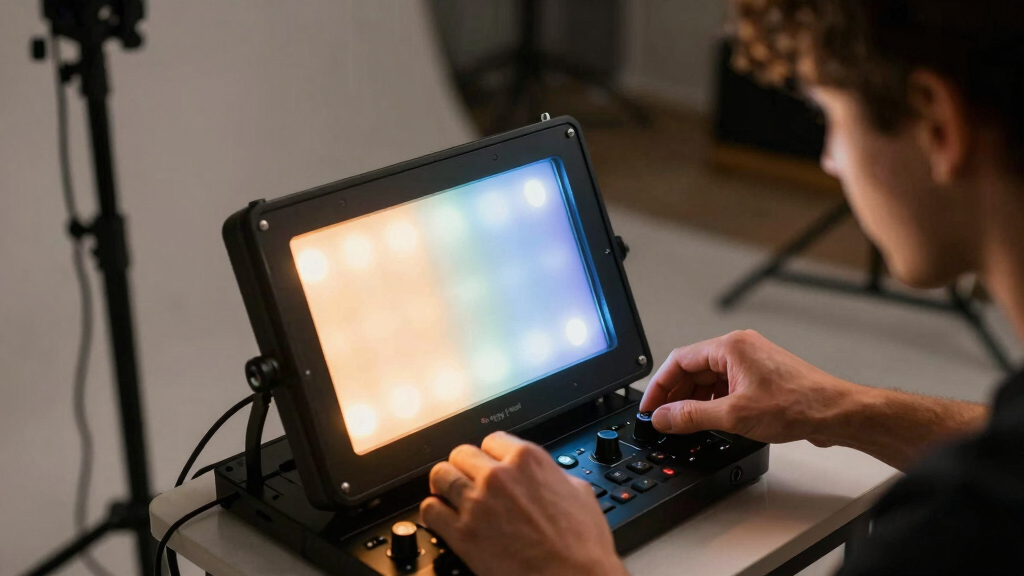
Mix red, green and blue channels for colorful backgrounds, dramatic accents and changing effects. More creative freedom brings more setup decisions.
Modern RGB has gone professional
The old assumption that RGB means compromised white light is fading. Better chips, calibration and control now let high-quality RGB fixtures compete in serious production environments.
Brighter, leaner LEDs
Many current panels exceed 2000 lumens while drawing less power than earlier generations.
CRI and TLCI above 95
High-end RGB panels now reproduce skin tones and product colors with far greater confidence.
Wireless adjustments
Wi-Fi and Bluetooth apps change brightness, temperature, color and effects without stopping a take.
Hybrid and modular
RGB plus bi-color engines and expandable systems can replace several specialized fixtures.
Match capability to the job
A feature only creates value when it shortens your workflow or unlocks a shot you regularly need.
| Decision factor | Bi-color | RGB | Hybrid RGB + white |
|---|---|---|---|
| Adjustable white light | ✓ Excellent | ~ Model-dependent | ✓ Excellent |
| Full-color effects | ✗ No | ✓ Full spectrum | ✓ Full spectrum |
| Simple operation | ✓ Fastest | ~ More controls | ~ More controls |
| Power efficiency | ✓ Strong | ~ Variable | ~ Variable |
| Creative flexibility | ✗ White only | ✓ Excellent | ✓ Maximum |
| Budget fit | Best value | Higher investment | Highest upfront cost |
Cost, power and complexity
Bi-color wins when the brief is reliable white light on a budget. RGB earns its premium when colorful output saves gels, extra fixtures or post-production work. Hybrid is most valuable for creators who genuinely switch between both modes.
From project brief to the right panel
Start with the scene you create most often, then test accuracy, control and cost. This prevents an impressive specification sheet from becoming unused complexity.
Name the main job
Interviews and portraits, or expressive color and moving effects?
Check color fidelity
For faces and products, target CRI or TLCI 95+ and stable white balance.
Fit the workflow
Confirm the panel supports physical controls, app access or DMX.
Buy for repeat use
Choose the simplest fixture that covers the shots you make regularly.
Three clear buying paths
There is no universal winner. There is only the fixture that solves your recurring lighting problem with the least friction.
You prioritize people
Best for interviews, portraits, tutorials and corporate work where quick white balance, natural skin and efficient power matter most.
You shape atmosphere
Best for music videos, stylized products, colorful backgrounds and dynamic scenes where the light itself becomes part of the design.
You switch roles often
Best for wedding teams, small studios and versatile creators who repeatedly need accurate white light and saturated effects from one fixture.
Do not pay for colors you will rarely use.
For critical photography, favor dedicated bi-color or a calibrated RGB/hybrid panel rated above CRI 95. Creative flexibility is valuable—but dependable output is the feature you use on every shoot.
What exactly are bi-color and RGB LED panels? Here’s the quick scoop
Bi-color LED panels are like your trusty adjustable desk lamp—switch between warm (around 3200K) and cool (around 5600K) white light with ease. This flexibility allows you to match ambient lighting conditions or create a specific mood. For example, if you’re shooting a corporate interview in a room with warm lighting, a bi-color panel can be tuned to match that warmth, ensuring natural skin tones without post-production adjustments. Conversely, in a studio with controlled lighting, you might prefer a cool white for a crisp, professional look.
RGB LED panels, on the other hand, are like a box of crayons—red, green, and blue LEDs blend to produce millions of colors. This capability means you can craft vibrant backgrounds, simulate sunsets, or add dramatic effects to your scenes. For instance, you could set an RGB panel to deep purple to evoke a mysterious mood or cycle through colors for a dynamic music video background. Think of RGB as your creative paint palette, offering endless possibilities but requiring more planning to achieve consistent results.
As an affiliate, we earn on qualifying purchases.
What’s new in LED panel tech? The latest features you’ll love
Recent advances dramatically boost what LED panels can do, impacting both the quality and ease of use. Brightness has skyrocketed—many now top 2000 lumens while sipping less power, meaning you can light larger spaces or achieve brighter effects without draining your batteries or increasing your energy bill. High CRI ratings above 95 ensure that colors, especially skin tones, appear natural and vibrant, reducing the need for color correction in post-production.
Control options have exploded. Many panels now sync with your phone via Wi-Fi or Bluetooth, allowing you to adjust color temperature, brightness, and effects remotely. For example, you can set your panel to gradually warm up for a sunrise effect or change colors during a live shoot without interrupting the scene. Hybrid models combine bi-color and RGB into one fixture, giving you all-in-one flexibility—imagine a single light that can switch from a warm white for interviews to a colorful background for a music video. Modular designs mean you can expand your setup easily, adding more panels or accessories as your needs grow.
RGB LED video light with app control
As an affiliate, we earn on qualifying purchases.
As an affiliate, we earn on qualifying purchases.
Cost, power, and use cases—what really matters when choosing
Bi-color panels are usually lighter on your wallet and power bill. They cost less—often under $200—and use fewer watts, making them perfect for quick setups or tight budgets. For example, a YouTuber filming at home may prefer a bi-color panel to quickly adjust white balance without complicated controls. Their simplicity means less setup time and fewer points of failure, which is crucial in fast-paced environments.
RGB panels tend to be pricier, from $300 to over $600, because of their complex LEDs and full color capabilities. They consume more power, especially at high brightness, but offer endless creative options. For instance, a filmmaker creating a sci-fi scene might use RGB panels to produce neon effects or simulate alien atmospheres. Consider whether your projects frequently require dynamic, colorful lighting—if so, investing in RGB might be justified despite the higher cost. Compatibility matters; ensure your chosen panel supports your control method—app, remote, or DMX—so you can integrate it seamlessly into your workflow without frustrations.
adjustable white LED panel for photography
As an affiliate, we earn on qualifying purchases.
As an affiliate, we earn on qualifying purchases.
Can RGB panels double up for professional photo work? Yes, but with caveats
RGB panels can be used for professional photography when they have a high CRI score, ideally above 95, to ensure accurate color rendering. For example, they’re great for creating vibrant backdrops or mood lighting that adds creative flair to portraits or product shots. However, because RGB panels often prioritize vivid colors over precise white balance, they might introduce color casts or inconsistencies when reproducing skin tones or accurate product colors. This means that while they’re excellent for artistic effects, they may require careful calibration or post-processing for critical work.
Think of it like choosing a paintbrush: a broad, colorful brush (RGB) is perfect for expressive strokes but less suitable for fine, detailed work like miniatures or realistic portraits, where a fine-tipped brush (bi-color) provides more control and consistency. If your project demands high fidelity and color accuracy, a dedicated bi-color panel or a high-CRI RGB panel with calibration options is advisable.
full spectrum RGB LED light for video
As an affiliate, we earn on qualifying purchases.
As an affiliate, we earn on qualifying purchases.
How do you control these panels? The options that make life easier
Most modern panels support multiple control options, which can significantly streamline your workflow. Apps are particularly popular—by connecting via Wi-Fi or Bluetooth, you can adjust color, brightness, or effects remotely, allowing you to make changes without interrupting your shoot. For instance, during a live event, you might want to subtly shift from warm to cool lighting or change colors to match music beats—an app makes this seamless. Some panels also support DMX control, which is standard in professional studios, enabling synchronized control of multiple fixtures for complex setups. Physical remotes are still common, especially on budget models, providing quick access for on-the-fly adjustments. Before purchasing, consider your typical shooting environment and control preferences—do you need remote operation, app compatibility, or professional-grade DMX integration? Matching these options to your workflow ensures efficient and frustration-free operation.
Should you go hybrid? The best of both worlds
Hybrid panels combine bi-color and RGB LEDs, giving you the flexibility to switch between white light, colorful effects, or both simultaneously. They’re like a Swiss Army knife—great for creators who want to experiment without investing in multiple fixtures. For example, a wedding videographer might use a hybrid light to provide steady white light during the ceremony and then switch to vibrant colors during the reception for a lively atmosphere. But, they’re also more expensive—often $400 or more—and can be overkill if you only need simple white light. Consider your typical projects: do you need both capabilities often? If your work predominantly involves white lighting, a dedicated bi-color panel might be more cost-effective and simpler to operate. Conversely, if your creative projects regularly demand both effects, a hybrid could be a worthwhile investment to streamline your gear and expand your creative options.
Frequently Asked Questions
Which LED panel is better for video interviews?
Bi-color panels are generally better for interviews because they provide adjustable white light that mimics natural daylight or warm indoor tones. They help keep skin tones consistent and avoid distracting color shifts.
Can RGB panels be used for professional photography?
Yes, especially if they have high CRI ratings. They’re ideal for creative effects and backgrounds, but for precise skin tones or product shots, a high-quality bi-color panel might be more reliable.
Are hybrid panels worth the extra cost?
If you frequently switch between white lighting and colorful effects, hybrid panels save space and money. If your projects are mostly white light, sticking with a dedicated bi-color panel makes more sense.
How do I control these LED panels?
Most support app control via Wi-Fi or Bluetooth, with some offering DMX compatibility for professional setups. Check your preferred control method before buying to ensure compatibility.
What should I consider when choosing between bi-color and RGB?
Assess your primary needs—white light for consistency or full creative control for effects. Also factor in your budget, existing gear, and whether you want flexibility now or later.
Conclusion
Choosing between bi-color and RGB LED panels boils down to your core needs. Want steady, adjustable white light? Go bi-color. Craving endless color options and effects? RGB is your friend.
Remember, technology keeps advancing—hybrid models blur the lines, offering both worlds in one fixture. Pick smart, and your lighting will elevate your work, not complicate it.
Halloween Picks
halloween
As an affiliate, we earn on qualifying purchases.