TL;DR

Get audio and creator gear delivered free with Prime
- Fast, free delivery on millions of items
- Prime Video, Amazon Music and more included
- Member-only deals all year
The iwrzwr/visual archive showcases more than 160 sound-visualization experiments, organized across more than 25 categories. Its project page links to a GitHub repository, but the source does not specify the experiments’ technical requirements, licensing terms or whether every item is interactive.
The iwrzwr/visual archive presents more than 160 sound-visualization experiments spanning over 25 categories, offering a browsable collection of ways to represent audio through animated and graphic forms. The project page also links to a GitHub repository, giving visitors a route to inspect the open-source project, though it does not spell out the license or technical details in the supplied description.
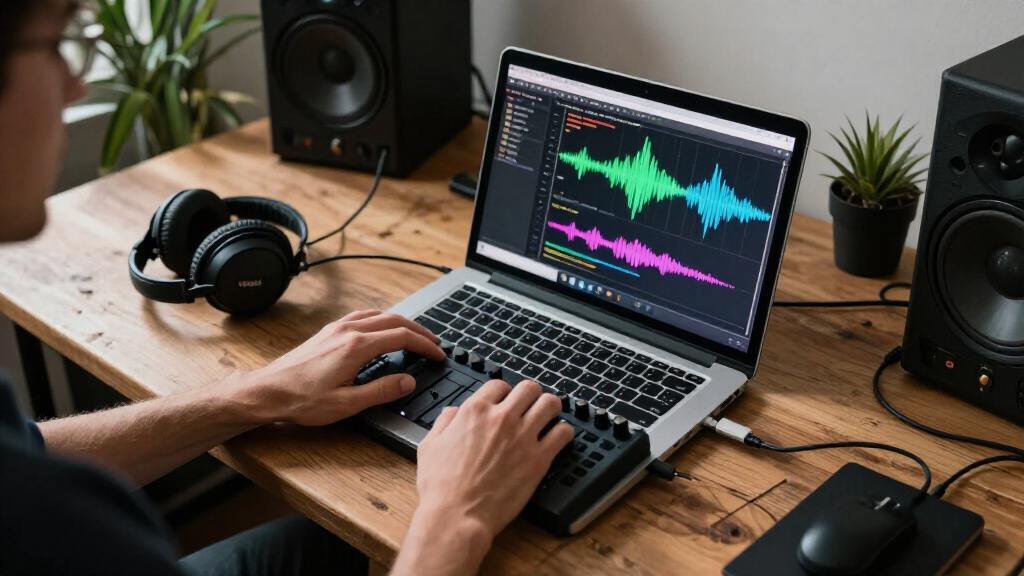
The collection’s description names several broad approaches, including waveform animations, spectrum-inspired patterns, matrix displays, particles, rhythm and memory. Its framing suggests a catalogue of visual experiments rather than a single audio tool: the entries are presented as distinct studies in how sound, signal and motion can be represented.
The page lists numbered groups and titled projects, among them “soundwave directions,” “vector studies” and “sound machines.” Other names include “signal translations,” “quiet telemetry,” “visible invariants” and “procedural marks.” The source also identifies sets such as “bloom · 10 alternatives,” “matrix · directions” and “sound and motion · 4 × 5.”
Several entries point to different visual or conceptual systems, including “spectral fan & band satellites,” “phase mechanics” and “orbital memory.” The page provides a “view GitHub repo” link and a “follow me on X” prompt. The source material does not provide a release date, a creator biography or a detailed account of how each experiment works.
A Broad Toolkit for Audio Experiments
The collection makes a range of audio visualization approaches easier to browse in one place. For artists, designers and developers, seeing many distinct treatments together can help with comparing visual languages, finding a starting point for a project or studying how a signal can be translated into motion and pattern.
Its size is part of the project’s stated appeal: over 160 experiments across more than 25 categories indicate breadth, while the named groups offer ways to navigate that range. The catalogue may also be useful as a reference for people exploring the overlap between sound and visual design. Those are potential uses, however; the project page does not report user numbers, adoption or measured impact.
The GitHub link matters because it gives visitors a path beyond the showcase to the project’s source repository. Whether that repository supports reuse, modification or contributions depends on details not included in the supplied page description, particularly its license and contribution guidance.
As an affiliate, we earn on qualifying purchases.
How the Archive Is Organized
The archive describes itself as containing 160-plus experiments across 25-plus categories, but the provided source does not explain when the work began or how often it is updated. Its visible list mixes numbered titles, thematic groupings and named sets, rather than presenting a publication timeline or a single sequence of releases.
The listed concepts range from familiar audio representations, such as waveforms and spectrum-inspired patterns, to more abstract terms including memory, inference and control. The source names these subjects but offers no detailed descriptions in the supplied text, so their precise meaning within individual experiments cannot be established from the listing alone.
The project is presented as open source and links to GitHub. That establishes a repository as part of the project’s public presentation, but open-source status is best understood through the repository’s actual license and contents. The source material does not quote either, so specific reuse permissions cannot be confirmed here.
“160+ sound visualization experiments across 25+ categories.”
— The iwrzwr/visual archive project page
As an affiliate, we earn on qualifying purchases.
Repository Details Still Need Checking
The source does not state when the archive was published, who created each experiment or whether the page’s count refers to currently accessible, finished items. It also does not explain what qualifies as a category, or how the more than 160 experiments are distributed among the 25-plus categories.
Although the project is described as open source and links to GitHub, the supplied material does not identify the software license, supported platforms, dependencies or installation steps. It is also unclear whether the entries are interactive, whether they process live audio or use prepared examples, and whether the repository accepts outside contributions. These points would need confirmation from the project page or repository itself.
As an affiliate, we earn on qualifying purchases.
Inspect the Linked GitHub Repository
Visitors can use the project page’s GitHub repository link to check the source code, license and any usage instructions. Those repository details would clarify what can be run or adapted and whether the experiments are available as standalone examples or as part of a larger application.
The supplied source announces the collection but does not give a schedule for new additions, a roadmap or an update cadence. For now, the next useful step for readers interested in a specific visualization is to open its entry and verify its description and requirements in the linked project materials.
As an affiliate, we earn on qualifying purchases.
Key Questions
What is the iwrzwr/visual archive?
It is a collection presented as more than 160 sound-visualization experiments across over 25 categories, with a link to a GitHub repository.
What kinds of visualizations does it include?
The project description mentions waveform animations, spectrum-inspired patterns, matrix displays, particles, rhythm and memory. It also lists themed entries such as “phase mechanics” and “orbital memory.”
Is the collection open source?
The project is described as open source and links to GitHub. The supplied source does not name its license, so readers should check the repository for specific reuse and modification terms.
Are the experiments interactive or ready to install?
The source does not say whether the entries are interactive, what hardware or software they require, or how to install them. Those details are not confirmed in the project description.
When was the archive released?
No publication or release date is provided in the supplied material. The page is described as currently listing the collection, but its launch date and update history are unclear.
Source: hn
Halloween Picks
halloween
As an affiliate, we earn on qualifying purchases.
![Sex Pistols Berate Dude For Infiltrating Women-Only Mosh Pit [Updated]](https://artzartz.com/wp-content/uploads/2026/10/sex-pistols-berate-dude-for-infiltrating-women-only-mosh-pit-updated-featured-260x140.jpg)