TL;DR
Open a free Amazon Business account
Business pricing, bulk buying and tax-exempt orders.
Create a free accountAs an affiliate, we earn on qualifying purchases.
Inline mic preamps are compact devices that boost weak signals from dynamic mics, providing cleaner gain without noise. They’re essential for live, field, or studio setups when your mic needs a little extra punch.
Ever tried recording a dynamic microphone and felt like your voice or instrument just isn’t loud enough? It’s frustrating. You might think a better mic or more powerful interface will fix it. But sometimes, the real answer is a tiny device called an inline preamp.
These humble gadgets sit right between your mic and your recording gear, giving that weak signal a healthy boost. If you’re working on a budget but still want professional-sounding results, understanding how inline preamps work can save your recordings and simplify your setup. Let’s break down what they do, how they’ve improved lately, and how to pick the right one for your needs.
What Exactly Is an Inline Mic Preamp—and Why Do You Need One?
An inline mic preamp is a small device that boosts your microphone’s signal right at the source. Think of it as a mini amplifier you plug directly into your mic cable. When your dynamic mic produces a low output—say, 1-2 mV—your interface or recorder might struggle to get a strong, clean signal. That’s where an inline preamp steps in.
For example, if you’re recording vocals in a noisy room or capturing a guitar amp in a garage, that low-level signal can get lost or muddled. An inline preamp provides typically 20-30 dB of gain, enough to bring the signal up to a usable level without adding hiss or distortion.
It’s especially handy for portable setups, live streaming, or field recordings where space is tight and you can’t rely on your gear’s built-in preamps to do all the work.
Understanding why this matters is crucial: low-output mics, like many dynamics, are designed to be robust and durable but often sacrifice output level for durability or noise rejection. Without enough gain, your recordings can sound weak, distant, or require excessive boosting in post-production, which often introduces noise. An inline preamp ensures you capture the true character of your sound without compromising clarity, reducing the need for aggressive digital gain that can amplify unwanted noise, and preserving the integrity of your audio signal from the start.

StudioMan DPM1 XLR Dynamic Microphones Preamp, 29dB Gain & Low-Noise Signal Boost, Plug-and-Play Metal Adapter,48V Phantom Power Required(not Included,Only for Dynamic Mics-for Studio/Stage
- Designed for Dynamic and Ribbon Mics: Provides +29dB clean gain for low-output mics
- Reduces Background Noise: Enhances signal-to-noise ratio for clear audio
- Studio-Grade Clarity: Delivers broadcast-quality sound for recordings
As an affiliate, we earn on qualifying purchases.
As an affiliate, we earn on qualifying purchases.
How Inline Preamps Give Your Mic the Extra Juice Without Noise
When your dynamic mic needs more gain, inline preamps deliver it with minimal noise. High-quality models use advanced circuit design to keep hiss, hum, and distortion out of your recordings. Unlike turning up the volume on your interface, which can amplify noise, inline preamps are designed to boost cleanly.
For instance, a budget preamp might add 3-4 dB of hiss at high gain, but a well-made inline preamp keeps that below 1 dB. That difference means your voice stays clear, your guitar remains punchy, and your podcast doesn’t sound muddy.
Recent innovations, like low-noise op-amps and better shielding, have pushed inline preamps into professional territory. Some even include built-in analog-to-digital converters for quick digital connection, skipping extra gear.
Choosing a high-quality inline preamp involves understanding the tradeoffs: higher fidelity often means a higher price and potentially more complex setup. Cheaper models may introduce hiss or coloration as they struggle to keep noise down at high gain levels, so investing in a well-designed unit is key to maintaining sound quality. The implication is that your choice of preamp directly impacts the clarity and professionalism of your recordings, especially when pushing the limits of your microphone’s output.

Bolanle NK1 in-Line Mic Preamp 28dB Gain XLR 48V Phantom Power
- 28dB Gain for Clear Audio: Boosts microphone signals with minimal noise
- High-Fidelity Sound Output: Delivers full-range, lossless audio
- XLR Connection Compatibility: Connects mixers, sound cards, and mics
As an affiliate, we earn on qualifying purchases.
As an affiliate, we earn on qualifying purchases.
The Cool New Features Making Inline Preamps More Versatile
Gone are the days of simple boost-only devices. Now, inline preamps pack features that expand your options. Some models have rechargeable batteries, making them perfect for field work or mobile podcasts. Others include digital outputs—USB or Thunderbolt—for direct connection to computers.
Some come with built-in EQ, compression, or impedance matching, giving you more control on the fly. Imagine adjusting the tone of your voice or smoothing out a guitar’s harshness without extra gear.
For example, a portable inline preamp with a rechargeable battery and digital output can sit on your mic stand, power itself via USB, and send a clean, boosted signal straight to your laptop. That’s efficiency in a tiny box.
These features matter because they offer flexibility and convenience, especially in unpredictable recording environments. They allow you to tailor your sound, reduce clutter, and adapt to different recording scenarios, which can significantly improve the quality and ease of your workflow.
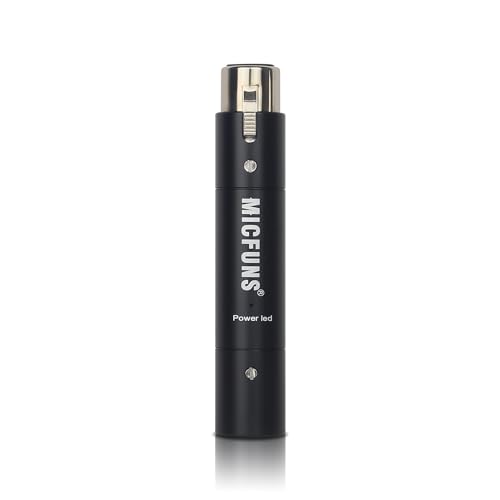
Micfuns M1 In-line Microphone Pream, Mic Booster Preamplifier with 28dB Gain for Dynamic and Passive Ribbon Microphones (Black)
- Gain: 28dB boost for passive microphones
- Output Buffer: Reduces RF interference and noise
- Power Requirement: Requires 48V phantom power
As an affiliate, we earn on qualifying purchases.
As an affiliate, we earn on qualifying purchases.
How to Pick the Perfect Inline Preamp for Your Setup
Choosing the right inline preamp hinges on a few key factors. First, decide how much gain you need. If your mic is very low output, look for models offering 25-30 dB of clean gain. Next, consider power—do you want a battery-powered unit for portability or one that draws power from phantom power?
Check connectivity—most use standard XLR or 1/4″ TRS connectors. Compatibility with your existing gear is essential. Also, think about size: a compact design fits tight spaces, while extra features like EQ or digital out might influence your choice.
Understanding your specific needs is crucial: if you frequently record outdoors or on the move, portability and battery power are vital. Conversely, in a studio environment, you might prioritize higher gain and additional features like EQ or digital outputs, which can streamline your workflow. The tradeoff often involves balancing price, size, and feature set to match your recording style, ensuring you get the most value without unnecessary complexity.
Micfuns M1 In-line Microphone Pream, Mic Booster Preamplifier with 28dB Gain for Dynamic and Passive Ribbon Microphones (Black)
- Gain: 28dB boost for passive microphones
- Output Buffer: Reduces RF interference and noise
- Power Requirement: Requires 48V phantom power
As an affiliate, we earn on qualifying purchases.
As an affiliate, we earn on qualifying purchases.
Comparison Table: Budget vs. Premium Inline Preamps
| Feature | Budget Models ( <$100 ) | Premium Models ( $150+ ) |
|---|---|---|
| Gain Range | Up to 20 dB | Up to 30 dB or more |
| Noise Level | Moderate hiss at high gain | Very low noise, transparent boost |
| Power | Battery or passive (phantom power) | Rechargeable batteries, USB, phantom power |
| Additional Features | None or basic | Built-in EQ, digital output, impedance matching |
| Size | Very portable, pocket-sized | Small but slightly larger for extra features |
Real-World Scenario: Boosting a Live Vocal with an Inline Preamplifier
Imagine you’re performing at a small venue. Your dynamic vocal mic sounds fine, but the sound engineer’s interface isn’t giving enough gain. The vocals are faint, and you’re straining to be heard. Plugging in a portable inline preamp boosts your signal by 25 dB—suddenly, your voice cuts through the mix with clarity.
This simple step transforms your performance. The audience hears your voice clearly, and your mic no longer picks up background noise or hiss. It’s a small device with a big impact in real-world situations.
Key Takeaways from Using Inline Preamps
- High-quality inline preamps deliver up to 30 dB of clean gain, making them perfect for low-output dynamic mics.
- Portability and features like rechargeable batteries or digital output make inline preamps versatile for field and live use.
- Choosing the right model depends on your gain needs, power preferences, and connectivity options.
- They can significantly improve your sound without adding noise or distortion if you pick a quality unit.
- Inserting an inline preamp can turn a weak, noisy signal into a crisp, professional recording — a small investment with big results.
Frequently Asked Questions
Can I use an inline preamp with any microphone?
Most dynamic mics will work fine, but check connector types and power needs. Some passive inline devices rely on phantom power, so ensure your mic and gear are compatible.Will an inline preamp introduce noise or color my sound?
High-quality inline preamps are designed to boost cleanly with minimal added noise. Cheaper models might hiss at high gain, so investing in a well-made unit pays off.How do I know how much gain I need?
Test your mic with your recorder or interface. If you’re consistently turning up the gain and still get weak signals or hiss, a preamp with more boost capacity is your answer.Are inline preamps suitable for field recording?
Absolutely. Battery-powered models are portable, durable, and perfect for outdoor interviews, live events, and mobile setups where space and power are limited.Do inline preamps affect sound quality?
Quality models preserve your sound’s integrity, providing a clean boost. Cheaper units might color or hiss, so choose based on your quality needs.Conclusion
If your dynamic mic isn’t giving you enough punch, an inline preamp can be the secret weapon. It’s a simple, affordable upgrade that makes your recordings crisper and louder without extra noise.
Think of it as giving your mic a shot of pure, clean energy—making every word, note, or sound count. When your setup demands a little extra gain, that tiny device can make all the difference.
Flea & tick season Picks
flea and tick prevention
As an affiliate, we earn on qualifying purchases.