
TL;DR

Get audio and creator gear delivered free — and shop member deals
- Fast, free delivery on millions of items
- Access to Prime Big Deal Days deals on October 6–7
- Prime Video, Amazon Music and more included
Ceiling clouds are suspended acoustic panels that absorb mid and high frequencies, especially effective in treating large, reflective ceilings. They’re worth it when ceiling reflection is a major source of echo or speech intelligibility issues, but not if your problem is sound transmission or already-dead rooms. Proper placement, coverage, and budget matter for real results.
Imagine walking into a room that feels alive with sound—echoes bouncing off every surface, making speech muddy or music overwhelming. Now picture that same space transformed, where every word is clear and every note sits just right. Ceiling clouds can be that game-changer, but they’re not always the right move.
In this guide, you’ll learn how to spot when overhead treatment like ceiling clouds actually makes a difference. We’ll cover when they’re worth the effort, how to install them smartly, and what pitfalls to avoid. Whether you’re building a home studio or upgrading a restaurant, knowing when to hang these panels pays off in sound quality—and in your budget.
Ceiling clouds are most effective in large, reflective spaces with high ceilings causing echo or speech clarity issues.
Proper placement—targeting first reflection points—maximizes their acoustic benefits.
Coverage of 15-30% of ceiling area often strikes the best balance between cost and performance.
DIY options can save money, but safety and mounting quality are critical for long-lasting results.
Don’t rely on ceiling clouds to stop sound transmission or if the room already sounds dead; they’re mainly for internal reverberation control.
Ceiling Clouds: When Overhead Treatment Is Worth the Effort
Suspended acoustic panels that absorb mid and high frequencies — a game-changer for large, reflective ceilings. They pay off when ceiling reflections drive echo or muddy speech, but not when your real problem is sound transmission or an already-dead room.
Placement, coverage, and budget decide whether you get real results — or expensive ceiling décor.
Clouds expose both faces plus the edges — and can hang at optimal depths. That’s why they outperform the same panel flush on a wall.
Key Insight · Two-Sided Absorptionquality cloud cores
typical starting coverage
clouds can help speech
for horizontal clouds
When Hanging Clouds Pays Off — and When to Skip Them
Clouds tame internal reverberation: echo, flutter, and poor speech intelligibility bouncing between floor and ceiling. They do almost nothing for sound traveling to the next room — that’s an STC/mass/construction problem.
Hang Them
Signs clouds are worth it- Large, flat, reflective ceiling — concrete, plaster, or bare drywall acting like a giant mirror
- Excessive flutter echo or a room that sounds “lively” even with soft furnishings
- Poor speech intelligibility in open-plan offices, restaurants, classrooms
- RT60 above 0.6 s in speech frequency bands (measure with a smartphone app)
- High ceilings (10–20 ft) — studios, home theaters, conference rooms
Skip Them
When effort is wasted- Sound transmission is the issue — noisy neighbors, upstairs footfall; clouds don’t block sound
- The room already sounds dead — heavy carpet, drapes, and furniture have done the work
- Low ceilings — use direct-mount panels instead of suspended treatment
- Small rooms with 8-ft ceilings — a few clouds may be overkill
- No safe structural anchor — mounting into drywall alone is non-negotiable unsafe
Absorption, Coverage & Cost at a Glance
Two-sided exposure plus an air gap makes each square foot of cloud work harder — and the gap itself extends absorption into lower frequencies.
Absorption Efficiency relative, per sq ft
Coverage Target % of ceiling area
Six Steps to Decide If Clouds Are Right for You
Work through this sequence before spending a dollar — it separates echo problems (cloud territory) from transmission problems (construction territory).
Identify the Problem
Echo, speech clarity, or transmission? Only the first two point to clouds.
Measure Reverb
Smartphone app or clap test — RT60 above 0.6 s in speech bands = candidate.
Assess the Ceiling
Large, flat, reflective? Can you access joists or concrete safely?
Estimate Coverage
15–30% of ceiling area for echo; more for critical listening rooms.
Compare Costs
DIY is cheap but less durable; commercial costs more, lasts longer, looks better.
Check Aesthetics & Safety
Style fit, fire rating, sprinkler clearance, and structural anchoring.
Clouds vs. Baffles: Which Fits Your Space?
Both are suspended acoustic treatments — but orientation and ceiling height decide the winner. Clouds hang horizontally; baffles hang vertically.
| Feature | Ceiling Clouds (Horizontal) | Baffles (Vertical) |
|---|---|---|
| Best For | ✓ Standard 8–20 ft ceilings, targeted zones | ~ Very high ceilings (30+ ft), gyms, warehouses |
| Reflection Control | ✓ Room-wide floor-ceiling reflections, first-reflection points | ~ Large-volume reflections at scale |
| Installation | Hangs horizontally, more visible, aircraft cable / chain | Hangs vertically, can be spaced apart in rows |
| Cost | ~ Moderate to high | ~ Similar or more, depending on size |
| Design Options | ✓ Decorative shapes, integrated LED lighting | Functional — printable, sculpted, less integrated |
| Small Studio (8 ft) | ✗ Often overkill — wall panels first | ✗ Wrong tool entirely |
| Open Warehouse / Gym | ✗ Impractical at that scale | ✓ Built for exactly this |
DIY or Buy? Making It Work on Any Budget
The build-vs-buy decision comes down to budget, aesthetic goals, and time. Either way, secure mounting into structure is non-negotiable.
Fiberglass or mineral wool cores wrapped in fabric. Cheapest per square foot, especially reusing materials or buying in bulk.
- Wear safety gear — fiberglass dust is no fun
- Less durable, finish quality varies
- Full control of size and fabric
DIY panels for broad coverage, plus a couple of commercial clouds in visible zones. Professional look without the full price tag.
- Balanced cost vs. performance
- Reliable anchors where it matters
- Scales as budget allows
Pre-made clouds from acoustics suppliers. Class A fire ratings (ASTM E84), consistent NRC, and architectural finishes.
- Code-compliant for commercial spaces
- Sculptural & acoustic-lighting hybrids
- PET felt recycled-content options
The Treatment Chain
Every successful cloud installation follows the same arc — diagnose, measure, place, mount, verify.
Where to Hang Them for Maximum Effect
Placement is everything — the goal is to break up the worst reflection paths, not carpet the ceiling. Strategic beats exhaustive, every time.
Use the Mirror Trick
Have someone slide a mirror along the ceiling while you sit at the listening position. Wherever you see the speakers reflected — that’s a first-reflection point. Mark it.
Studios: Over the Mix Position
Hang clouds directly above the listening spot, roughly 12–18 inches above head height, to tame flutter echo at the exact point it matters.
Large Rooms: Cluster Over Noise Zones
Conference tables, stages, and workstations generate the most energy. Cluster arrays over busy zones, or distribute evenly across the ceiling.
Respect Code & Infrastructure
Commercial installs must respect sprinkler clearances, lighting, and HVAC. Class A fire-rated products are often the deciding factor in spec projects.
Why Ceiling Clouds Are a Game-Changer for Sound Clarity
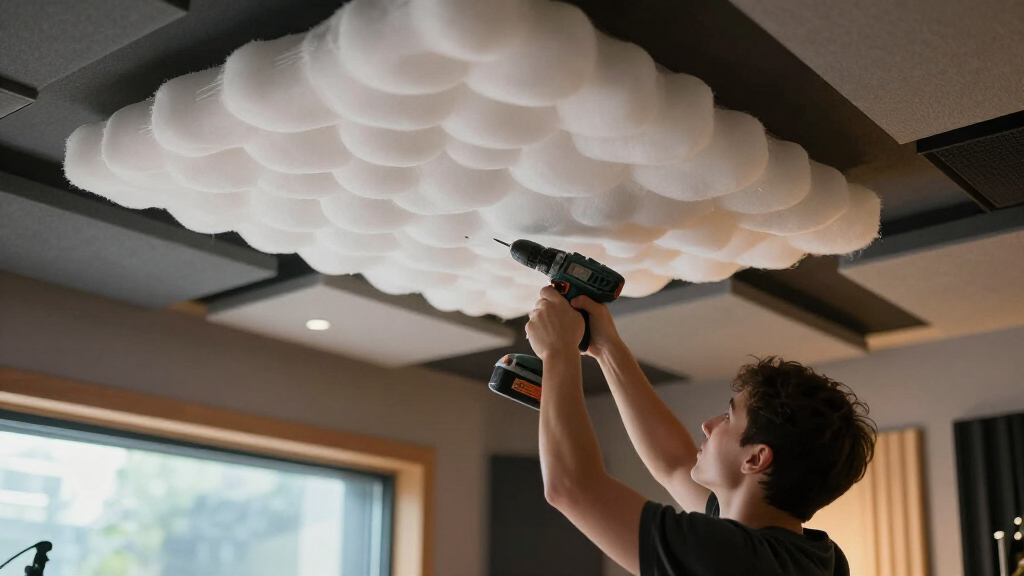
Ceiling clouds are special because they target the biggest, most reflective surface in many rooms: the ceiling. Unlike wall panels, they hang just below the ceiling, trapping sound waves and soaking up energy before it bounces back. This makes a huge difference in rooms where echo or flutter is a problem.
For example, a home recording studio with 10-foot ceilings often struggles with reverberation. Installing a few clouds above the mixing position can cut reverberation time in half—making recordings cleaner and mixing easier. They’re especially effective in spaces with hard, flat ceilings like concrete or plaster, which bounce sound like a giant mirror.
Plus, because they hang freely, clouds can be positioned precisely where sound reflection is worst—like over a conference table or a speaker’s head—offering targeted control that wall panels can’t match.
ceiling acoustic panels for sound absorption
As an affiliate, we earn on qualifying purchases.
As an affiliate, we earn on qualifying purchases.
When Installing Ceiling Clouds Really Pays Off
Ceiling clouds shine brightest when your room has a large, flat, reflective ceiling that causes echo or muddiness. Think of a 20-foot-high open-plan office, a home theater with a high ceiling, or a restaurant with bare concrete overheads. If your room sounds like a cave, clouds can tame the chaos.
For example, in a small recording studio with an 8-foot ceiling, clouds might be overkill. But in a 15-foot ceiling conference room, hanging clouds above the main seating area can bring clarity and reduce fatigue during long meetings.
Key signs you need clouds include: excessive flutter echo, poor speech intelligibility, or a room that sounds ‘lively’ even with soft furnishings. Measure reverberation time (RT60) if possible—if it’s above 0.6 seconds in speech frequency bands, clouds can help.
Remember, the bigger the space and the more reflective the ceiling, the more coverage you’ll need. Typically, 15-30% of ceiling area is a good starting point for many spaces.
suspended ceiling clouds for large rooms
As an affiliate, we earn on qualifying purchases.
As an affiliate, we earn on qualifying purchases.
How to Decide If Hanging Ceiling Clouds Is Worth It for You
Here’s a simple step-by-step process to figure out if ceiling clouds are the right move:
- Identify your problem: Is it echo, speech clarity, or transmission issues?
- Measure the room’s reverberation: Use a smartphone app or a stopwatch to gauge how long sound lingers.
- Assess the ceiling: Is it large, flat, and reflective? Can you access it safely for installation?
- Estimate coverage needed: Roughly 15-30% of ceiling area for echo issues; more for critical listening rooms.
- Compare costs: DIY panels are cheap but less durable; commercial clouds cost more but last longer and look better.
- Consider aesthetics and safety: Will the clouds suit your style? Are installation methods safe for your ceiling type?
If your room’s echo is out of control, and the ceiling is a major culprit, hanging clouds are likely worth the effort. If your issue is sound transmission or the room already sounds dead, skip them.
As an affiliate, we earn on qualifying purchases.
Clouds vs. Baffles: Which Hanging Solution Fits Your Space?
Both ceiling clouds and vertical baffles are suspended acoustic treatments, but each suits different spaces. Clouds hang horizontally, ideal for regular ceilings of 8-20 feet, and target room-wide reflections. Baffles hang vertically, perfect for very high ceilings (say, 30+ feet) or large, open areas like gyms or warehouses.
Here’s a quick comparison:
| Feature | Ceiling Clouds | Baffles |
|---|---|---|
| Best for | Standard ceilings, targeted zones | Very high ceilings, large open spaces |
| Installation | Hangs horizontally, more visible | Vertical, can be spaced apart |
| Cost | Moderate to high | Similar or more, depending on size |
| Design options | Often more decorative, integrated lighting | Functional, can be printed or sculpted |
If your ceiling is 10-20 feet and you want a clean look, clouds are usually the better choice. For sprawling gyms or warehouses, baffles can handle the scale and high reflections better.
professional ceiling cloud installation
As an affiliate, we earn on qualifying purchases.
As an affiliate, we earn on qualifying purchases.
DIY or Buy? Making Ceiling Clouds Work on Any Budget
Ceiling clouds can be built DIY with basic materials or purchased pre-made from acoustics suppliers. Your choice depends on budget, aesthetic goals, and time.
For DIY: Use fiberglass or mineral wool cores wrapped in fabric. You can build a panel for under $50, especially if you reuse materials or buy in bulk. Just remember to wear safety gear—fiberglass dust isn’t fun to inhale.
For ready-made: Expect to pay $200–$400 per panel, with larger or designer clouds costing more. Installation costs vary, but hanging panels securely from ceiling structure is non-negotiable for safety.
Pro tip: Combining a few DIY panels with a couple of high-quality commercial clouds can save money while still providing a professional look and reliable performance.
In either case, proper mounting—using aircraft cable or chains anchored to joists or concrete—is essential to prevent accidents and keep the clouds looking sharp.
Where to Place Ceiling Clouds for the Best Results
Placement is everything. To get the most out of ceiling clouds, target where sound reflections are worst—usually the first reflection points. Use the mirror trick: Have someone move a mirror along the ceiling while you sit in the listening or mixing position. When you see the reflection of the speakers or source, mark that spot.
In a studio, hang clouds directly above the main listening/mixing spot—about 12-18 inches above your head—to tame flutter echoes. In large rooms, cluster clouds over busy zones like conference tables, stages, or workstations.
Spacing matters too. For larger spaces, hanging multiple clouds at different points can better control reflections. Even distribution often beats clustering, but in a small room, a few targeted clouds make the biggest difference.
Remember, the goal is to break up the most problematic reflection paths, not to cover every inch of ceiling. Strategic placement maximizes performance and saves money.
What You Can Expect When Ceiling Clouds Do Their Job
Once installed, ceiling clouds can dramatically improve room acoustics. Expect a reduction in reverberation time—sometimes by half—and clearer speech. Music recordings sound tighter, and conversations become easier to understand.
For example, a home theater with a 0.9-second RT60 might drop to 0.4–0.5 seconds after clouds are added. That’s a noticeable difference when watching movies or hosting parties.
Subjectively, the room feels calmer, less ‘lively,’ and more controlled. Even simple smartphone apps can give you a rough idea of the improvement by measuring how quickly sound decays after a clap or hand slap.
Keep in mind: clouds won’t block sound between rooms. They focus on internal reflections. For soundproofing, you need different solutions like mass, isolation, and sealing.
When Ceiling Clouds Are Not the Fix You Need
Ceiling clouds aren’t a cure-all. If your main issue is sound leaking between rooms or upstairs neighbors, clouds won’t help much. That’s a problem of sound transmission, not reverberation.
In spaces that are already dead—like a room with lots of soft furniture, carpet, and curtains—adding clouds might make the room sound muffled or lifeless. Sometimes, less treatment is more.
Similarly, if your ceiling is very low (under 8 feet), hanging clouds can feel intrusive or reduce headroom. In those cases, direct wall panels or bass traps are better options.
Finally, if your budget is tight and the room isn’t causing major issues, DIY wall panels or softer furnishings might be enough—saving money without sacrificing much acoustic quality.
Frequently Asked Questions
How many ceiling clouds do I need for my room?
Start with about 15-30% coverage of your ceiling area. For example, a 200 sq ft ceiling might need 30-60 sq ft of clouds. Focus on the first reflection points and noisy zones for best results.Can ceiling clouds stop sound from escaping or coming in?
No. Ceiling clouds absorb internal reflections but don’t block sound transmission between rooms. For that, you need mass, sealing, and isolation measures.Is it safe to hang ceiling clouds from drywall?
Hanging from drywall alone isn’t recommended. Use anchors into ceiling joists or concrete structures. For drop ceilings, compatible T-grid panels are safer and easier to install.Are ceiling clouds worth the cost compared to wall panels?
If your room has a large, reflective ceiling, clouds offer targeted control and more effective sound absorption. For small or already dead rooms, wall panels or soft furnishings may be enough.How much improvement in echo can I expect?
Expect reverberation times to drop by about 50% with proper coverage. Speech clarity and music quality often improve noticeably, making your space sound more professional and comfortable.Conclusion
Ceiling clouds aren’t magic, but they’re a proven way to tame stubborn echoes and clarify sound in the right space. If your room’s reflection issues are getting in the way of work or play, hanging a few carefully placed clouds can make all the difference.
Remember, they’re most worth it when the ceiling is a major reflection source. Otherwise, explore simpler or more targeted treatments. The key is knowing your room’s specific problem—and matching it with the right solution.
Sound better, feel more comfortable, and get that professional edge. Your space is waiting for the right overhead treatment—are you ready to hang it?
Fall Picks
fall essentials
As an affiliate, we earn on qualifying purchases.